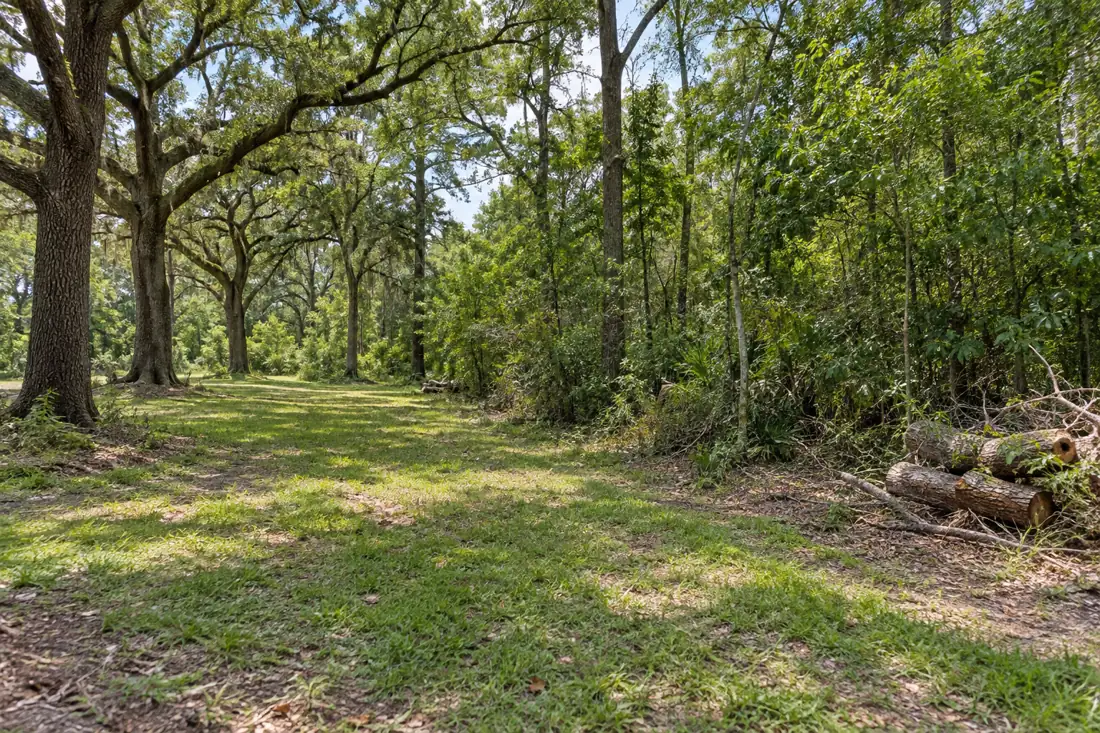
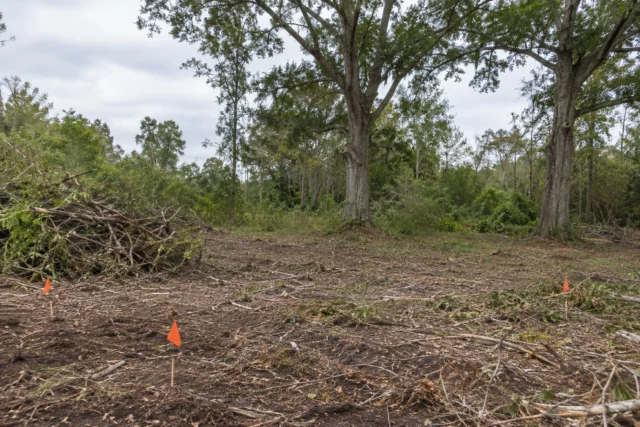
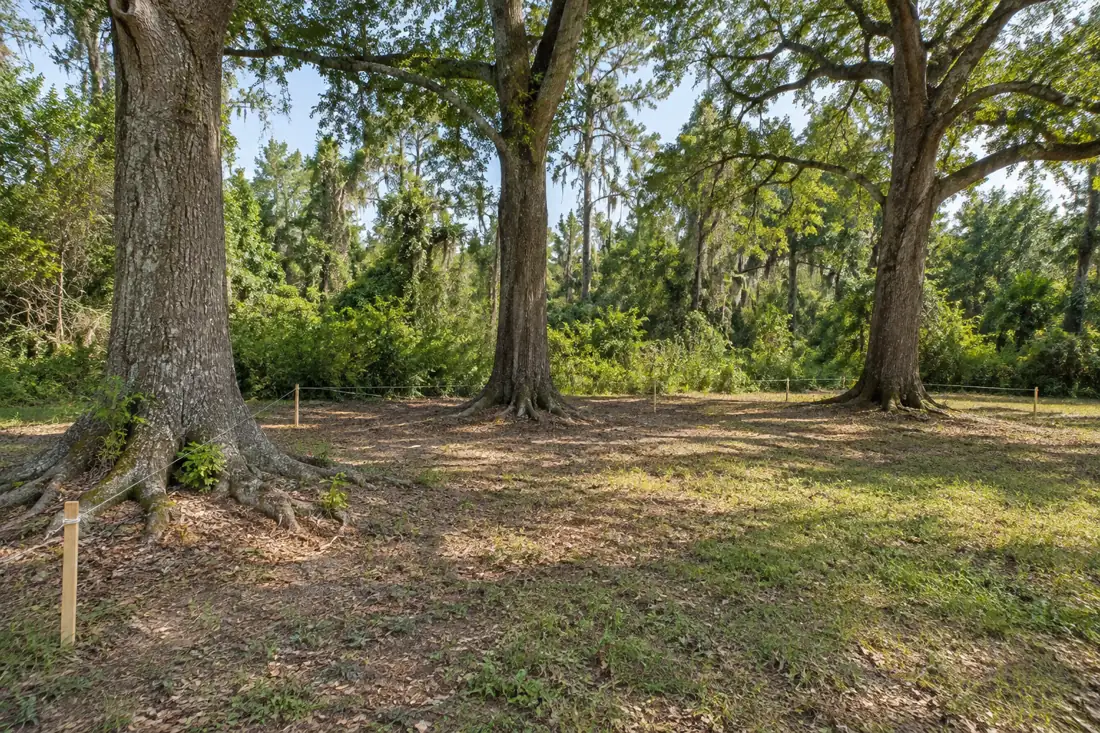
Selective clearing needs a clear distinction between the vegetation to remove and the trees to protect. Mark retained trees and discuss access before machines enter. The plan should account for roots, trunks and material handling, not just the final appearance of the lot. Clearing and long-term tree care may require separate scopes.
Site-specific planning checkpoint: Mature oaks can be the defining asset of a lot, so selective clearing should start with a tree-retention sketch and ground limits, not simply an instruction to remove undergrowth. Identify the intended clear areas around each retained trunk and note low limbs that might be struck by machinery. Soil compaction, grading, trenching and root severance can affect long-term health even if the canopy initially appears unchanged. Ask the project planner whether a driveway or building footprint can be shifted to reduce conflicts. Keep equipment, excavated soil, storage and debris piles outside designated root-protection zones unless a qualified plan explicitly permits work. Include a documented stop point if hidden roots or unexpected obstacles appear. Separate brush removal from tree-health recommendations and from any later construction work. Maintain clear photographic records of retained trees before and after clearing.
Selective clearing around mature oaks should begin with a mapped inventory of trunks, visible defects, canopy reach and proposed access corridors.
Identify which mature oaks are worth designing around
Selective lot clearing near mature oaks starts with a tree inventory, not a bulldozer path. Mark each candidate for retention by location and visible characteristics, including trunk condition, canopy spread and proximity to proposed use areas. A valuable mature tree may shape the entire future plan, but a visibly compromised specimen deserves qualified evaluation before the owner assumes it is safe to preserve.
Photograph the whole tree from several safe angles and note nearby pavement, fill, drainage and structures. Distinguish live oaks from other oak species where possible, because growth form and site tolerance vary. Avoid presenting an unverified age or health diagnosis as a fact. The purpose of the first visit is to establish which decisions require arboricultural input before crews disturb the ground.
Before the first cut, note whether each oak shades a structure, buffers summer heat, or anchors a usable outdoor area. Photograph the canopy from fixed public or owner-approved viewpoints and compare that record with the proposed access drawing. This makes preservation measurable rather than an informal wish.
Keep mature-oak protection visible through every clearing phase
Selective clearing around mature oaks should begin with a mapped inventory of trunks, visible defects, canopy reach and proposed access corridors. A photograph is not enough to establish age, health or species; those questions may require an arborist on site. Identify which specimens the owner wants to retain and which need closer examination before authorizing removal.
Discuss where machines will turn, how logs will leave and where no fill, excavation or stored debris should be placed near retained roots. A tree can be harmed by ground compaction and grade changes without a saw touching it. If the proposed drive, drainage work or foundation conflicts with the protection area, send that design conflict back for review before the first clearing pass.
Use a clear retention map and a stop-and-review procedure for discoveries or requested changes. Separate tree protection from wholesale lot clearing and subsequent grading. The completion walkthrough should evaluate the agreed limits and remaining vegetation, not present an educational planning scene as evidence of a previous customer project.

Set a protective root zone beyond the visible trunk
Most important roots are not confined to a neat circle immediately beside the trunk. Heavy machines, soil storage and trenching can damage a mature oak without touching its bark. Ask a qualified arborist to help define a practical protection area based on the tree and site conditions, and stake or fence it so every trade understands where travel is restricted.
Treat protection boundaries as project requirements rather than temporary decorations. Locate a separate place for trucks to park, spoil to accumulate and debris to be staged. When a necessary route approaches the protection area, evaluate an engineered or arborist-approved approach instead of assuming a few boards will solve soil-compaction risk.
Clear understory carefully to expose the oak's structure
Brush, vines and small volunteer trees can hide the base of a mature oak. Begin with selective hand or small-equipment work from safe ground so crews can see buttress roots, low limbs, cavities and existing debris. Cutting back vegetation may reveal important defects or past grading that were invisible in an aerial view. Do not pull vines from high branches or disturb unstable deadwood casually.
Keep tools and cut material away from major exposed roots and the trunk flare. A clean-looking root zone is not achieved by stripping soil, shaving roots or cutting everything beneath the canopy. Where vegetation is competing but harmless, retention may be preferable to bare soil that erodes during heavy Louisiana rains.
A small hand-cut opening may show whether vines, volunteer saplings or deadwood are creating the apparent congestion. Keep saw cuts away from the retained tree's trunk and major exposed roots, and reassess the equipment path once the understory is visible. The goal is better access without creating a new tree problem.

Design access around low limbs and canopy clearance
Mature live oaks can have broad, low-growing limbs that create narrow equipment passages. Measure the real vertical and horizontal clearance at each proposed route, including the height of loaded trucks. Do not assume limbs should be raised simply to suit a preferred machine. Sometimes moving the travel path or using smaller equipment is less disruptive than removing a structurally important limb.
If pruning is needed, specify the exact objective and have an appropriately qualified professional assess it. Avoid topping, flush cutting or excessive canopy reduction. The owner should understand that pruning for temporary construction access can change the tree permanently, whereas adjusting the construction sequence may protect shade and long-term value.
Make the retained oak the fixed point of the clearing plan
Selective clearing around a mature oak should start with a clear inventory of retained trunks, visible root flare and important low limbs. Photograph the proposed equipment entry, intended structure footprint and nearby storage areas from accessible ground. Identify root-protection zones through professional site assessment rather than drawing an arbitrary tiny circle around the trunk. Removing undergrowth may improve visibility, but it does not make the soil above major roots suitable for repeated heavy travel or stockpiling.
Selective clearing near a mature oak starts with the preservation boundary
A mature live oak can have large limbs and an extensive root system that make the obvious shortest vehicle path the worst route for preservation. Start by distinguishing the project goal: remove volunteer trees and vines, open a specific building footprint, improve visibility or prepare a smaller service corridor.
Identify the oak trunk, exposed buttress roots, canopy spread, existing pavement and visible drainage changes. Do not infer health from leaf color alone or assume that cutting every small stem beneath the canopy is harmless. An inventory of intended removals helps prevent an equipment operator from treating every trunk as an obstacle.
Work with the responsible designer and qualified arborist when grading or trenching might affect major roots. A compact machine can still compact wet soil near the oak; barriers, alternative staging or hand removal may be worth discussing. Keep branch pruning for equipment clearance separate from full tree removal and do not prescribe topping to create overhead space.
The agreement should document which trees remain, how brush is moved away from them and what happens when hidden roots, utilities or property-line restrictions appear during work. A preservation plan does not replace utility locating, survey work or any required project permission.
Preserve drainage patterns around established roots
An oak adapted to one ground elevation may respond poorly when fill, excavation or a new runoff channel changes the root environment. Map natural low points, existing ditches and proposed grade changes before clearing. Water pooling next to the trunk after a storm is worth documenting, but it does not by itself prove a particular disease or the need for removal.
Coordinate grading proposals with the appropriate site designer and arborist rather than asking the tree crew to reshape the root zone. Keep chips, brush and spoil out of drainage paths, and plan erosion control where exposed ground may wash toward roots. Selective clearing succeeds when the remaining trees still have an environment they can use after the equipment leaves.
Do not treat a low patch under an oak as spare space for imported fill. Record where surface water currently crosses the protected area and ask the drainage designer how finished contours will retain that route. Sudden changes in soil depth or wetness can matter long after the clearing crew leaves.

Clear Understory Selectively Around Mature Oaks
Selective clearing around mature oaks begins with understanding which trees form the long-term landscape. Identify the trunks and low limbs to keep, the understory vegetation that can be cut, and any invasive vines that need separate attention. Do not assume every vine should simply be pulled off: a tightly attached growth may require careful staged removal to avoid bark damage. Provide an overview of each oak's crown and root flare so the proposed clearing can be matched to the actual tree.
An oak's important roots often extend beyond the trunk's immediate base. A machinery operator who steers around the bark may still compact root-bearing soil or shear a shallow root while scraping brush. Establish a protective area with the people responsible for the project before defining access routes. If clearing must cross that area, discuss lower-impact methods rather than treating heavy equipment as the default. Trees that are declining, hollow or structurally suspect also deserve a professional evaluation rather than an automatic removal decision.

Protect the root zone and low canopy
Some low limbs look inconvenient but shade the trunk, contribute to the tree's form or protect an area from sun and wind. Tree pruning should have a purpose: eliminating identified deadwood, creating reasonable access or addressing a documented defect. Ask what cut sizes and canopy changes the proposed clearing entails, and keep selective branch work distinct from indiscriminate raising of the entire crown. Maintain ground cover or mulch appropriately where erosion and moisture retention matter, without piling material against the trunk.
Finalize a plan with retained-tree markers, boundaries for brush work, a debris route and a list of excluded root excavation. Check for newly exposed roots or damaged bark when work concludes. If paving or construction follows, continue the same protection through the next phase; a one-day clearing plan alone will not safeguard mature oaks from later grading and storage. The value of selective clearing is measured by both the resulting access and the trees that remain healthy.
Distinguish nuisance branches from actual defects
A heavy limb over a future driveway may be inconvenient without being structurally unsound. Conversely, a major crack or failing union can matter even when no branch presently obstructs the site. Ask for a specific inspection and objective recommendation instead of treating every low limb as hazardous or every mature oak as untouchable.
Where risk is uncertain, a professional assessment can consider targets, likelihood of failure and consequences while explaining limits of the inspection. The outcome may involve pruning, monitoring, reducing exposure or removal of a particular tree. Record that decision by tree ID so the clearing contractor is not left to interpret a casual verbal instruction.
Handle stump work without cutting retained roots
Removing unwanted small trees near an oak can leave stumps intertwined with the older tree's root system. Grinding depth and footprint must be chosen carefully; a desire for a perfectly smooth lawn is not a reason to sever major structural roots. Mark the retained tree's protection area and discuss what can be done safely before authorizing any grinder pass.
Where uncertainty exists, leave a limited stump remnant for later evaluation rather than forcing a machine into an unsafe position. Separate stump removal from selective clearing in the estimate, and note any areas excluded to protect the oak. This makes the result predictable instead of promising complete underground root removal, which is rarely realistic or desirable.
A stump near a retained oak may be entwined with living roots from the tree being protected. Verify the target stump's identity and location before grinding, and describe the safe working limits in the estimate. When root ownership is uncertain, the prudent action is investigation rather than deeper unplanned excavation.

Keep construction materials away from retained oaks
After clearing, an open shady area often becomes the most convenient place for pallets, trailers and excavated soil. That convenience can undo the tree protection achieved during initial work. Assign a different staging zone for future trades and preserve barriers until construction activity is genuinely complete, not merely until the tree-cutting crew leaves.
Include protected-tree locations on contractor orientation materials. If a subcontractor needs temporary access, require review of the actual route and a documented modification rather than quietly moving the fence. Photographs and simple maps are useful, but they work only when supervisors check compliance on the ground.
Mark the trees that must survive before clearing
Selective clearing is successful only when the retained trees are treated as part of the project, not just objects left standing. Mark the trees to keep, explain the intended future use of the lot, and identify where machinery, spoil, and stored materials would go. Mature oak root zones can extend well beyond the trunk, and excavation or repeated traffic can injure roots even when the canopy looks untouched.
Ask for a proposed equipment corridor and practical no-disturbance limits around the most important trees. The correct limits depend on actual site conditions and should not be guessed from a generic circular setback. A plan sketch with trees numbered and wide site photographs will make the estimate discussion more precise and reduce misunderstandings.
Price selective clearing as a preservation project
A selective job can take more planning and controlled handling than a broad open-site clearing. Ask that the estimate identify retained trees, permitted access routes, vegetation to remove and cleanup methods. Include whether hand clearing, sectional dismantling or specialized equipment is expected. Avoid comparing bids by area alone when one protects several mature oaks and the other assumes unrestricted access.
Make exclusions explicit: arborist assessments, root investigations, stump grinding, fencing, landscape restoration and future construction damage may be handled separately. A clear document lets the owner choose the protection level deliberately rather than finding out that an inexpensive quote omitted the very measures that matter most.
Compare estimates on the same retained-tree boundaries, access restrictions, debris handling and restoration requirements. A lower number that omits protective fencing or requires cutting valuable limbs is not the same scope. Request a written list of exclusions so future surprises become informed decisions instead of accidental damage.

Inspect preserved trees after the clearing work
At the final walk, check barriers, trunk surfaces, major visible roots, soil grade and debris removal. Look for new ruts or stockpiles inside the protected area and document them promptly. A tree that appears unchanged immediately after work may still need observation, particularly where nearby excavation or heavy traffic occurred.
Keep the tree inventory with completion records and schedule professional follow-up when damage or changing condition warrants it. Do not promise that any retained oak is risk-free or guaranteed to survive future construction. The value of selective clearing is that the owner makes informed choices, protects as much of the existing landscape as practical and knows which conditions still need attention.
Measure success by the health of retained oaks, not the volume hauled
Selective clearing beside mature oaks has a different goal from clearing a vacant development site. Record the objective—access, visibility, invasive vegetation removal or assessment—and define what must remain intact. Heavy traffic, soil stockpiles and unapproved root cutting can damage a retained tree even when its trunk is untouched.
Have a qualified tree professional set limits where substantial roots or grade changes are involved. Final inspection should check protected areas for equipment tracks, piled material and damaged trunks as well as confirming what vegetation was removed.
- Identify every retained oak and the site-specific protection boundary.
- Specify which vines and understory stems may be disturbed.
- Keep equipment, grading and storage outside protected zones.
- Transfer protection instructions to subsequent contractors.
Make mature-oak retention the constraint that shapes the clearing method
Selective clearing around mature oaks starts with the particular trees that must survive the project. Their root zones, low scaffold limbs and surrounding soil can limit where machinery travels or cut material is stacked. Simply leaving a trunk upright while compacting the roots or changing the grade around it is not a successful preservation outcome. Define sensitive areas with appropriate qualified advice, and keep the marked protection boundary visible through every phase of work.
This guide addresses how to open usable space without treating a mature oak as ordinary brush. A retaining decision should consider branch clearance, anticipated drainage changes, the next construction trade and the possibility of uncovering defects as understory vegetation is removed. The broader lot-clearing planning guide starts one step earlier: deciding the whole property’s use, clearing limits and the complete list of features to retain. Use that broader plan to authorize the work, then apply this oak-specific protection discussion in the field.
- Identify the oaks that are deliberately retained and where equipment must not travel.
- Show changes to grade, driveways or utilities near the retained root zones.
- Assign who can pause the work if exposed roots or new structural concerns change the plan.
For the related but different decision, see Lot Clearing and Retained Tree Planning. Confirm the work required for this property before relying on a general example.
Questions about this project
What should be marked before selective clearing?
Identify the authorized boundary, trees or landscape to retain, vegetation to remove and any restricted access. Make sure the site markings, map and written scope describe the same work before equipment enters.
Does clearing include grading and construction preparation?
Only where those tasks are specifically included and appropriately assigned. Tree and brush removal, stump work, excavation, grading and base preparation are different responsibilities with potentially different completion requirements.
Is leaving the trunk untouched enough to protect a tree?
No. Roots, soil conditions and nearby work can matter even when the trunk is not cut. Identify retained trees before planning access, excavation and storage, and ask what site-specific protection is appropriate.
Can pruning undo construction-related root damage?
Do not assume it can. Share the work history and ask for an assessment of the current tree and site. Pruning, monitoring or other recommendations should address an identified need rather than substitute for protection planning.
Is a total tree count enough for a large quote?
Usually the parties also need locations and tasks. Use consistent tree numbers, marked photos or a site plan so the estimate and crew instructions refer to the same trees and retained areas.
Does a work inventory include a condition assessment?
Only if that service is expressly part of the scope. A list used to identify and price tasks should not be mistaken for a documented assessment of every tree's condition or risk.
Can tree equipment use any driveway?
No general assumption should be made. Pavement condition, edges, support, buried infrastructure and the proposed equipment all matter. Ask the contractor to assess the intended setup and route for the particular property.
Do mats guarantee there will be no ground damage?
Ground protection is one part of a site-specific plan. It does not remove every load, soil or access limitation. Discuss the proposed measures and any restoration responsibilities in the written scope.
What should I compare besides the price?
Compare tree identification, work objectives, access assumptions, hauling, stump treatment, site finish and exclusions. Ask whether permits or other coordination are part of the scope and who can approve changes if conditions differ.
Does an online request book the crew?
No. A request starts the estimate conversation. The company still needs to discuss scope, availability and any site assessment. For a dangerous or urgent condition, call 504-458-8336 rather than relying on a form response.
What should I tell Tree Huggers about selective lot clearing around mature oaks?
Explain the property address, the work you want and the specific concerns: retained oaks, machinery routes, root protection. Send safe photos of the tree, surroundings and access route. The contractor can then discuss the assessment and scope needed for this situation.
How do I request an estimate for this work?
Call 504-458-8336, text photos or use the estimate form on this page. Include the address, desired outcome and any timing constraints. The company will need to review scope and availability; an online request does not confirm a price, appointment or emergency dispatch.
Treat a retained mature oak as a design constraint, not an obstacle
Selective clearing near a mature live oak begins with the trees that are not to be removed. Identify their trunks on the work plan, inspect low limbs and visible surface roots from safe positions and keep proposed machinery routes and stockpiles away from sensitive areas pending professional review. A clear understory does not prove that heavy equipment can cross the soil above the roots. Altering grade, cutting exposed roots or repeatedly compacting the same travel lane can compromise an otherwise retained tree.
This guide is specifically for projects where mature oaks determine the clearing method. The broader lot-clearing planning guide is a better starting point when retained vegetation includes several kinds of trees and the owner is still defining boundaries and the final use of the site. If the job leads to a fence, the fence-line removal guide covers post locations and contractor sequencing; protection measures around surviving oaks still need individual assessment. Ask for marked retain/remove decisions in writing before access work begins.
Related decisions: Lot Clearing and Retained Tree Planning · Tree Removal Before Installing a New Fence
Get a scope for your property
Show each live oak's full canopy, base, low limbs and nearby planned work zone, and identify which trees must be retained.