Patio pruning often involves a balance between usable space and valued shade. Describe the clearance needed for people, furniture and fixtures without assuming the entire canopy should be raised. The estimator should account for branch size, tree condition and the locations that need protection during work.
Patio pruning: protect seating without stripping healthy canopy
Begin with how the patio is used, not a request to cut everything above it. Identify the places where people sit, walk, cook and enter doors, plus any branch that is already damaged or rubbing a structure. Photograph the full canopy and the obstruction from ground level. A low limb that blocks a walking path may justify a different cut from a healthy limb providing shade over an outdoor dining area.
Pruning changes the tree’s load distribution and future growth. Ask whether selective clearance, reduction to an appropriate lateral or removal of deadwood solves the practical problem. Excessive lifting can leave a tall, top-heavy canopy, while indiscriminate topping can produce weak regrowth. The method should account for species, age, natural architecture and the location of any previous cuts rather than an arbitrary clearance number.
Plan the worksite as carefully as the cuts. Move furniture and grills, protect pavers, identify irrigation and landscape lighting, and determine where falling brush and equipment will travel. If the patio is used by guests or tenants, mark a temporary exclusion area and confirm cleanup expectations. Keep the written estimate specific about which limbs and surfaces are included, so the finished work can be reviewed against the agreed goal.
For this project, separate shade retention, people clearance and outdoor fixtures. These details help the contractor understand what must be protected, what information needs confirmation and what result you want from the work. A clear request is more useful than an assumed method or a price based only on tree size.
A patio may sit under branches that provide valuable cooling but also include rubbing limbs, old storm breaks or growth crowding a roof or pergola. Define whether the concern is falling debris, safe headroom, outdoor lighting or repeated contact with the structure. Photographs taken from the seating area and from the tree's base can help explain the spatial relationship. Keep guests out of the work zone and avoid hanging decorations or heavy fixtures from limbs without a qualified assessment.
The pruning discussion should cover how much shade will remain, whether large limbs need structural evaluation and if cuts can be made at suitable branch unions. Mark furniture, pavers, planting beds, irrigation and access gates before the crew arrives. Request a separate line item for debris removal and any work on the pergola or roof, which is not automatically part of tree pruning. Reassess future growth periodically so the tree can be maintained without repeated indiscriminate cutbacks.
Tree Pruning Around a Patio: Start with the Seating Footprint
A patio changes how people experience a tree’s condition: a limb that might be a minor concern over an unused lawn can hang directly above a dining table, play area, or outdoor kitchen. Begin by mapping where people sit, stand, cook, and walk, including chairs pulled back from tables and routes to the house.
Note which areas are occupied most often and whether anyone gathers there after dark. This use map helps turn a vague request to “trim the tree” into a practical assessment of specific overhead targets.
In southeast Louisiana, patios may be used through much of the year, with occupancy changing as heat, rain, mosquitoes, holidays, and outdoor cooking shape routines. Record regular gatherings, not only the current day’s furniture arrangement: a pergola may be empty during inspection but busy in the evening, and seasonal decorations can change where people stand.
Identify places where children, older adults, or guests might remain beneath the canopy. Use the map to ask an arborist which branches merit assessment over occupied areas, rather than assuming every limb above the patio needs removal.

Make a Ground-Level Record of the Canopy
From safe locations on the ground, note visible changes in limbs that extend over seating: dead or leafless sections, hanging broken branches, cracks, cavities, loose bark, and limbs that have shifted since earlier photographs. Record the tree’s species if known, approximate trunk location, and which patio areas lie beneath each concern. A phone photograph taken from the same marked viewpoint can help document change over time. These observations are useful context, not a diagnosis; some defects are hard to see from below, and an apparently healthy canopy does not prove that every branch union is sound.
Do not climb the tree, shake a branch, probe cavities, or stand beneath a suspect limb to get a closer look. Keep people away from an area with a newly broken or suspended branch while arranging a qualified assessment. After strong wind or heavy rain, compare the canopy with earlier images from a safe position, looking for fresh splits, hanging material, or limbs resting on other branches.
If a branch contacts or approaches a power line, do not approach it or try to move it; treat the line as energized and contact the utility and appropriate qualified specialists.
Describe patio use before choosing canopy cuts
Outdoor dining, grilling and a seating area may each require different clearance. Record which surfaces are used most, whether low branches brush umbrellas or lights, and which limbs provide valued afternoon shade. A request for more sunlight can conflict with a request to retain a cool patio, so write the primary goal before choosing the scope.
Do not equate a tidy-looking crown with an appropriate pruning outcome. Excessive raising can remove important lower foliage and change the visual balance of a mature tree. Discuss selective reduction or clearance where appropriate and ask what the tree is likely to look like immediately after the work and as new growth develops.
Ask How Branch Unions Will Be Evaluated
A branch union is the place where a limb joins another branch or the trunk. The form of that connection matters, especially when a large limb reaches over a table, roofed patio, or cooking station. From the ground, note obvious tight forks, seams, included bark, old wounds, or visible cracks, but do not treat any one sign as a complete risk finding.
Ask the assessor to explain what can be seen, what cannot be confirmed without closer inspection, and how the limb’s size, direction, and occupied target affect the recommendation.
A sound-looking union is not a promise that a branch cannot fail, and a narrow fork alone does not establish that removal is necessary. The assessment should consider the whole tree, the branch’s loading and attachment, prior pruning, and the consequences of failure at that particular location.
Ask whether a recommendation is based on an identified defect, a clearance need, or a general preference to reduce canopy. If the proposed work involves a large limb over seating, ask how the cut sequence will control its weight and prevent uncontrolled movement toward people or structures.

Keep the patio usable without sacrificing the shade people value
Start with a simple plan of the patio rather than a request to lift the entire crown. Note dining chairs, the grill, the door to the house, ceiling fans under a pergola, lights suspended from the structure and any water features or fragile planters. People sitting and standing need different room than a contractor carrying material through the space. Mark the few positions where branches interfere with normal use. A large tree can provide important afternoon shade, so preserving sound foliage may be part of the desired result, not an obstacle to the project. Photograph from the patio doors and from the lawn so the actual conflict is visible in context.
Distinguish short twigs touching lights from substantial limbs resting against a pergola or showing visible defects. Ask for an assessment of branch attachment, existing decay indicators and the potential effect of selective reduction before approving cuts. Hanging décor, electrical fixtures and building attachments have their own owners and maintenance needs; the tree crew should not be expected to rewire outdoor equipment.
If someone has strung lights directly through branches, identify what must be disconnected by an appropriate person before work starts. When the patio is paved or raised, consider whether roots or access arrangements restrict machines or material removal.
For an estimate, send a safe wide photo, a close view from the ground of the identified conflict, and a note about features that cannot be moved. Plan where furniture, pots and cushions can be stored before a confirmed appointment, and discuss access through side gates rather than assuming equipment can cross finished stone.
Ask what debris pickup and final sweeping are included; outdoor kitchens and drainage grates require particular care. Review the finished view from the occupied seating positions, not just from the street. If preserving shade and clearance are both essential, write that tradeoff into the scope and agree on a realistic later review as branches grow.
A maintenance note can also identify where leaves and fruit collect, whether branches have already rubbed a pergola and which furniture can be moved without disassembly. Those observations help distinguish ordinary seasonal nuisance from an actual clearance requirement. Avoid describing leaf litter as evidence that a tree is unhealthy; many healthy shade trees shed material through the year.
Patio users may prefer more shade during summer and more sun during cooler months, so record what the household values rather than treating maximum sunlight as the only goal.


Fit Inspection and Work to Local Conditions
Tree condition and patio use can look different across the seasons. Leaf cover may conceal branch structure, while leaf drop can reveal crossing limbs and connections that were difficult to see. Louisiana storms can leave fresh damage, and saturated ground may affect access for vehicles or lifting equipment. Record recent changes such as a limb losing foliage, new cracks, or repeated debris in one seating area, but avoid treating weather or season alone as proof that a tree is unsafe. A qualified assessor can decide whether a closer inspection or prompt action is warranted.
Plan the assessment and pruning around actual patio routines rather than assuming a single season is safest or most convenient. Ask how the work schedule accounts for forecast conditions, wet ground, nearby occupied spaces, and any locally applicable nesting or property restrictions. If a concern appears urgent, suspend use of the affected area while seeking professional advice instead of waiting for a preferred pruning season.
For routine work, agree on a period when the patio can be closed and the crew can establish a controlled work zone without guests, deliveries, or cooking activities crossing into it.
Patio shade and clearance: plan the experience before marking branches
Begin with a simple plan of the patio rather than a request to lift the entire crown. Mark dining chairs, the main walking route, cooking and heat sources, overhead fans, doors, gutters and any hanging lighting. A branch low over a rarely used planter may be less urgent than one rubbing the roof or limiting an accessible passage.
Take wide ground-level pictures that show the tree's trunk and the whole canopy, not just a close-up of one twig. Note whether wind movement, fallen twigs or visible cracks are part of the concern. Do not cut over people or equipment to demonstrate the desired space.
Ask the estimator which particular branches can be reduced to suitable laterals, which might require removal, and which should remain to preserve shade and normal crown form. A uniform horizontal line across an oak can remove valuable foliage without solving the real clearance issue. Discuss equipment protection for pavers, furniture, garden lighting and irrigation.
If a dining business is involved, plan closures around actual use, not a guaranteed return time. Agree whether falling leaves and fine dust are covered by cleanup or only cut material. At the final walk, stand at the original marked positions and confirm clearance and retained shade with the property contact.
Account for furniture, drains and narrow access
Patio work often involves breakable pavers, retaining edges, patio doors and lighting cables. Show the contractor the access width and whether furniture, planters or shade sails can be moved. If material needs to be lowered into a confined space, agree where the landing area will be and how people will be kept outside it.

Keep the patio usable without sacrificing the tree's structure
A patio can sit directly beneath valuable shade, making ordinary branch clearance feel more urgent than it is. Identify the actual conflict first: contact with a pergola or roof, an assessed hazardous limb, grill ventilation, seating clearance or routine leaf drop. Each goal calls for a different decision, and removing healthy live canopy solely to eliminate leaves may create future growth and heat problems.
Before work, show the contractor fragile pavers, irrigation, outdoor lighting, counters, glass and access constraints. Move loose furniture where practical, and let the tree crew choose rigging and protection methods without promising that material can simply fall onto the patio. Distinguish acceptable minor cleanup from separate masonry, plumbing or outdoor-kitchen repairs in the scope.
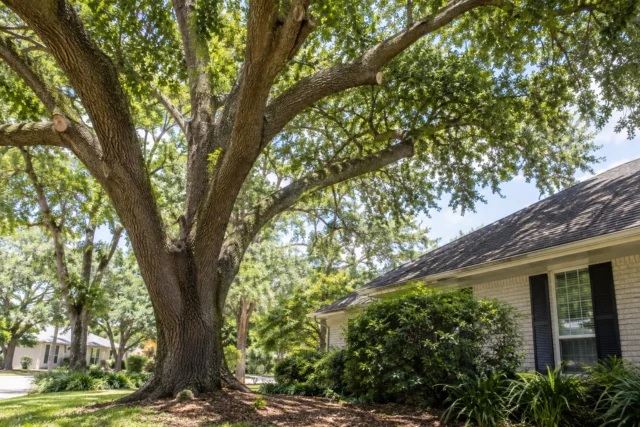
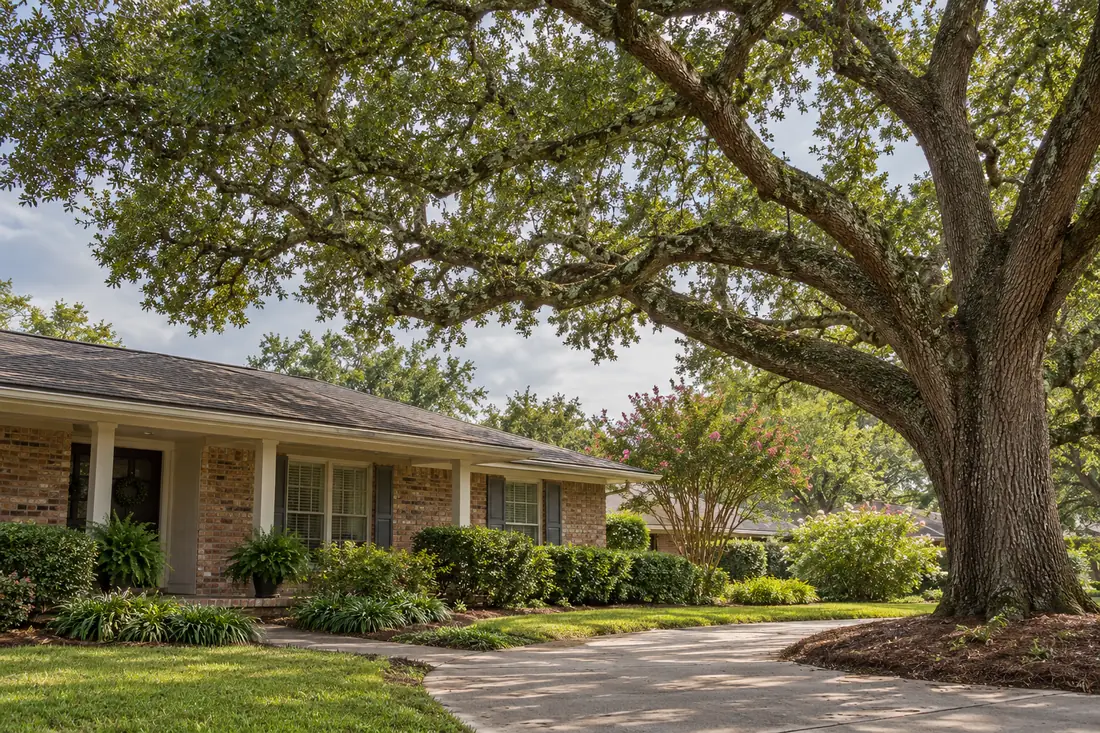
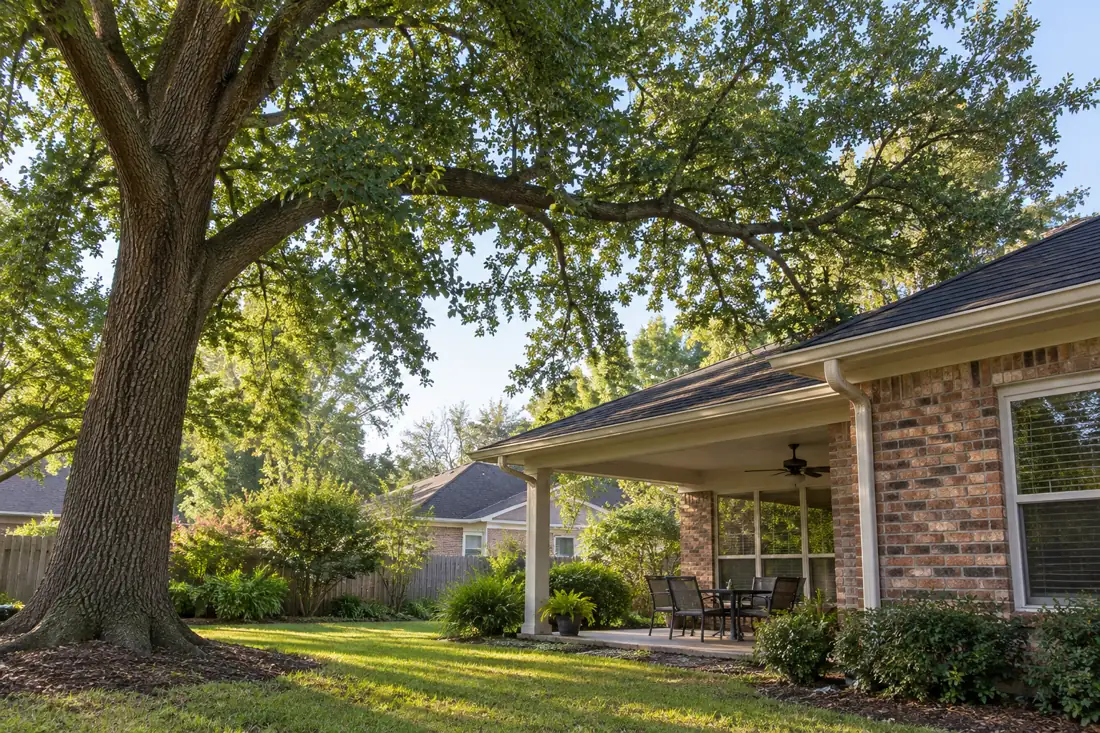
At closeout, inspect the agreed clearance points, accessible surfaces and debris removal while the work area is safe. A photograph of branches over a patio illustrates an access challenge rather than a verified jobsite or proof of a particular safety hazard.
Verify whether cleanup includes collecting small twigs from planting beds, removing sawdust near outdoor drains or replacing moved furnishings. An estimate should distinguish the tree work from optional restoration. Keep overhead work separate from an open gathering; an event deadline is a scheduling constraint, not a reason to bypass safety planning.
See the related Tree Huggers service and request an appropriate assessment
Choose a Qualified Assessment, Not a Guess
For a limb with a concerning defect over a regularly occupied patio, seek an assessment from a qualified tree-care professional with relevant arboricultural knowledge and experience evaluating mature trees. Ask who will inspect the tree in person, what credentials or training they hold, and whether the proposed work will be supervised by that person.
Credentials can help establish expertise, but they do not replace a clear explanation of the tree’s condition and the reasoning for each recommended cut. If a specialist is needed for access, rigging, or a difficult defect, ask how that expertise will be provided.
Request a written description that identifies the tree, the limb or area of concern, the target below it, and the proposed work. Ask what alternatives were considered, what visible evidence supports the recommendation, and what uncertainty remains. For example, reducing a specific limb may address clearance or weight, while removal may be advised if its condition and location warrant it; neither choice should be automatic.
Seek another qualified opinion when a substantial removal recommendation is unexplained or conflicts sharply with the observed facts. Do not interpret a professional opinion as a guarantee against future branch failure.

Set a Pruning Objective Instead of Thinning by Default
A useful pruning plan states what should change and why: remove a dead branch above a table, create a defined clearance from a pergola, or reduce a particular limb’s reach if an assessor finds that appropriate. Ask the professional to identify the intended branches before work begins and to distinguish safety-related cuts from appearance or clearance work. Broad, indiscriminate thinning can remove substantial foliage without addressing a defective union or a poorly placed limb. It can also expose remaining branches to changed wind and light conditions, so “make the canopy lighter” is not, by itself, a precise objective.
Agree on boundaries for the work, including which limbs must stay for shade, screening, or the tree’s form. Ask how the plan will preserve suitable branch structure and avoid excessive removal at one time. If a contractor suggests topping or cutting branches back to arbitrary points, ask for the specific pruning purpose and the intended cut locations; those methods may leave poor attachments or encourage weak regrowth.
The final decision should connect each cut to an observed condition, a practical patio clearance, or a clearly described management goal, rather than a general wish for a tidier-looking tree.
Account for Kitchens, Pergolas, and String Lights
An outdoor kitchen adds heat, appliances, and frequent movement to the work area; a pergola adds overhead members that may be mistaken for safe access or a place to attach rigging. Tell the assessor and crew about grills, chimneys, vents, counters, gas piping, electrical outlets, and any removable furniture.
Identify the actual clearance needed for people to cook, open lids, carry hot food, and maintain equipment. Do not assume pruning alone resolves fire, ventilation, or appliance-clearance concerns; check the equipment instructions and consult the appropriate building or trade professional where those issues arise.
String lights, festoon cables, and seasonal decorations can tangle with branches or conceal where a limb moves. Before work, identify who will disconnect, protect, or reinstall them, and whether any cable is connected to a permanent electrical circuit. Never use a wire, pergola beam, or light strand as a tie-off point or ask a crew to work around an energized cable without an appropriate plan.
Decide whether the goal is a defined gap for lights or simply keeping branches from rubbing them. The tree professional should describe the intended clearance and avoid promising that branches will never grow back toward the installation.

Plan Equipment Access and Protect the Patio
Walk the route a crew and its equipment would use, from the street or driveway to the work area. Note gates, narrow passages, soft lawn, retaining edges, drains, irrigation lines, pool features, and overhead obstructions. Explain which surfaces cannot bear heavy equipment and ask what access method is proposed. A compact machine may still damage pavers or settle into wet Louisiana soil, while carrying branches by hand may require more space and time. The work plan should account for the actual site rather than assume that the patio can serve as a convenient equipment platform.
Agree in advance how furniture, planters, screens, grills, and fragile fixtures will be moved or protected, and who is responsible for each item. Ask how the crew will protect pavers, natural stone, decking, or concrete from dropped limbs, dragged brush, and equipment traffic. Mats or other surface protection may help, but their suitability depends on the surface, load, and site conditions.
Identify an unloading and debris-staging area that does not block exits or damage planting beds. Photograph existing conditions and record any delicate features before work so that concerns can be discussed clearly.
Control People and Work Around Electrical Hazards
Before cutting starts, establish a work zone that includes the drop area, equipment route, and places where limbs may swing or debris may travel. Keep guests, household members, pets, and deliveries outside that zone; a verbal warning is not a substitute for a clear boundary and a responsible person controlling access.
Close the affected patio and any connecting walkway where work could create exposure. Ask who will direct pedestrians and how the crew will pause if someone enters the area. Schedule cooking, play, and contractor visits for another time rather than trying to share the site with active pruning.
Identify overhead electrical lines and service drops before selecting equipment or a cutting method. Treat every power line as energized; do not touch, approach, or attempt to move a line or a branch in contact with one. Stop planning work in that area and involve the utility and appropriately qualified specialists through the proper process.
Ask the tree contractor who is responsible for coordinating that work and what area must remain closed. Keep ladders, poles, ropes, equipment, and falling limbs away from lines; only personnel qualified for the specific electrical hazard should undertake work requiring that expertise.

Review the Cut Plan and Close Out With Aftercare
Ask the crew lead to review the agreed cuts, access route, drop or rigging plan, and protection measures before work begins. Pruning cuts should be placed and sized for the branch being removed, with the professional avoiding cuts that leave long stubs or injure the trunk or parent limb. Large overhead branches may need to be lowered in controlled sections rather than allowed to fall freely; the method depends on the tree, target, and site. Do not try to reproduce hazardous work yourself with a ladder, saw, pole tool, or improvised rope system.
After work, inspect the patio from outside the still-controlled area with the crew lead. Confirm that agreed branches were addressed, debris was removed, and furniture, lights, surfaces, and access routes were checked for damage or displaced items. Ask what cuts were made, whether the crew found anything different from the assessment, and whether any follow-up inspection is recommended.
Keep an eye on the remaining canopy over time and after significant weather, documenting new changes from a safe location. Pruning is a maintenance decision, not a permanent guarantee; reconsider the seating layout or close an area if a new concern appears.
Questions about this project
How should I describe the pruning I want?
Explain the objective: clearance for a route or building, deadwood, a damaged branch or structural development. Ask for suitable tree-specific work rather than requiring an arbitrary shape or amount of canopy to be removed.
Will pruning resolve every tree concern?
No. Root, trunk and major structural problems may need a different assessment or response. State the full concern so pruning is not used as a substitute for evaluating the condition that prompted the call.
Which property features should I point out?
Identify buildings, vehicles, fences, fixed fixtures, landscape features, utilities and occupied routes. Explain what can move and what must remain. Include existing damage and any buried features you know about along the access route.
Should people remain inside the work area?
The contractor and site contact should establish an exclusion area and access arrangements appropriate to the work. Keep children, pets, visitors and other workers outside the active zone until the responsible parties say it can reopen.
Is leaving the trunk untouched enough to protect a tree?
No. Roots, soil conditions and nearby work can matter even when the trunk is not cut. Identify retained trees before planning access, excavation and storage, and ask what site-specific protection is appropriate.
Can pruning undo construction-related root damage?
Do not assume it can. Share the work history and ask for an assessment of the current tree and site. Pruning, monitoring or other recommendations should address an identified need rather than substitute for protection planning.
Does cleanup include every root and wood chip?
That depends on the written scope. Tree removal, stump grinding, chip hauling and root excavation are different tasks. Ask what material is removed, what remains and whether soil or landscape restoration is separately included.
What should a final walk-through check?
Compare the identified trees and tasks with the agreement. Check agreed debris handling, stump treatment, access openings and any listed restoration. Record unresolved items clearly instead of relying on a general impression that the property looks finished.
What should I compare besides the price?
Compare tree identification, work objectives, access assumptions, hauling, stump treatment, site finish and exclusions. Ask whether permits or other coordination are part of the scope and who can approve changes if conditions differ.
Does an online request book the crew?
No. A request starts the estimate conversation. The company still needs to discuss scope, availability and any site assessment. For a dangerous or urgent condition, call 504-458-8336 rather than relying on a form response.
What should I tell Tree Huggers about tree pruning around a patio?
Explain the property address, the work you want and the specific concerns: shade retention, people clearance, outdoor fixtures. Send safe photos of the tree, surroundings and access route. The contractor can then discuss the assessment and scope needed for this situation.
How do I request an estimate for this work?
Call 504-458-8336, text photos or use the estimate form on this page. Include the address, desired outcome and any timing constraints. The company will need to review scope and availability; an online request does not confirm a price, appointment or emergency dispatch.
Get a scope for your property
When planning pruning beside a patio, mark the chairs, walkways, pergola, roof edges, lights and plants that should stay protected. Photographs taken from normal seating and walking positions help show the clearance problem while also revealing the shade worth retaining. Request selective branch work that addresses identified contact or headroom issues, not an arbitrary percentage of canopy reduction.
Ask for a proposal that defines access, temporary furniture relocation, debris removal and the intended appearance from the patio afterward. If a patio slab or drainage feature has shifted, keep that inspection separate from the tree-pruning decision.