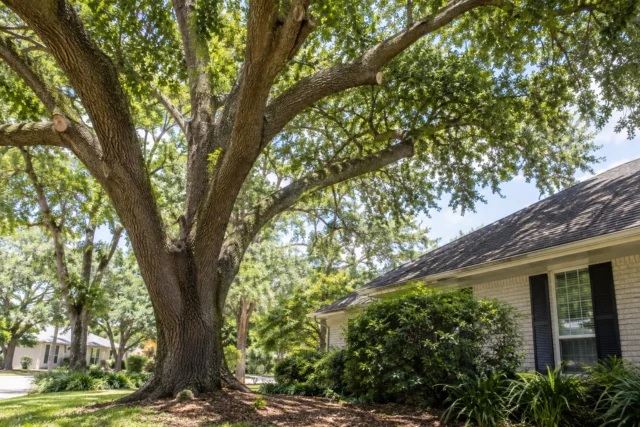
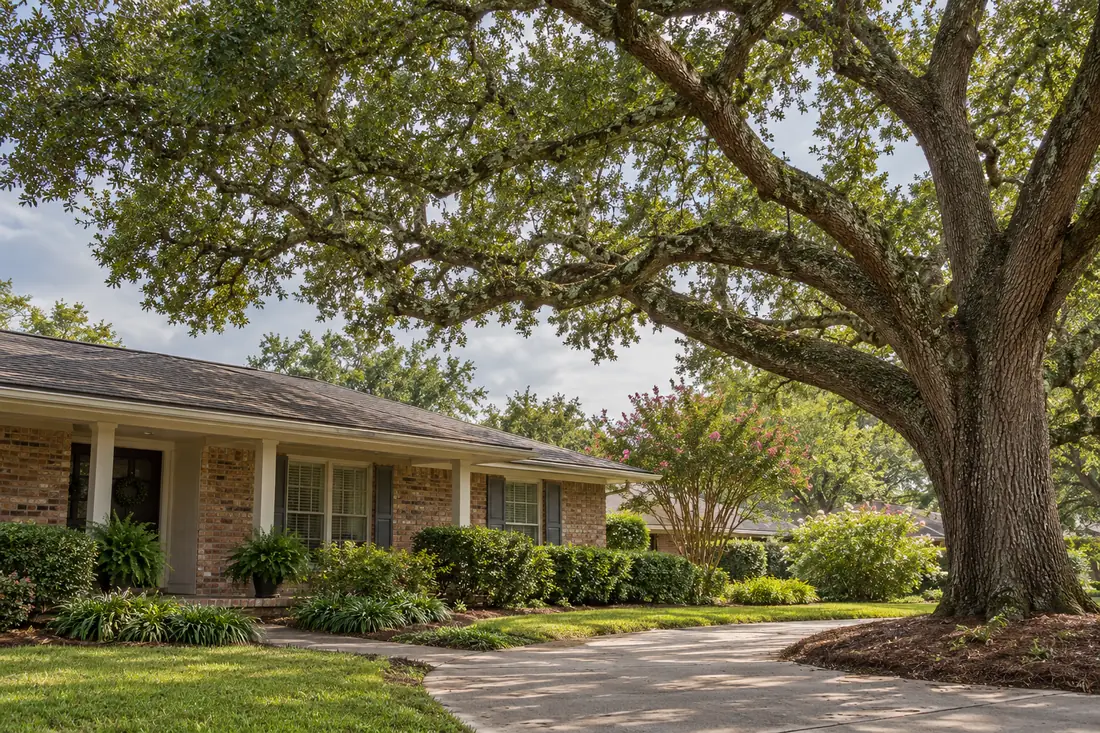
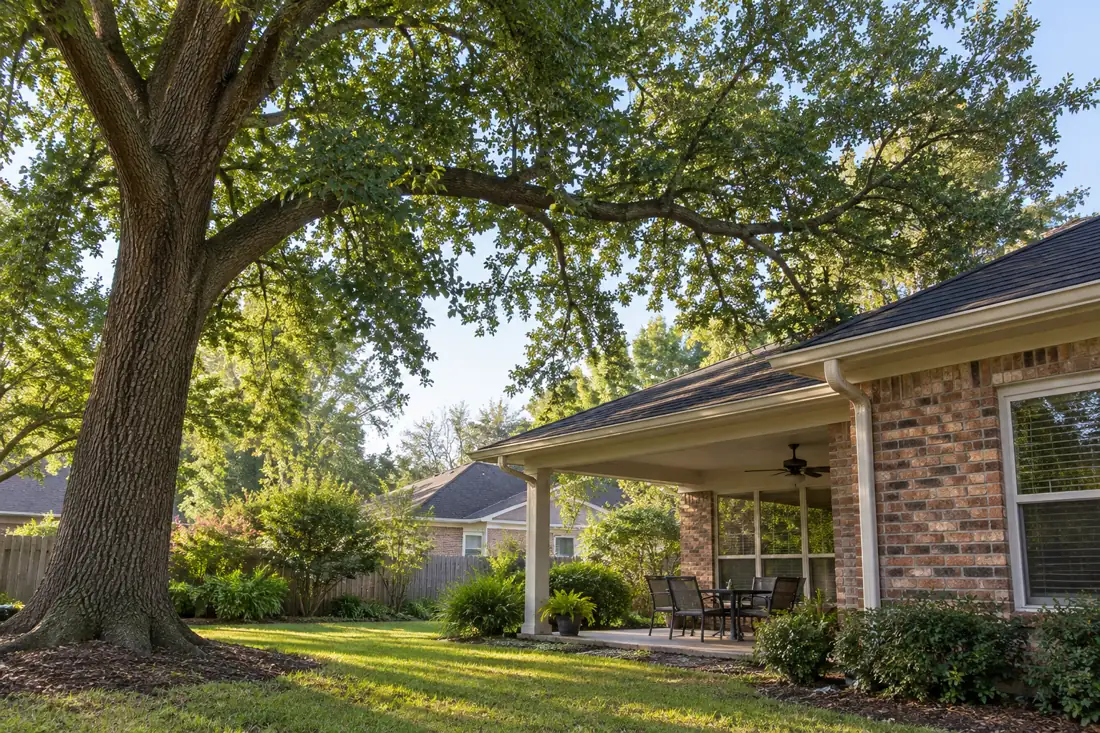
A roofing project may need clearance for workers, materials or access equipment. Coordinate the tree scope with the roof contractor before work begins. Identify the affected branches and any temporary staging area, then ask what pruning is appropriate. Tree work should protect the building without turning a temporary access need into unnecessary canopy loss.
Coordinate the tree and roofing trades with a single access sketch
Ask the roofer which roof slopes, ladders, material deliveries and debris containers need clear access. Then mark the branches that actually conflict with that envelope. Pruning a large mature tree before the roofing crew has set its plan risks unnecessary cuts and may still leave a second obstruction when scaffolding is positioned.
Schedule the pruning while roof surfaces are not cluttered with roofing bundles or exposed underlayment. Confirm whether gutters, vents, aerial service conductors or skylights change the rigging strategy. The tree crew should not be asked to work above unprotected roofers, and the roofer should not assume branches will be pushed aside during a material lift.
Include photographs of the agreed clearance before and after, with the reference points visible. The pruning quote should say how debris leaves the site and who restores access for the roof crew. Clarify that future branch growth is normal and that a one-time clearance cut does not provide permanent roof separation.
Have the roofer identify the exact roof edges, scaffolding or lift locations that need clearance and the planned sequence of tear-off and installation. Photograph the tree, roofline, gutters, service conductors and access routes together. Removing all branches above a roof is not necessarily required, and large cuts performed purely to clear a temporary work area can leave lasting wounds. Discuss which limbs can be reduced appropriately and whether temporary access methods can avoid unnecessary pruning.
Before ordering work, settle who coordinates the arborist and roofer, which trade controls the ground-level exclusion zone, and when protective coverings or equipment may be staged. A written scope should distinguish clearance for safe work from any independent tree-health recommendation. Check whether new roofing materials, flashing or gutters change the final needed spacing. Keep debris and falling branches away from unfinished roof sections, and do not have roofing crews improvise tree cutting as an incidental task.
Align the tree scope with the roofing project, not the calendar alone
A roof replacement brings ladders, tear-off debris, supply deliveries and workers to areas that may normally be quiet. Branches above the roof can interfere with staging, prevent safe access or complicate installation, but not every overhanging limb should automatically be removed. Start by asking the roofer which areas require access and what clearance is relevant to the actual installation method. Then ask a tree professional whether that objective can be achieved without inappropriate cuts or damage to the retained tree.

Sequence roof work and tree access without creating a second hazard
Roof replacement often brings ladders, tear-off debris, delivery vehicles and temporary material staging into a tree's dripline. Identify the actual roof faces and work areas before specifying cuts. The roofer may need access near gutters or scaffolding that will be removed later; trimming the entire crown to make a short-term work zone clear can damage the tree unnecessarily.
Ask the roofing contractor to mark ladder and delivery locations and to describe what clearance is genuinely necessary. Have a qualified tree professional evaluate the relevant limbs, especially if there is a cracked union, suspected decay or a limb carrying substantial weight over the work zone. Keep branch rigging and roof protection within the respective crews' approved responsibilities; a roofing proposal should not be mistaken for authorization to prune.
Agree on timing, weather restrictions, disposal, gutter protection and a handoff before roof work begins. After the project, check for impact to the root zone from stockpiles or vehicles and whether any newly visible defects warrant a follow-up assessment. A photograph can communicate access constraints, not certify the stability of an overhead branch.
Sequence roof access and selective clearance in writing. Agree on the roofing contractor's scaffold, dumpster, material lift and worker entry locations before pruning begins. Ask which branches interfere with a documented safe work path and whether selective clearance can meet that need without making harmful cuts or removing healthy canopy unnecessarily. Schedule access and cleanup so roofers are not beneath active tree operations and the tree crew is not working under loose roofing material. The written scope should identify who protects gutters, flashing, landscaping and driveway surfaces and who handles separate damage repairs if needed. Do not promise that removing a branch prevents future roof maintenance problems.
Record the roofing schedule, roof sections involved and any fixed commitments such as material deliveries. Tree work may need to precede scaffolding or other roofing setup, but a planned date is not permission to rush an unsafe operation. The two contractors should know who is responsible for access and when each work area will be available. A shared site plan helps prevent the roofing crew from assuming a tree issue has already been resolved.
Mark exactly which limbs conflict with the roof work
A photograph showing a green canopy over the house does not explain whether the problem is a low branch above the ridge, a limb crossing the access ladder, or twigs near the gutters. Identify the tree, the relevant roof face and the work activity that requires space. Take safe ground-level photographs from several angles; do not climb onto an unfinished roof or reach out beneath damaged limbs to document the conflict. If multiple trees surround the building, label each separately.
Ask the tree estimator to distinguish temporary construction clearance from long-term building clearance. A branch may be outside the roofer's required work envelope and still be suitable for retention. Conversely, a large limb that touches or loads the roof may require more careful evaluation than routine trimming. Written objectives should describe the desired unobstructed area rather than ordering the canopy to be reduced to a particular shape.

Choose pruning cuts that preserve reasonable tree structure
Pruning around construction can become excessively aggressive when several trades ask for more working room. Heavy cuts on one side may remove important live crown, encourage poorly attached regrowth or create large wounds. The tree professional should consider branch size, attachment points, species, current condition and whether the clearance objective is achievable through suitable cuts. If the requested clearance would require damaging the tree, an alternative construction method or a separate removal decision should be discussed.
Do not ask workers to top the tree to match the new roofline. If a branch appears cracked, dead or otherwise compromised, that concern may warrant assessment rather than ordinary clearance pruning. A green canopy does not establish that the structure is sound, and a branch close to a building does not establish that removal is necessary. The written estimate should explain the tree work that is proposed and the limits of what it can resolve.
Roof replacement may require space for ladders, debris removal, gutters or materials rather than major crown reduction. Identify the precise roof edge and work zone, then ask the tree specialist which cuts, if any, would be appropriate. A tree's proximity to shingles alone is not a technical diagnosis and should not dictate large pruning cuts.
Agree on access windows and a point of contact between roofing and tree crews. Record vulnerable gutters, fixtures, driveways and planting beds before work. The finished condition should be checked against the approved scope, including whether the roofing area is usable and whether retained branches were handled as agreed.
Separate the roofer's working envelope from tree-care decisions
Before a roof replacement, identify where roofers expect to stage ladders, material deliveries, tear-off debris, and temporary protection. Walk the property with a site plan rather than asking for general clearance. Record the exact roof face, overhanging limbs, gutter lines, driveway access, and any protected planting areas. The safest route for roof materials may be different from the safest route for tree equipment, so those paths should not be assumed interchangeable.
Pruning should be specified by its objective rather than by a promise to clear an arbitrary distance from every roof surface. A branch that obstructs scaffolding may need a different response from a branch that touches a gutter only during strong winds. Ask the tree professional to consider species, branch attachment, prior cuts, and overall crown balance before agreeing to removal. The roofing schedule does not justify severe cuts that leave the tree structurally compromised.
Plan access before roofing materials cover the driveway
A tree crew may need the same driveway or side passage that the roofing contractor plans to use for dumpsters, shingles and staging equipment. Schedule conflicts can prevent equipment from reaching the tree or force heavy material to move across finished landscaping. Confirm gate widths, overhead obstructions, parking restrictions and surface conditions before either trade mobilizes. The owner should identify any irrigation, septic components or buried services relevant to equipment access.
Discuss whether protective mats, temporary vehicle relocation or a different work sequence is practical. Do not assume that every machine can work from the street or that the roofing crew will automatically move its materials. If electrical lines or public areas are involved, additional coordination may be necessary. Establish which contractor is responsible for communicating access closures and when the property can safely resume normal use after each stage.

Coordinate pruning with a roof replacement without confusing the two trades
Before a roof is stripped, establish what the roofing contractor actually needs. A low limb may obstruct a ladder, shingle-delivery lift or debris chute while another limb simply casts shade across the roof. Ask the roofing contractor for a marked diagram of the affected roof planes and equipment locations. Provide the tree estimator with ground-level photographs showing the full branch-to-trunk attachment rather than a close crop of leaves against shingles. If a limb looks dead or cracked, that condition deserves its own inspection instead of being treated only as a scheduling obstacle.
Determine which contractor controls roof protection and which controls tree-work lowering and cleanup. New shingles, gutters, fascia, skylights, solar equipment and landscaping can all be vulnerable to dropped material or equipment movement. Where branches approach electrical service drops, do not let either crew touch or move energized equipment; coordinate the appropriate utility procedures. Ask how an approved work zone will be managed so residents are not walking beneath overhead work. A shared schedule does not automatically transfer responsibility from one trade to another.
A written pruning scope should identify individual obstructions and a realistic objective, while the roofing proposal should specify its own access, debris and inspection plan. Avoid broad crown reduction merely because a roofing crew would prefer an open sky. Healthy limbs can be retained if safe access and work requirements can be satisfied by narrower cuts or different equipment.
Discuss whether removing foliage will expose previously shaded roof surfaces to more sun and whether the owner values that shade. The suitable decision depends on tree structure, practical access and the actual scope of roof work.
After pruning, have the roofing contractor recheck equipment and ladder access before proceeding. Once roof installation is completed, any concern about punctures, flashing or shingle damage belongs in the roofer's inspection process; a tree contractor's cleanup photo cannot certify roof integrity. Record final ground-level views of branches and roof edges for future maintenance, together with the date and work description. These records help distinguish later branch growth from a claim that a contractor failed to perform an unspecified clearance.
Coordinate pruning with roof replacement without harming the tree
Roof work and pruning have overlapping access needs but different safety duties. The roofing contractor may need ladder placement, tear-off space, tarp access, or a clear path to the dumpster, while the tree can still require a healthy crown structure and careful protection of limbs.
Walk the perimeter with both scopes in mind. Identify specific roof slopes and elevations where branches physically obstruct work, then distinguish temporary workspace requirements from ongoing clearance for maintenance. Photograph the limb relationship to shingles, gutters, flashing, and service drops; avoid describing every branch near the roof as hazardous without inspection evidence.
Sequence the tree work before the roof crew occupies the area where practical, and make sure the roof contractor knows when tree debris will be removed. Do not assume the roofer may cut live branches, and never route trimming around energized utility conductors without the utility's proper process.
Aggressive reduction or topping can create a bigger structural or health problem than measured clearance would solve. If a tree shows cavities, dead unions, or root movement, obtaining a qualified assessment may be more important than creating cosmetic roof clearance. The written estimate should say what clearance is targeted, how cuts will be selected, how access and surface protection will work, and what is intentionally excluded.

Protect existing roof and surrounding features during tree work
When pruning occurs before roof replacement, the existing roof still protects the interior and can contain skylights, vents, gutters and equipment that must not be damaged. Tree work should not rely on the assumption that old shingles are disposable or that the roofer will repair any incidental damage. Tell the estimator about fragile roof features, solar equipment, awnings, decorative fixtures and nearby windows. Establish where cut material may be lowered and which areas must be kept clear.
Roofing debris, nails and temporary structures can create hazards for tree crews if the sequence is reversed. If pruning must occur after roofing begins, the site coordinator should revisit access and protection rather than relying on the original plan. The property owner should not stand under work or enter a controlled zone to watch. A clear interface between trades reduces arguments about whether damage occurred before or after each task.
Document the handoff before roof tear-off begins
Agree who owns the responsibility for ground protection, access gates, detached branches, and roof-edge repairs. Record which contractor will remove vegetation debris and who may move vehicles or equipment through the root area. Where a mature tree shades the roof, document likely changes in sun exposure and debris fall before making assumptions about future maintenance. A clear handoff prevents each contractor from relying on an informal promise made to the other.
Photograph the work zone from the ground before the first delivery, noting driveway surfaces, exposed roots, fence openings, and the existing roof condition. Revisit the pruning plan if the roofer discovers hidden deterioration or changes the scaffold arrangement. Do not let a roofing crew cut structural limbs as an improvised site-access solution. Arrange a separate tree assessment when branches, utilities, or trunk condition change the risk.
Roofing sequence and safe tree access
Before confirming dates, ask the roofing contractor which roof edge, scaffold position and delivery path actually require branch clearance. Mark those places on a shared photograph, note overhead conductors, and keep the planned pruning separate from any unrelated crown reduction. The tree specialist should decide what cuts are appropriate for the species and structure; the roofer should define the work-access needs.
Request two clearly coordinated schedules, an exclusion area for falling material and a statement identifying which contractor handles debris and protects gutters, windows and landscaping.
Explore tree-pruning services and discuss roof-project clearance

Coordinate roofing access and canopy care
A roof replacement and tree pruning are different scopes with different crews and work zones. Branches near gutters can complicate ladder placement and debris handling, but the aim should not automatically be to remove every overhanging limb. Record the actual clearance objective, roof schedule and areas that must remain protected. Ask both contractors to agree on the sequence and responsibilities before either starts cutting or stripping the roof.
Define cleanup, hauling and site handoff responsibilities
A roofing project already generates substantial debris, and tree work adds branches, sawdust and sometimes heavy wood. State whether the tree contractor will chip and haul brush, stack retained wood, or leave specified material on site. Identify where any branch material can be staged without blocking the roofer's dumpster or delivery lane. Do not assume tree cleanup includes magnetic nail sweeping or roofing debris disposal; those belong to the appropriate trade unless explicitly contracted.
The handoff should confirm which entrances, roof areas and working surfaces are released for the roofing crew. If the tree contractor could not achieve the desired clearance without unsuitable cuts, that limitation needs to be communicated before scaffolding or materials are installed. Document any retained branches and the plan for working around them. A tidy lawn is not the sole completion measure when the real purpose was safe roofing access.

Write a scope that both contractors can understand
The tree estimate should identify the tree, specific roof-facing limbs or clearance zone, proposed work objective, access assumptions, protection measures, debris disposition and any exclusions. The roof contractor should be able to recognize whether its stated access need has been addressed. Avoid phrases such as “trim back as needed,” which can mean very different amounts of cutting to different people. A photograph annotated from a safe position can help connect the written scope to the right branch.
If roofing work reveals hidden structural damage or a different access requirement, additional pruning should be reviewed and separately authorized. The tree crew should not alter a large portion of the canopy simply because the project is in progress. Record who is allowed to approve changes when the homeowner is absent. A comparable written scope is essential if multiple bids will be requested before the roof replacement begins.
Recheck the tree after construction without inventing a guarantee
Construction can change the environment around a tree through compaction, excavation, material storage, soil disturbance or altered drainage. The roofing project may not involve those effects, but the property owner should still protect the root zone from unapproved equipment and material piles. After completion, look from safe ground for visible damage or new conflicts and request professional evaluation if warranted. Do not cut exposed roots or perform additional large pruning merely to make the finished roof look cleaner.
Keep before and after photographs, the approved pruning description and any relevant roof project notes. They help explain why a particular limb was retained or removed to future property owners and maintenance providers. Neither a completed roof nor a tree-service invoice proves that every future storm exposure has been eliminated. The final goal is appropriate clearance for the roof work with sensible care for any trees left standing.
Use the estimate request to coordinate the sequence early
When contacting Tree Huggers, include the anticipated roof work dates, the roofer's clearance concern, photographs of the whole tree and the affected roof area, and the known driveway or side-yard restrictions. State whether a roofer, general contractor or homeowner will coordinate access. Ask for the tree-service scope and likely prerequisites rather than a promise that any equipment can arrive on a fixed date without inspection.
If tree condition, utility proximity or a confined work area makes the request complicated, a site visit may be necessary. Treat that as part of responsible planning rather than an obstacle. A clear work order helps the roofer and tree crew avoid working over one another, reduces unnecessary cuts and makes completion easier to verify. A late request for “extra clearance” should be reviewed against the tree's actual structure, not accepted as an automatic command.
Questions about this project
When should tree work be discussed on a building project?
As early as practical, while the footprint, access, excavation and staging can still be coordinated. Identify retained trees and share drawings before clearing or other site activity creates avoidable conflicts.
Does stump grinding complete construction site preparation?
Not necessarily. Excavation, root removal, base preparation, compaction and grading may require separate work and acceptance criteria. Coordinate the tree scope with the contractor responsible for the next construction phase.
How should I describe the pruning I want?
Explain the objective: clearance for a route or building, deadwood, a damaged branch or structural development. Ask for suitable tree-specific work rather than requiring an arbitrary shape or amount of canopy to be removed.
Will pruning resolve every tree concern?
No. Root, trunk and major structural problems may need a different assessment or response. State the full concern so pruning is not used as a substitute for evaluating the condition that prompted the call.
Which property features should I point out?
Identify buildings, vehicles, fences, fixed fixtures, landscape features, utilities and occupied routes. Explain what can move and what must remain. Include existing damage and any buried features you know about along the access route.
Should people remain inside the work area?
The contractor and site contact should establish an exclusion area and access arrangements appropriate to the work. Keep children, pets, visitors and other workers outside the active zone until the responsible parties say it can reopen.
Is leaving the trunk untouched enough to protect a tree?
No. Roots, soil conditions and nearby work can matter even when the trunk is not cut. Identify retained trees before planning access, excavation and storage, and ask what site-specific protection is appropriate.
Can pruning undo construction-related root damage?
Do not assume it can. Share the work history and ask for an assessment of the current tree and site. Pruning, monitoring or other recommendations should address an identified need rather than substitute for protection planning.
What should I compare besides the price?
Compare tree identification, work objectives, access assumptions, hauling, stump treatment, site finish and exclusions. Ask whether permits or other coordination are part of the scope and who can approve changes if conditions differ.
Does an online request book the crew?
No. A request starts the estimate conversation. The company still needs to discuss scope, availability and any site assessment. For a dangerous or urgent condition, call 504-458-8336 rather than relying on a form response.
What should I tell Tree Huggers about tree pruning for a roof replacement project?
Explain the property address, the work you want and the specific concerns: roofing access, staging, suitable branch cuts. Send safe photos of the tree, surroundings and access route. The contractor can then discuss the assessment and scope needed for this situation.
How do I request an estimate for this work?
Call 504-458-8336, text photos or use the estimate form on this page. Include the address, desired outcome and any timing constraints. The company will need to review scope and availability; an online request does not confirm a price, appointment or emergency dispatch.
Get a scope for your property
Tree pruning ahead of a roof replacement must be coordinated with the roofer's work plan, not judged from a picture of limbs touching the shingles. Identify the roof sections, planned scaffold or lift positions, material delivery route and the branches affecting access. Photograph the tree and building together from the ground, and explain whether the goal is temporary worker clearance, long-term roof separation or removal of deadwood.
Share the roofing contractor's expected sequence and any restrictions involving overhead wires, gutters, solar equipment or fragile landscape surfaces.
The written tree-work scope should identify the exact limbs or clearance objectives, access method, debris handling and whether the work occurs before scaffolding or roofing materials arrive. Ask the roofer to verify its own required workspace; avoid ordering severe cuts based on a guessed clearance dimension.
Protect the trunk, root zone and retained branches from equipment or stored roofing material. If a major leader appears defective or the tree is structurally compromised, that is a separate question from improving roof access and should be evaluated before work begins.