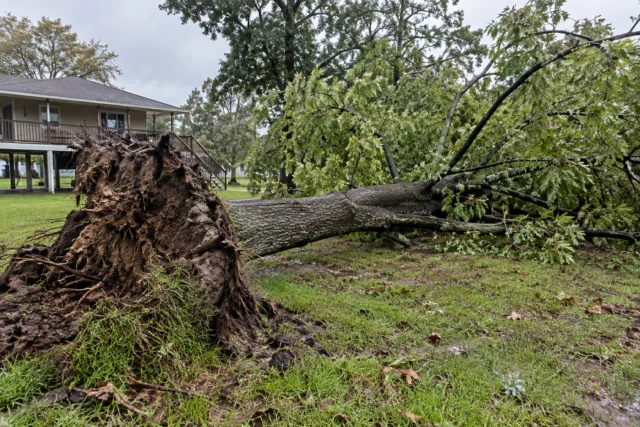
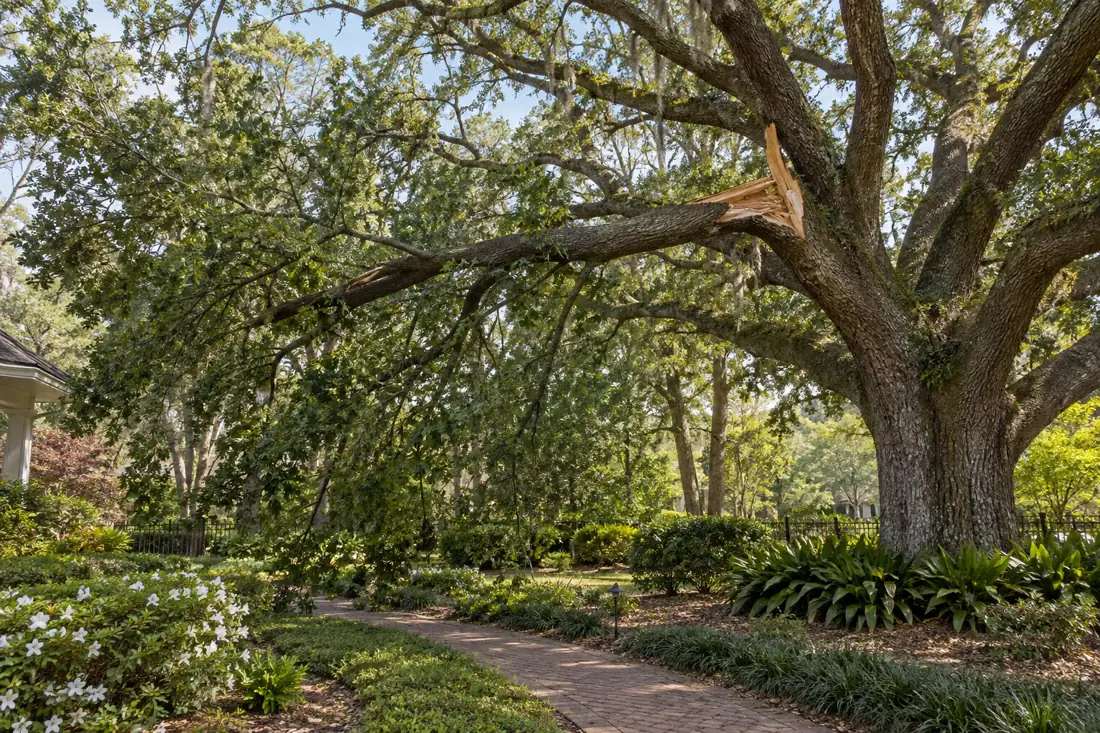
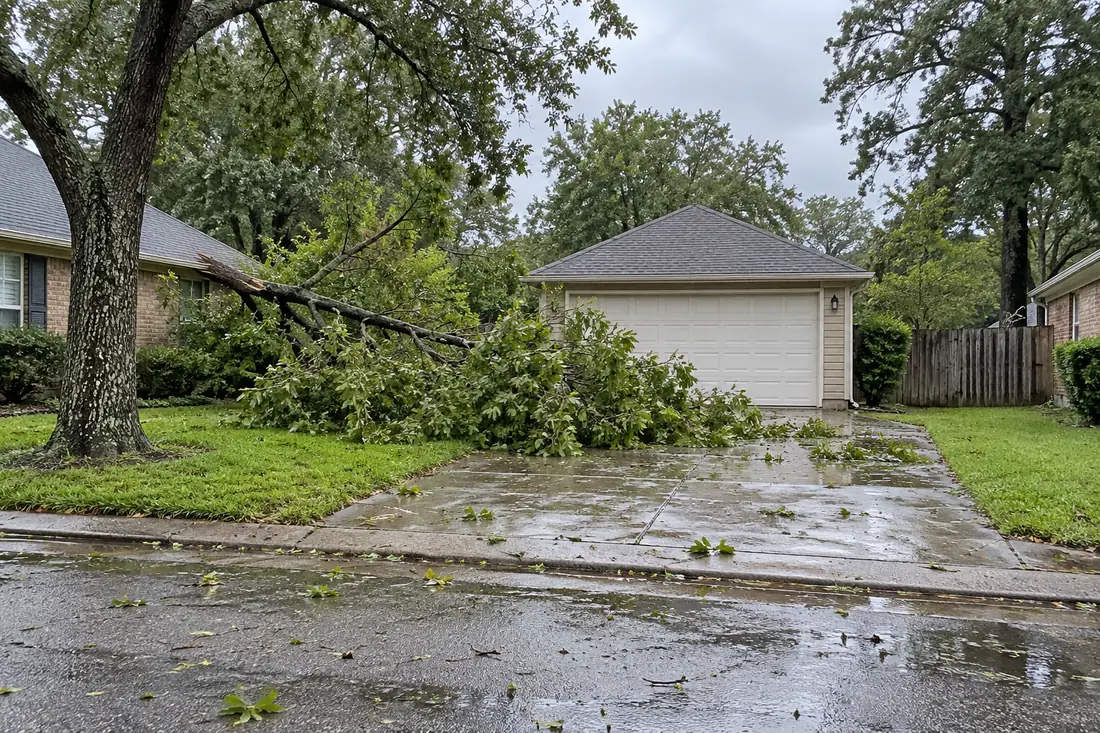
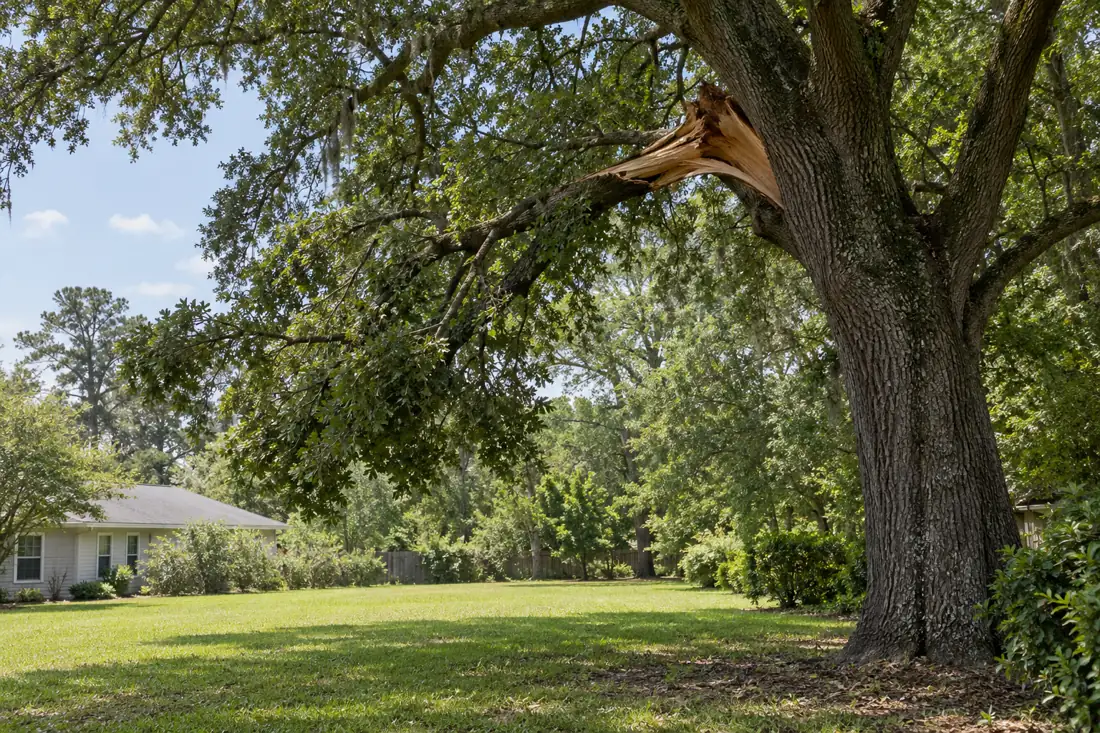
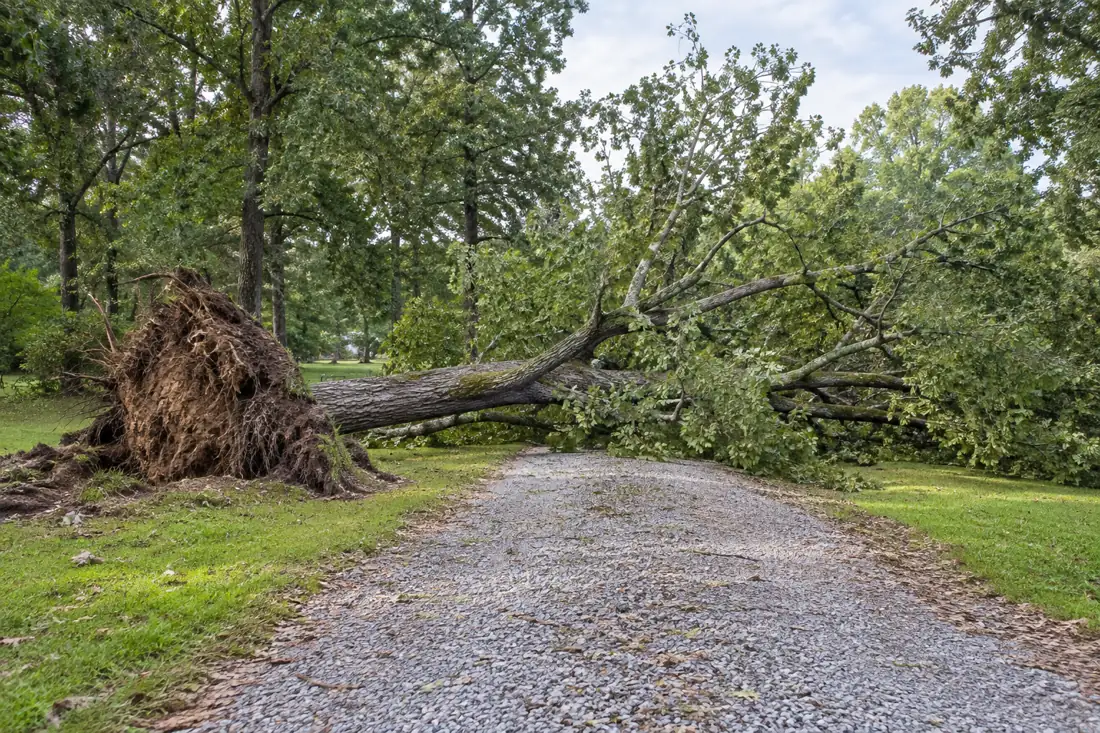
A blocked driveway may be an access problem and a hazardous work area at the same time. Do not walk beneath suspended branches or assume a trunk resting on the ground is stable. Tell the contractor whether another exit exists, whether wires are involved and whether emergency access is affected. Restoration of access can be scoped separately from complete debris removal.
A blocked driveway: preserve access and avoid a second injury
First determine whether the fallen tree is resting on a line, building, fence or vehicle. Keep people away from the trunk and suspended branches, which can be under tension even after a storm has passed. Do not attempt to cut a gap through the tree for a car. If the driveway is the only usable exit, explain that access restriction when calling for professional help, but use another safe exit when available.
If the site is safe to observe from outside the fall zone, take one wide photograph showing the entrance and one showing where the trunk is supported. Note parked vehicles, gate widths, a shared drive, adjacent sidewalk and any visibly damaged utilities. Photographing a condition is not a reason to approach an unstable load or climb onto debris. Preserve photos and notes if an insurer or property manager later needs a record.
The requested scope should say whether the objective is emergency access clearing, full tree removal, stump work, debris hauling or restoration. Those are different deliverables. Ask the contractor how the cutting sequence will control trapped tension and where brush and wood can be staged without blocking emergency vehicles. Confirm who is responsible for final sweeping or disposal instead of assuming every emergency clearing includes it.
For this project, separate blocked exit, loaded branches and access priority. These details help the contractor understand what must be protected, what information needs confirmation and what result you want from the work. A clear request is more useful than an assumed method or a price based only on tree size.
Keep people and vehicles outside the blocked section. A trunk resting on a fence, another branch or a vehicle may shift suddenly when one piece is cut. Look from safe positions for hanging limbs, damaged utilities, leaning neighboring trees and pavement disturbance. Use another entrance if practical, and contact the relevant responders if essential emergency access is affected. Do not attempt to pull or drive beneath a partly suspended trunk to reopen the route.
Tell the estimator whether the driveway is shared, which side offers truck access and where removed wood can be staged. Ask for a scope that covers controlled cutting, hauling and a final check for smaller suspended debris. Document visible pavement, drain and fence conditions before and after the work. Tree clearance does not repair a cracked driveway or prove the remaining crown is sound; record those follow-up needs separately before reopening routine traffic.
Fallen Tree Across a Driveway: Establish the Scene
A tree across a driveway can look like a simple obstruction while concealing serious hazards: branches may be carrying weight, a trunk may be pinned against a fence, and broken wood may hang over the vehicle path. Keep occupants, visitors, and pets away from the tree and its likely movement area.
Do not walk beneath suspended limbs or step over the trunk to inspect the far side. From a safe location, note whether the driveway is fully blocked and whether any structure, vehicle, or person is threatened.
In southeast Louisiana, recent rain can make a fallen tree less stable and the ground less dependable than it appears. Saturated soil, drainage ditches, soft shoulders, and concealed culverts affect where responders can safely stand or place equipment. If immediate life safety is at risk, contact emergency services; otherwise, arrange for qualified tree professionals to assess the obstruction. Tell them what you can see without approaching it, including leaning sections, hanging branches, damaged fences, and whether access is needed for residents or scheduled responders.

Treat Every Nearby Utility Line as Energized
Look for electrical, telephone, cable, and service lines from a safe distance, including wires caught in branches or lying low across the drive. Assume any power line is energized, even if it is quiet, looks intact, or appears disconnected. Keep people, vehicles, ladders, and equipment out of the area and do not touch the tree, a fence, or standing water that may contact a line. Contact the electric utility to report the hazard and follow its instructions before anyone works near the affected span.
A qualified tree specialist and the appropriate utility must coordinate when overhead lines or utility attachments are involved; a general cleanup crew should not be asked to resolve an electrical hazard. Share the property address, a callback number, and the line’s visible location, and ask what boundaries occupants should maintain while waiting.
If the line serves only communications, still avoid contact and have the relevant provider identify it. Do not assume a line is safe because another provider or crew has inspected a different part of the site.
Plan Temporary Access Before Moving Debris
When one property entrance is blocked, decide first who must be able to reach the property and what alternate route is genuinely available. Check whether a second gate, shared access agreement, rear lane, or neighboring entrance can be used with permission. Confirm that the route is wide enough for the intended vehicle and does not cross a ditch, weak culvert, or soft lawn. Do not create a new exit by driving over a fence, drainage feature, or unverified shoulder.
Tell residents, employees, delivery drivers, caregivers, and scheduled service providers which entrance is usable and which is closed. Keep emergency responders informed if access is constrained, and arrange a clear meeting point if a vehicle cannot reach the occupied building. An alternate route should not send traffic beneath the fallen tree or through the work zone. Ask the tree contractor how pedestrian movement and equipment access will be separated, and decide who will update people if the work boundary or available route changes.

Assess Suspended Wood and Hidden Loads
A trunk resting across the driveway may be held in place by a branch, stump, fence, vehicle, or another tree. A limb suspended above the vehicle path can shift when its support is removed, even if the entire tree seems settled. From outside the exclusion area, record the direction of the fall, the apparent support points, broken tops, and any trunk sections under tension. Provide photographs only if they can be taken without entering the hazard area or standing beneath unstable wood.
Ask the qualified tree professional how the hanging material will be controlled, what could move during each stage, and where the crew will establish its exclusion zone. Discuss nearby buildings, parked vehicles, gates, lighting, and underground drainage features that could be affected by access equipment.
The professional should determine whether specialized rigging, lift equipment, or another controlled method is appropriate; property owners should not attempt to release, pull, or cut loaded wood. Base the work plan on an on-site assessment, not a guess from a distant view.
Restore necessary passage without creating a second emergency
A fallen trunk over a driveway can be supported unpredictably by branches, vehicle roofs, fences or another tree. The safest first step is to keep people and vehicles out of the impact zone and report any downed conductors. Tell the responding contractor whether this is the property's only vehicle entrance and whether someone needs medical or emergency access.
Share a wide photo from a safe vantage that shows both ends of the obstruction and the surface beneath it. Do not cut a small section yourself to 'open a lane'; the remaining load may shift.
Ask for a staged response if full cleanup cannot be done at once: make the area safe as assessed by the crew, recover critical passage if appropriate, then remove the remaining wood and debris under a documented scope. A path wide enough for a person is not necessarily usable by a service truck or wheelchair, and a narrow opening may still lie under an unstable limb.
Clarify who checks pavement, drainage grates and fences after the heavy pieces are removed. Emergency access restoration and final landscape repair are different deliverables.
Choose Between Limited Clearance and Full Removal
The immediate objective may be to restore a safe passage, not to haul every branch away at once. A limited first phase can remove only material needed to open a defined route, while leaving stable, accessible debris for a later visit. That option may be unsuitable if remaining wood is unstable, continues to block drainage, or prevents safe equipment movement. Ask the contractor to explain what will remain, where it will be placed, and whether the area can stay securely isolated between phases.
Full hauling may make sense when the property needs unrestricted access, debris would obstruct work or drainage, or a single coordinated visit is more practical. Compare the disruption of a longer work period with the consequences of leaving material temporarily; avoid choosing solely by the amount of visible debris.
Agree on the boundary between emergency access work and final cleanup, including whether logs, chips, and small branches are included. Request a clear description of the proposed sequence and disposal plan rather than assuming that opening the driveway means the site is fully cleared.

Match Equipment to Ground and Driveway Conditions
Equipment suitable for a firm paved lot can damage a narrow residential drive or sink into a wet Louisiana shoulder. Before arrival, describe the driveway width, surface, slope, gates, overhead clearance, ditch crossings, and any soft areas. Point out irrigation heads, buried service routes if known, drainage grates, and culverts. Ask what access path the crew proposes and whether its equipment can operate there without crossing vulnerable ground. Never direct a machine toward an unverified line or a surface that is already settling.

Traction and stopping space matter as much as machine size. Rain-soaked clay, leaf litter, algae, gravel, and cut vegetation can make a driveway slick, while a loaded truck can rut an edge or slide toward a ditch. Ask the operator how the route will be kept clear of loose debris and how turning and loading areas will be protected. The crew should assess conditions on the day of work; a route that seemed usable when scheduled may need to change after additional rain or a change in ground firmness.
Set a Controlled Sequence for Clearance
A sound work sequence accounts for suspended branches, trunk sections, access needs, and where each piece can be placed without loading a weak surface. Ask the professional to identify the first work area, the protected crew positions, and how the overhead hazard will be addressed before the vehicle path is reopened.
Keep occupants outside the crew’s marked exclusion zone and do not enter to retrieve a car or belongings. If a vehicle is trapped, ask the professional to decide whether it can be moved safely and when.
During phased work, confirm the exact point at which access will be allowed, who will communicate that decision, and whether vehicles must wait until equipment and loose debris are clear. A visually open gap is not proof that overhead wood is stable or that the surface is ready for traffic.
If conditions change, such as a shifting limb, new line damage, or rain softening the ground, pause and ask the crew to reassess. Do not pressure workers to rush a lift or release wood merely to meet a convenient reopening time.

Coordinate Hauling, Staging, and Debris Placement
Before work starts, decide whether cut material will be chipped, loaded for removal, or staged temporarily on the property. Choose a staging area that does not block the alternate route, cover a drainage inlet, narrow emergency access, or sit beneath unstable branches. Confirm who is responsible for hauling and whether the plan includes trunk sections as well as brush. If the property uses a shared drive, coordinate staging and truck movements with other users so that one cleared entrance does not create a new obstruction.
Ask how trucks will turn, where loads will be assembled, and whether any trailer or equipment must reverse near buildings or soft edges. Keep children, pets, and bystanders away from loading operations, and remove parked vehicles only when the crew confirms a safe plan. If debris must remain temporarily, set a specific location and arrange an appropriate follow-up rather than letting piles spread into the drive or ditch.
Tree material can hide nails, wire, or broken fencing, so do not treat a debris pile as a safe play or storage area.
Treat the blocked exit and the unstable wood as separate problems
First establish whether anyone is trapped, injured or unable to reach essential care. If immediate life safety is at risk, use emergency services rather than trying to move the tree. A trunk can appear to rest on a driveway while limbs, fences, a roof or a vehicle carry part of its weight.
Avoid passing beneath hanging branches, standing on the trunk or testing a branch with a saw. A partly uprooted tree may also shift as saturated soil settles. Keep children, pets and bystanders away from the obstruction.
From a safe location, note whether the driveway is the only vehicle access, whether an alternate pedestrian exit exists, whether utility lines are involved and whether emergency responders could reach the building. Describe the trunk diameter approximately only if you can judge it without approaching. Capture one wide image showing the full driveway approach and a second view of nearby structures or drainage, but do not climb over the debris for a better photo. These observations help distinguish urgent access restoration from complete tree removal.

Record what must reopen first without entering the load zone
Ask for a phased scope where appropriate: securing the area, making a route usable after professional assessment, controlled cutting and loading, hauling the remaining debris, and optional stump or ground restoration. Opening a narrow passage does not necessarily mean a driveway is safe for all vehicles or that the entire tree has been removed. If a vehicle is pinned or a gate is bent, specify that separately. A tree contractor should not be assumed to repair vehicles, pavement or gates.
Write down who can authorize the work, how access for the crew will be arranged and whether insurance photographs or a property-management approval are needed. Clarify service limitations and the difference between an initial assessment and a final price. Avoid making a dangerous scene worse by clearing scattered small branches if they are connected to a loaded trunk. The goal is a safe, accurately prioritized recovery plan, not a rushed promise to reopen at any cost.
Inspect and Restore the Driveway Surface
After the tree and equipment are removed, inspect the full access route for fresh ruts, crushed gravel, displaced pavers, cracked concrete, scraped pavement, and damage to shoulders or drainage features. Compare affected areas with photographs taken before work, if available, and note whether water is ponding or running differently. Look closely at culvert ends and driveway edges, where a heavy vehicle may have pushed soil inward. Keep traffic off any visibly unstable section until the responsible contractor or a suitable repair professional has assessed it.
Agree on the restoration scope before crews leave: who will remove remaining chips, regrade disturbed soil, replace displaced aggregate, or arrange specialized pavement repair. Surface repair should preserve the drive’s drainage rather than simply cover a rut with loose material. In southeast Louisiana, another heavy rain can reveal poor compaction or a blocked flow path, so check the area after rainfall and report new settlement promptly.
Ask for any stated follow-up responsibilities in writing; do not assume that tree removal automatically includes repairs to every affected surface or landscape feature.

Reopen Deliberately and Record the Work
Before normal traffic resumes, confirm with the responsible professional that the work area is clear of equipment, loose cuttings, and known overhead hazards within the completed scope. Reopen only the route that has been assessed, and keep any remaining debris or unstable area visibly restricted. Tell residents and service providers about weight limits, temporary detours, or portions of the drive that remain closed. If utility work is still pending, follow the utility’s directions and do not treat tree clearance as confirmation that a nearby line is safe.
Keep the contractor’s work description, utility contacts, photographs, and notes about surface damage together for later reference. Ask what warning signs would require another inspection, such as fresh leaning, new cracks in a standing tree, or further ground movement near a damaged root zone.
After the immediate access problem is resolved, consider whether routine pruning or review of trees near the drive is appropriate, using a qualified professional rather than attempting hazardous cutting yourself. A careful closeout helps property owners and site managers distinguish completed work from remaining risks.
Separating Emergency Driveway Access From Final Cleanup
When a fallen tree blocks the only vehicle entrance, the first objective may be a safe passage for people or emergency services, not the complete removal of every log and branch. Ask the responding contractor to explain whether the wood is resting under load against a structure, fence, another tree or a utility.
Never have residents crawl beneath the trunk, push a vehicle around a hanging limb or attach a tow rope. Only trained responders and appropriate utility personnel should determine how a hazardous load can be released.
A two-stage written scope can help: first describe the access area to be made safe and reopened, then list the remaining cutting, hauling, stump work and surface cleanup. Take photographs from outside the danger zone, including driveway cracks, curbs and drainage inlets that may be affected. A reopened route does not by itself prove that a standing root system is stable or a damaged line is de-energized. Note remaining restrictions plainly at the handover.
- Tell the estimator whether the drive is the only exit and whether medical or fire access is affected.
- Describe visible utility involvement without touching or approaching damaged lines.
- Specify which sections must be cleared now and which debris may be handled later.
Questions about this project
Should I wait for a form reply about a dangerous tree?
For an urgent condition, call to discuss availability and the next step. A form does not confirm dispatch. Keep clear, and contact emergency services or the utility when there is immediate danger or an electrical hazard.
Does emergency work always include full cleanup?
The initial authorized work may focus on stabilization or restoring access. Ask what is included and what follow-up removal, hauling or repairs need a separate scope. Confirm the plan directly with the contractor.
Can I identify a safe wire by looking at it?
No. Do not approach or touch wires, a tree contacting them or connected objects to investigate. Keep clear and contact the utility or emergency services when there is an immediate electrical hazard.
Does a tree estimate include utility disconnection?
Only if the appropriate coordination and responsibilities are explicitly arranged. Utility work may require the service provider or another qualified party. Confirm those arrangements before assuming the tree crew can proceed near affected services.
How should several storm-damaged trees be described?
Use marked photos or a simple tree list showing locations, affected targets and access problems. Identify urgent routes or buildings separately from later cleanup. The contractor can then discuss assessment and a practical work sequence.
Can restoration be handled in phases?
Yes, when the parties agree on clear scopes. Initial hazard or access work, planned removal, hauling and building or landscape repairs may involve different stages and providers. Record the responsibilities and completion requirements for each.
Does cleanup include every root and wood chip?
That depends on the written scope. Tree removal, stump grinding, chip hauling and root excavation are different tasks. Ask what material is removed, what remains and whether soil or landscape restoration is separately included.
What should a final walk-through check?
Compare the identified trees and tasks with the agreement. Check agreed debris handling, stump treatment, access openings and any listed restoration. Record unresolved items clearly instead of relying on a general impression that the property looks finished.
Which photos should I text first?
Send a wide tree view, the base if safely visible, nearby targets and the equipment route. Add the address, desired work and any recent change. Identify each tree clearly if the request involves several.
Can photos confirm that a damaged tree is stable?
No. Photographs may omit defects, support conditions and other important details. Use them to prepare for the contractor's assessment, and avoid entering hazardous areas to obtain a better view.
What should I tell Tree Huggers about fallen tree across a driveway?
Explain the property address, the work you want and the specific concerns: blocked exit, loaded branches, access priority. Send safe photos of the tree, surroundings and access route. The contractor can then discuss the assessment and scope needed for this situation.
How do I request an estimate for this work?
Call 504-458-8336, text photos or use the estimate form on this page. Include the address, desired outcome and any timing constraints. The company will need to review scope and availability; an online request does not confirm a price, appointment or emergency dispatch.
Get a scope for your property
If a tree blocks the driveway, keep people and vehicles away from the trunk and branches until the load and attachment points can be assessed. Do not try to pull the tree with a vehicle or cut a tensioned limb. Tell the estimator whether the drive is the only accessible exit, which structures or wires are involved, and whether another safe route exists. Photos taken from outside the hazard area help clarify the immediate access priority and later cleanup.