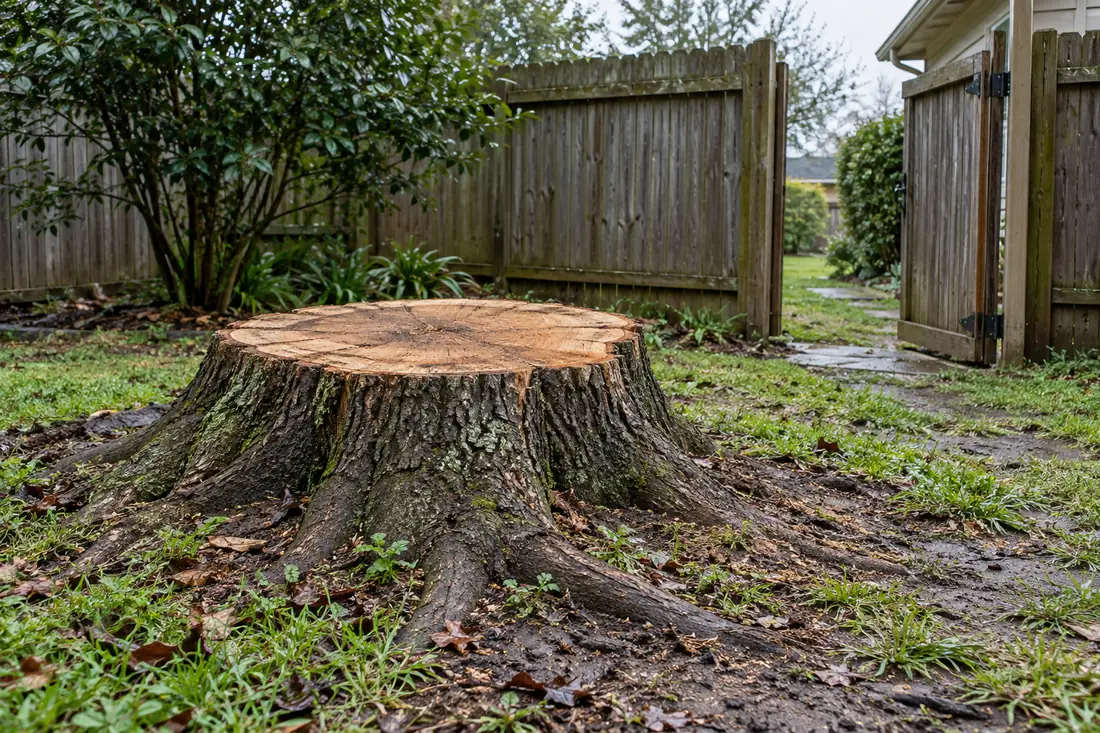
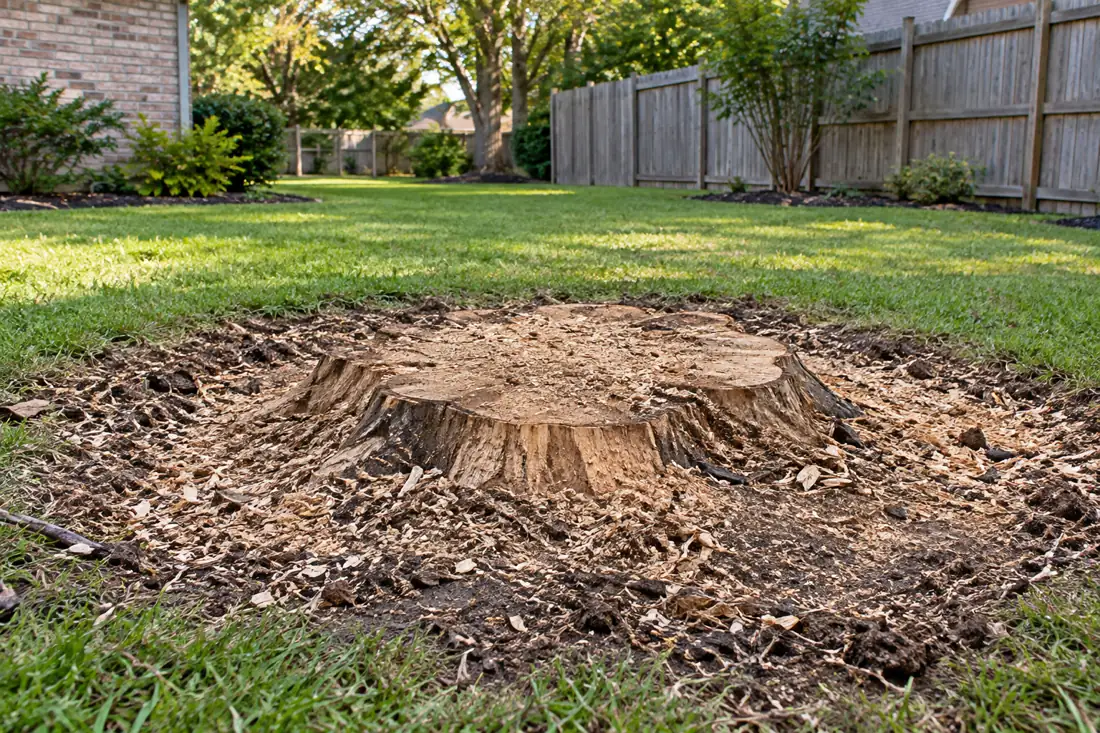
Rocks, edging and buried construction material should be identified around a stump. They can affect preparation, machine work and the surrounding property. Ask what must be removed before arrival and who handles it. The desired landscape finish should be separate from the basic grinding scope.
Site planning detail: Decorative river stone, buried gravel, concrete fragments and metal edging create different hazards around a stump. Identify visible materials and ask whether the landscape fabric, edging or loose rock must be pulled back before the machine works. A photograph taken from above can hide the depth of a stone layer or buried objects, so do not describe the area as obstruction-free without inspection. Keep loose material away from the cutting zone and leave removal of embedded hazards to the crew’s documented method rather than trying to reach under a running machine.
Discuss what stone will be saved and who will replace fabric, borders or mulch after work. If the owner wants new planting, the restored bed needs a separate soil and drainage plan; grinding alone does not provide that finish.
Decorative stones, buried edging, gravel and retaining-wall blocks can be struck or thrown by stump-grinding equipment. Photograph the stump and materials first, and determine which stones may be moved by an authorized person. Do not assume the operator will excavate every hidden rock or reconstruct the landscape bed.
Define a safe preparation boundary and a stop-work approach if unexpected hard material appears. Note irrigation, lighting cables and roots of nearby plants concealed beneath mulch or stone. Clarify whether separating debris, resetting stones, replacing mulch and leveling soil are included or left for a landscaper.
Identify which stones are decorative and which are functional
Landscape stone around a stump is not necessarily a loose layer that can be pushed aside. A property may have river rock over fabric, compacted crushed stone supporting edging, large boulders holding a slope, or masonry blocks forming a retaining border. Walk the entire stump perimeter and distinguish loose decorative pieces from structural or drainage-related material. Removing the wrong stone can destabilize a border or redirect runoff even before grinding begins. Photograph the arrangement before anyone changes it.
Ask the contractor which stones need to be moved for safe access and who will perform that preparation. Homeowners should not pry or roll heavy boulders into a new position without appropriate equipment. If a stone appears integrated with a retaining wall, step, or foundation, treat it as a separate construction concern instead of ordinary landscaping clutter. An accurate scope starts by acknowledging that the visible rocks can serve different purposes and cannot all be handled the same way.

Understand the projectile hazard from hidden rock
A stump grinder is designed to process wood, not loose stone. Even small rocks concealed under mulch or soil can become dangerous if struck by rotating equipment. A contractor should inspect the exposed work area and establish an exclusion zone, appropriate shielding, and a safe approach before engaging the cutting wheel. Do not remain nearby for a close-up video or ask the operator to continue through visible stone to save preparation time.
A surface that appears clear may still contain buried rock, old bricks, fence hardware, or fragments from previous landscaping. These hazards are not always visible until work progresses. The estimate should explain how an unexpected hard obstruction is handled: pause, assess, potentially change scope, and document the condition. No one can guarantee that every concealed object has been found from a simple yard photograph. That uncertainty belongs in the plan rather than being ignored.
Map a realistic clearance around the stump
The wooden flare often extends beneath decorative stone and edging, so the visible trunk diameter can understate the required work envelope. Establish where the grinder needs safe access, how much clearance its protective guard requires, and whether adjacent boulders or raised edging would prevent the cutting head from reaching the proposed depth. A narrow stone ring can be more restrictive than a much larger open lawn. The exact clearance depends on the actual equipment and the operator's assessment.
Use a marked photo to show which rock sections can be temporarily removed, which must remain undisturbed, and which are outside the quoted scope. If the homeowner wants every stone returned to its original pattern, that restoration may be a separate labor item. It is better to define the boundary beforehand than to discover later that the contractor considered the rock bed an obstacle while the owner expected it to look untouched.

Keep decorative rock and landscape materials out of the grinding path
Photograph the full bed before work begins, including any river rock, gravel, metal edging, pavers, drip tubing, shrubs and landscape lighting. Gravel visible on top can continue under mulch and into soil immediately around the trunk. Describe the approximate width of the stone border and whether fabric or mesh appears under it. A grinder is intended to reduce wood, not process rocks, metal anchors or buried masonry. Even a small hard object can become a projectile or damage equipment when the cutting wheel reaches the work zone.
Discuss a practical removal and protection boundary with the operator. A client may be able to relocate loose decorative stones after the work area is clearly identified, but digging around an unknown utility line or unstable stump is not an appropriate do-it-yourself shortcut. If the border contains mortared stone, buried edging or integrated drip lines, list those as fixed conditions.
Ask whether the contractor can limit the cut near obstacles and how much buried wood will remain. Do not assume the grinder can sweep under a retaining wall or that every stone can be returned to precisely the same placement.
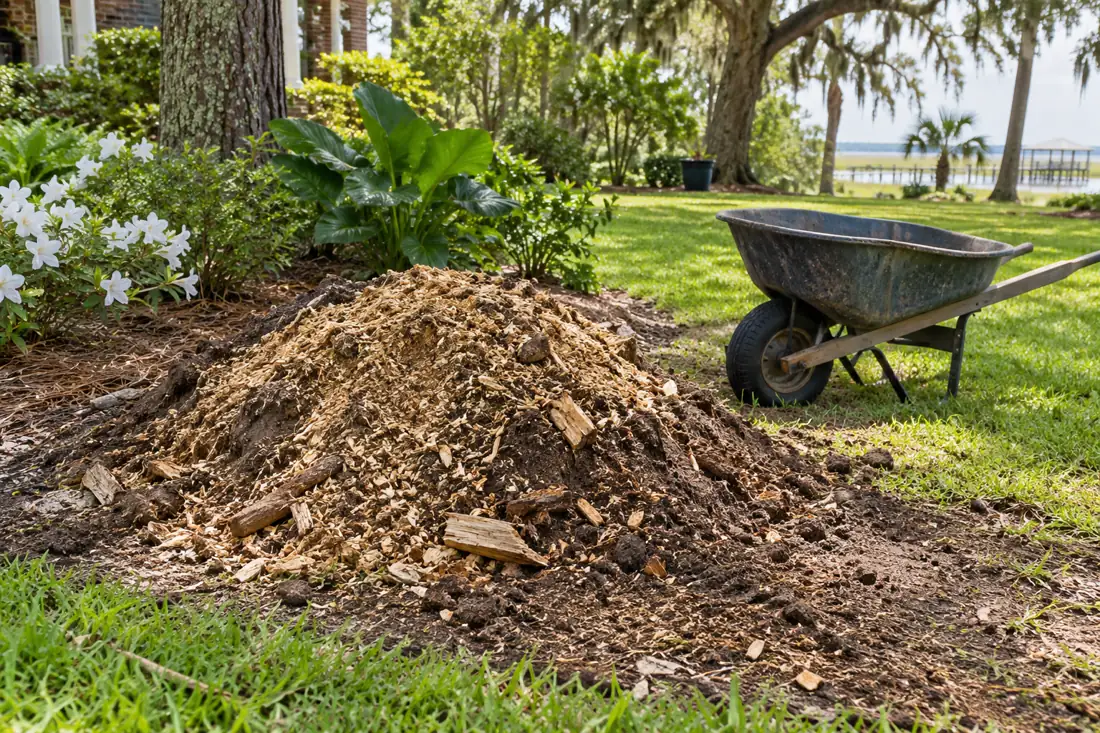
Decide where stone, mulch, soil and wood chips will go during work. Mixing all four in one pile makes restoration harder and can leave sharp chips where a family expects a tidy ornamental bed. If the planting bed will be redesigned, provide a simple sketch of the intended future edge before the stump is ground.
If the goal is replanting, discuss whether old root mass, residual chips and drainage need further attention from a landscape professional. Keep the stump-grinding estimate separate from planting design and irrigation repair unless they are explicitly included.
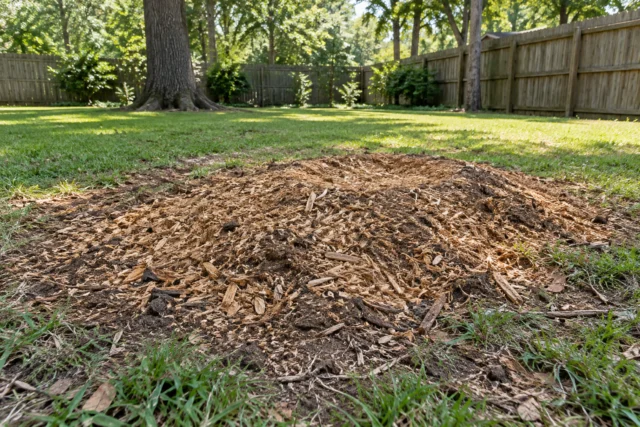
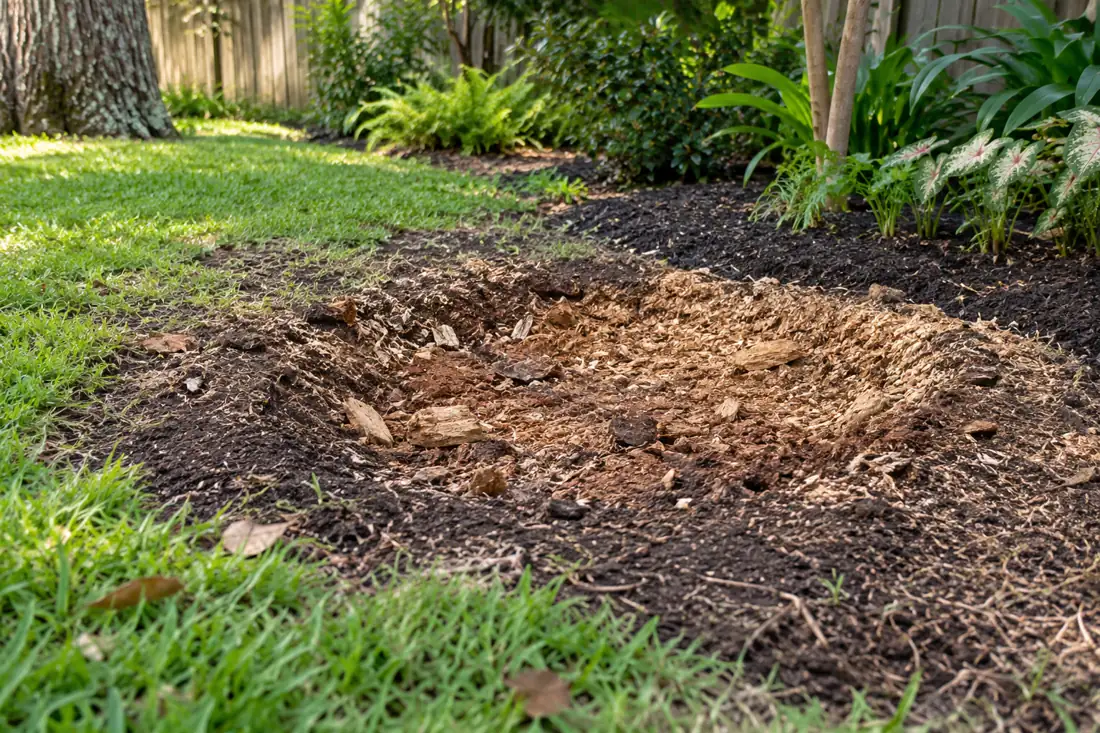
Walk the bed after the equipment has left the immediate cutting area. Look for rocks thrown into the lawn, shifted edging, torn fabric, broken drip emitters, excess chips against living shrubs and voids around the stump hole. Photograph the cleaned border from the same angle used in the initial record.
Confirm the depth and perimeter actually reached, especially near stones that were not removable. A scope that states which decorative materials were protected, temporarily moved or excluded is easier to evaluate than a vague promise to restore everything.

Look below fabric, mulch and surface gravel
Weed barrier fabric and old layers of mulch can hide small stones, irrigation tubing, landscape staples, or cable lighting near the stump. Avoid assuming that removing the top decorative stones exposes a clean work surface. Ask about the history of the bed, including changes in edging and any buried irrigation repairs. The contractor can determine how the area must be inspected before grinding safely. Pulling blindly on fabric near roots or utilities may create additional damage.
If fabric must be cut or removed, clarify whether replacement is included and whether the disturbed material will be discarded. Some beds contain multiple old layers that cannot realistically be restored by laying one sheet over fresh chips. A future replanting plan may also call for a different soil finish. Treat each material layer as a potential scope decision rather than hiding those decisions in a general cleanup promise.
Separate decorative stones from buried grinding hazards
Landscaping rock can hide a stump flare, edging stakes, irrigation lines or landscape-light cable. A grinder can throw debris and damage cutting teeth when an obstruction enters the working area. Do not push loose rocks against the stump to make the area look tidy. Instead, show the stone bed in a wide photo and identify the boundaries, retaining edges and any recently installed services.
Before pricing the work, ask whether movable surface rocks, edging and fabric must be cleared by the owner or will be handled by the crew. If the stones are embedded beneath roots, that may change the work sequence. Protect nearby windows, parked cars and accessible walkways during operation according to the contractor's plan; visitors should remain clear. Specify whether the final surface should retain chips, be prepared for new stone or be turned over for planting. Those are distinct restoration outcomes.
Protect irrigation and lighting features in the rock bed
Rock landscaping frequently contains drip tubing, emitters, valve boxes, and low-voltage lighting wires close to the soil surface. The visible location of one fixture does not prove the route or depth of its supply line. Provide diagrams or installation history if available, and arrange suitable public or private locating as necessary. Ask the contractor to mark known vulnerable components and to explain where the machine can safely work without entering their clearance areas.
Moveable light fixtures can sometimes be protected or temporarily removed by a qualified person, but permanent wiring or irrigation modifications should not be improvised by a grinding crew unless that work is explicitly in its competence and scope. If a line cannot be confidently located, specify the excluded area or revised depth. A lower grinding depth near a buried service can be a responsible limit, not a failure to finish an otherwise well-defined job.

Choose a machine route that preserves hardscape edges
A rock bed can be reached only by crossing part of the property. The equipment path may pass over pavers, thin landscape edging, a small drain cover, or a driveway joint. Identify the narrowest opening and turning area, and ask how loading, unloading, and ground protection will work. Stones that seem strong underfoot may shift under wheel or track loads, particularly if they sit on uncompacted soil.
Avoid treating a convenient shortcut across a neighbor's bed or a fragile patio as automatically available. Permissions and support conditions matter. The contractor may choose a different machine, stage from a farther position, or recommend a smaller achievable scope. The work plan should protect the route as well as the stump, because repairing a cracked border or disturbed drainage strip can overshadow the value of the grinding itself.
Set depth expectations for the intended new landscape
The desired grinding depth depends on whether the owner wants to re-establish a decorative rock bed, plant a shrub, install lawn, or later place a permanent structure. Accessible central wood can be reduced, but grinding does not guarantee complete extraction of the broader root network. Discuss the target surface and any planned reuse before choosing a scope. Near large stones, equipment geometry may limit how much wood can be reached without removing material outside the grinder's responsibility.
If paving, a wall, or a footing will follow, seek appropriate ground preparation rather than assuming wood chips and loose soil form a suitable structural base. Even for decorative stone, a cavity filled mostly with organic grindings may settle and distort the finished pattern. Ask whether backfill, compaction, fabric replacement, and stone placement belong to the same quote or to a follow-on landscaping project. Specific finish terms prevent mismatched expectations.

Handle rock and wood-chip mixtures deliberately
Grinding inside a stone bed can mix wood fragments, soil, and small gravel. Once combined, those materials may be difficult to separate cleanly. Decide in advance whether the owner prefers to keep loose stones, remove contaminated grindings, or accept some loss of decorative material. A promise to restore every pebble exactly can be unrealistic. Identify a staging area where chips and salvaged stone can remain separate, with protection against runoff into drains.
A contractor may be able to provide basic raking and sweeping without delivering full landscape reconstruction. Ask for the difference in writing. If the homeowner wants matching replacement stone, confirm the product and quantity separately rather than assuming the old material can all be reused. The cleanup outcome should match the actual materials present, not a generic description borrowed from a stump in open grass.
Protect living plants and retained tree roots
Rocks commonly surround shrubs, ornamental grasses, and trees that the owner intends to keep. Before work, mark plant crowns, drip lines, exposed roots, and any roots that belong to a living retained tree. A grinding operation aimed at an old stump should not become an unreviewed removal of nearby healthy roots. If significant cutting or access would affect a valuable tree, a qualified arborist may need to assess the risk and propose a different approach.
Keep temporary stone piles and grinding chips away from plant crowns and the bases of living trunks. Heavy stone can compact wet soil or break delicate stems, while piled chips can alter moisture conditions. Identify which plants need moving by a landscaper and which can be protected in place. These details determine whether the finished bed remains usable after the stump is gone and are worth capturing before equipment arrives.

Inspect the finished edge and document restoration work
At completion, compare the rock border and surrounding area with the pre-work photos. Confirm the agreed stump reduction, remove any accessible sharp debris within the crew's cleanup scope, and examine edging, paving, drains, and visible irrigation fixtures. Do not reach into a fresh cavity or manually probe the cutting area. Note any stone that was intentionally moved or excluded from reinstatement, along with material that still needs a landscaper's attention.
Keep the estimate, photos, utility notes, and instructions for the next stage. A restored decorative bed may need clean backfill, replacement fabric, or fresh gravel after the cavity settles. If that work was not purchased, record it honestly rather than calling the entire landscape installation complete. A successful grinding project around rocks leaves a clear record of the stump work, the protected features, and any remaining restoration responsibilities.
Questions about this project
Does stump grinding remove the entire root system?
Grinding normally addresses an agreed stump area and depth. It should not be assumed to extract every underground root. Describe your future use of the site and ask what additional work or coordination is needed.
Can the area be paved or planted immediately afterward?
That depends on the intended project and the agreed finish. Chips, remaining roots, excavation and soil preparation may need separate attention. Coordinate the grinding scope with the installer who is responsible for the next phase.
Which property features should I point out?
Identify buildings, vehicles, fences, fixed fixtures, landscape features, utilities and occupied routes. Explain what can move and what must remain. Include existing damage and any buried features you know about along the access route.
Should people remain inside the work area?
The contractor and site contact should establish an exclusion area and access arrangements appropriate to the work. Keep children, pets, visitors and other workers outside the active zone until the responsible parties say it can reopen.
Does cleanup include every root and wood chip?
That depends on the written scope. Tree removal, stump grinding, chip hauling and root excavation are different tasks. Ask what material is removed, what remains and whether soil or landscape restoration is separately included.
What should a final walk-through check?
Compare the identified trees and tasks with the agreement. Check agreed debris handling, stump treatment, access openings and any listed restoration. Record unresolved items clearly instead of relying on a general impression that the property looks finished.
Will a utility locate show every private line?
Do not assume it will identify all irrigation, pet-fence, drainage or other customer-owned systems. Provide available plans and ask what additional locating or coordination is needed for the actual work and access area.
Who should arrange utility-related preparation?
Set that responsibility before scheduling. The property contact, contractor and relevant providers need to identify who handles locating, disconnection, relocation or separate repair work. Uncertain utility information should be resolved rather than guessed.
What should I compare besides the price?
Compare tree identification, work objectives, access assumptions, hauling, stump treatment, site finish and exclusions. Ask whether permits or other coordination are part of the scope and who can approve changes if conditions differ.
Does an online request book the crew?
No. A request starts the estimate conversation. The company still needs to discuss scope, availability and any site assessment. For a dangerous or urgent condition, call 504-458-8336 rather than relying on a form response.
What should I tell Tree Huggers about stump grinding around landscaping rocks?
Explain the property address, the work you want and the specific concerns: rocks and edging, preparation, landscape finish. Send safe photos of the tree, surroundings and access route. The contractor can then discuss the assessment and scope needed for this situation.
How do I request an estimate for this work?
Call 504-458-8336, text photos or use the estimate form on this page. Include the address, desired outcome and any timing constraints. The company will need to review scope and availability; an online request does not confirm a price, appointment or emergency dispatch.
Get a scope for your property
Decorative rock, edging, pavers and fabric near a stump can create hidden project limits and a risk of material being struck by equipment. Show the full landscape bed, the distance from the stump to hard edging and whether stones are loose, embedded or mortared. Explain which plants and finished surfaces you want protected.
Moveable decorations should be identified, but do not dismantle masonry or disturb unknown irrigation lines simply to prepare for a quote. A picture taken before any authorized clearing helps establish what is already present.
Ask who removes and replaces rocks, edging and fabric if they block the grinding footprint, and what happens if buried stones appear under the visible bed. The estimate should define how chips will be separated from decorative material and whether replacement mulch, soil, gravel or re-leveling is included.
If surrounding plants have roots intertwined with the old stump, discuss realistic protection limits and the possibility that the work area must be adjusted. A written finish description prevents a clean grinding job from leaving a disorganized landscape bed.