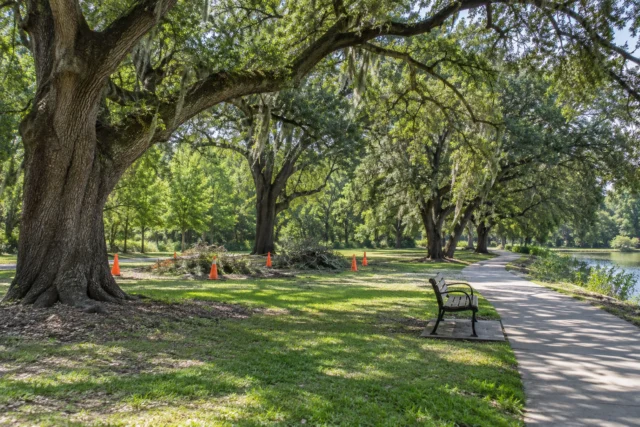
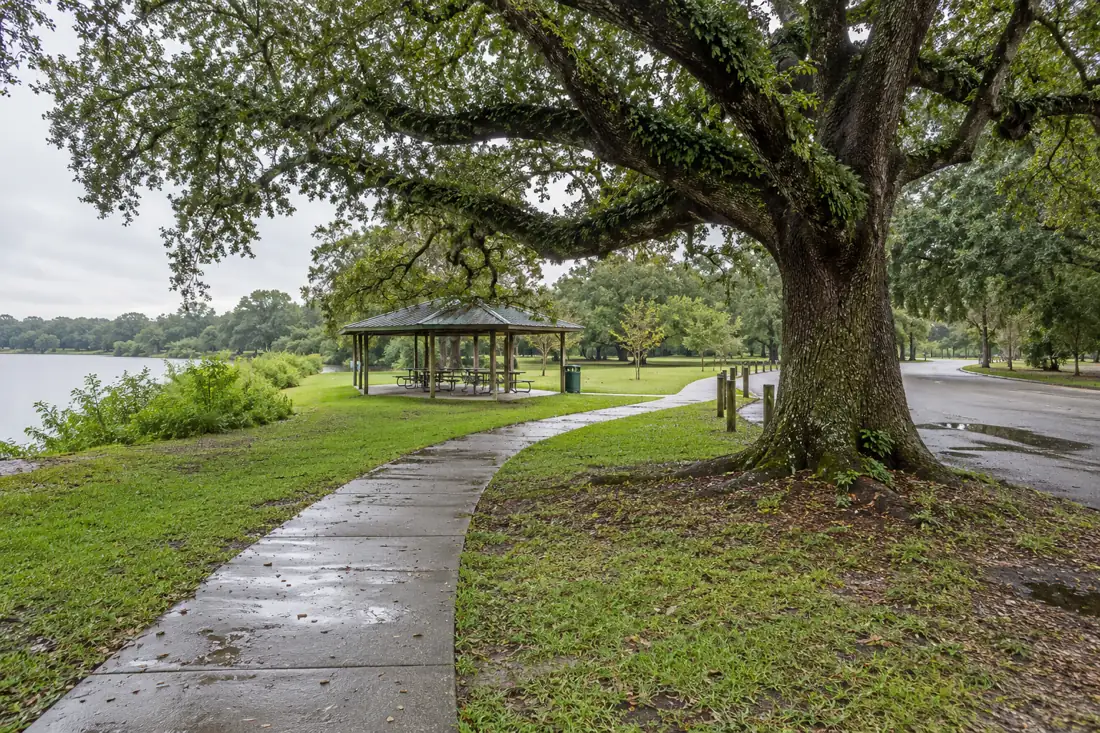
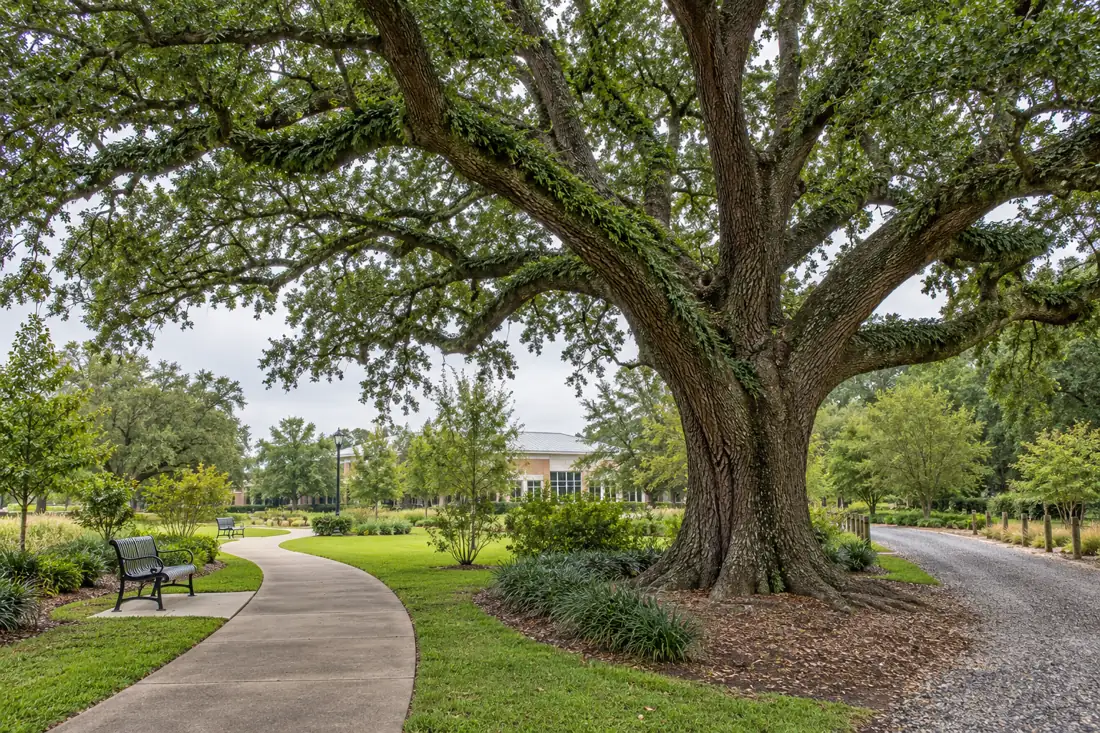
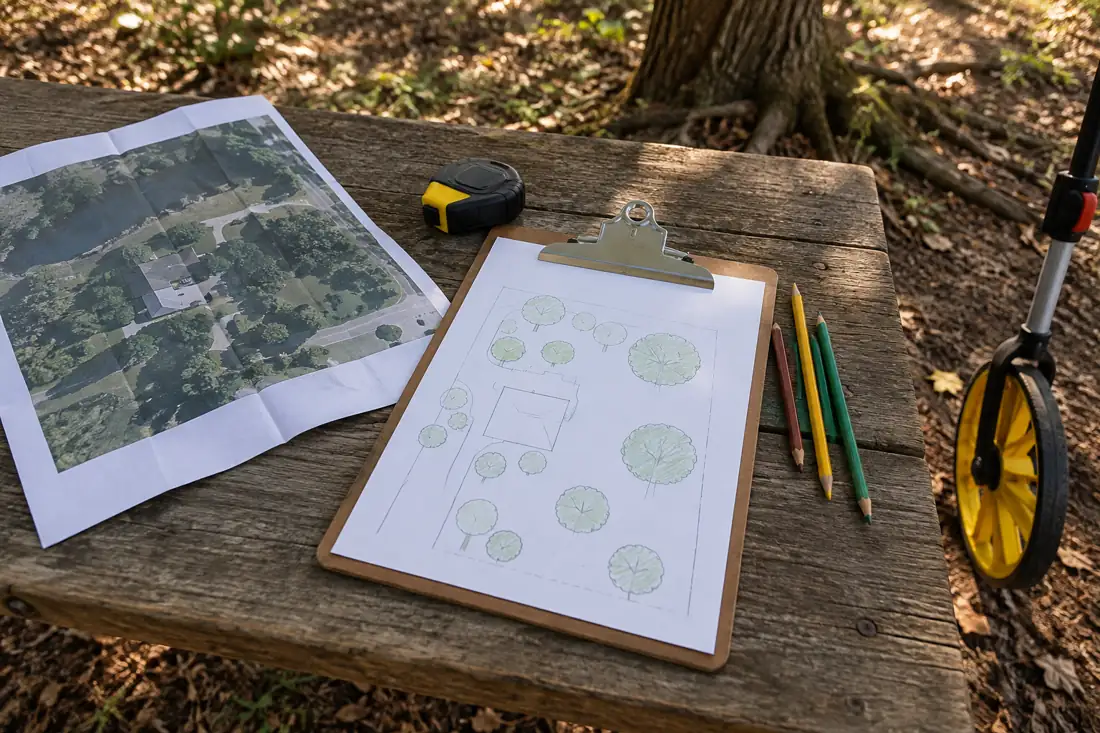
Recreation centers may remain busy outside conventional business hours. Include activity schedules, arrival routes and the locations of sports or play equipment in the scope discussion. The agency and contractor need an agreed exclusion area and reopening process. A tree list or marked plan helps separate the approved work from unrelated maintenance.
Site-specific planning checkpoint: At a recreation center, tree work may overlap with after-school programs, fitness classes and activities using different entrances throughout the day. Ask the facility manager for actual occupancy and delivery patterns instead of assuming a single morning closure is enough. Identify playground edges, sports courts, parking, lighting, utilities and drainage before selecting the equipment route. Fence off the specific work area and coordinate reentry only after the site has been inspected for debris and surface damage. When a tree appears unhealthy, separate the assessment from a preselected removal decision. The written plan should also address where logs or chips can be staged without obstructing patrons or emergency vehicles.
Build a facility closure map around real programs
Ask the recreation-center manager for the current calendar of games, after-school activities, camps and maintenance work, and mark which fields, courts, gates and pedestrian routes each group uses. A closure that looks short on paper can interrupt arrivals or make an alternate entrance inaccessible. Confirm who can notify participants and who has authority to close or reopen each affected area.
Mark sprinkler heads, irrigation controls, buried services, fence gates and surface types along potential equipment paths; uncertain underground conditions require verification rather than guesswork. Separate the approved tree tasks from restoration of turf, play surfacing and any protective coverings. If wet ground or a competing event changes the available access, the work plan should allow a properly authorized reschedule instead of forcing unsafe operations.
At completion, have the facility inspect debris, play surfaces, gates, access routes and any equipment-contact areas before public use resumes. Document pending repairs explicitly; a photograph of a tree after cutting does not establish that the whole facility is ready to reopen.

Keep fields, courts and playgrounds distinct
A recreation campus may contain soccer fields, ball diamonds, basketball courts, playgrounds, picnic areas and walking loops with very different surfaces and hazards. Map their entrances, fencing, seating and surrounding trees individually. A dead limb above a playground requires a different access and exclusion discussion from a tree bordering an unused maintenance yard. The goal is to protect the actual users and functions of each area.
Identify equipment that cannot be moved, such as installed goals, backstops, lighting poles and fixed shade structures. Ask which features can be temporarily closed or removed under the facility's authority. Do not assume that playground surfacing can support a lift or chip truck simply because it looks flat. Ground bearing, underground utilities and restoration standards must be reviewed before selecting an equipment route.
Read the related planning tree work for a sports complex guide · Review public-sector tree-work services
Use the recreation calendar to plan safe access: Recreation centers bring changing groups of children, spectators, staff and service vehicles through outdoor routes. Review the calendar for camps, practices, events and school transport before proposing a work window. Identify entrances to gyms, pools, fields, courts and restrooms, including accessible routes, and decide where a secure isolation perimeter can be maintained. Never assume a small limb can be safely lowered over an active play area simply because the work will be brief.
Understand the calendar of public activities
A recreation center can be busy at dawn, after school, on weekends and during seasonal events, even when the building's office appears closed. Ask the facility manager for leagues, camps, classes, maintenance visits and special-event schedules. A tree job that intersects a field, playground or pedestrian shortcut needs an operating plan based on when people actually use it. Identify the trees and the affected routes on a map before assuming an afternoon closure is adequate.
Discuss the time required for equipment arrival, setup, cutting, hauling and final reopening as separate phases. A schedule should remain conditional on qualified site assessment, weather and coordination requirements. Do not promise that a playing field will reopen by a particular hour before its surface and access can be inspected. Name the person who has authority to change the site calendar and communicate closures to program leaders.

Evaluate tree condition and preserve healthy assets
Document the visible condition and requested outcome for every tree using stable identifiers and wide location photographs. A large shade tree may be important to field users while also developing branch defects that require professional evaluation. Avoid labeling a tree dangerous solely because it is tall or close to activity. Ask a qualified tree professional to distinguish appropriate pruning, protection, monitoring or removal based on the actual condition and site targets.
Record trees to retain and their root zones before any equipment is routed across the grounds. Mature trees provide shade that is difficult to replace quickly, and damage from soil compaction can create later health problems. A recommendation to remove one compromised tree should not be treated as permission to clear surrounding healthy trees. Keep uncertainty visible in the scope, including any need for specialized arboricultural assessment.
Design an exclusion plan for active public use
Tree removal and pruning can create falling-object and equipment hazards extending beyond the trunk. A rope, caution sign or casual verbal warning is not a replacement for a properly established work zone. The contractor and facility need to agree which public routes can close, where barriers belong and how visitors will be redirected. Children, spectators and runners may approach from several directions, not only the main parking lot.
Identify who controls access during operations and who can call a pause if the exclusion area is compromised. Keep emergency access and accessible routes in the coordination plan. Do not direct recreation-center staff or volunteers to enter a cutting zone to retrieve a ball or guide the public past equipment. The final separation plan must reflect the actual removal method and any changing conditions at the site.
Check access through gates and service roads
Walk the entire approach from public road to tree, noting narrow fencing, turn radii, overhead lights, soft turf, irrigation heads and drainage swales. A maintenance golf cart route may not be suitable for a loaded log truck. Identify where lifts or cranes could set up only after ground and clearance conditions have been reviewed. Ask who owns and can authorize temporary fence changes or access through adjacent parcels.
If a machine must cross a field or lawn, discuss protection, possible closure and restoration responsibility. Avoid promising no ruts or compaction before site bearing and weather are known. Different site conditions may call for different equipment or a different time of year. Photographs of both the tree and the full access route help an estimator evaluate feasibility without treating the image as an engineered access plan.

Scheduling tree work at a recreation center
A recreation center can combine several tree-work environments in a small footprint: court edges, rooflines, playgrounds, parking and heavily used walkways. A proper plan marks each affected tree and the nearby activity, then checks whether the facility can close the area during work. An estimate based only on a tree close-up misses the practical restrictions around children, events and vehicle circulation.
Inspect access for chip trucks and lifting equipment without assuming a court surface, sidewalk or landscaped area can support heavy loads. Fences, sports lighting, sprinklers and overhead conductors may affect routing. The site team should identify protected features and the permitted work area before equipment is selected, leaving the final method to a qualified crew after actual conditions are reviewed.

Coordinate around games and building access
Separate hazard-related maintenance from elective cosmetic pruning. A limb with a reported defect near a busy walkway calls for an appropriate assessment, while branches that obstruct a light fixture may require a different scope. Public operators should have the opportunity to confirm whether retaining shade is important and whether the tree has other functions during summer programs.
Closeout should confirm that courts, trails and entrances are free of debris, damaged surfaces are documented and any remaining maintenance recommendations are clear. If activities must resume at a particular time, that deadline belongs in the scheduling conversation rather than an unverified guarantee in marketing copy. Photos should be limited to the site and work condition, avoiding unnecessary images of visitors.
Find underground irrigation and facility utilities
Recreation properties may have sprinkler mains, field drains, low-voltage lighting, buried communications and shallow electrical service along fence lines. Ask for available utility maps and note where their accuracy is uncertain. Ground protection, stump grinding and machine stabilizers can affect subsurface infrastructure even when no digging is planned in the usual sense. Responsible locating and utility coordination must be assigned before ground disturbance.
Look for overhead service drops, floodlights, scoreboard cables and nearby buildings as additional constraints. Tree personnel should not approach energized conductors or assume an electrical system is inactive because the lights are switched off. Identify who can authorize shutdown or protection by the appropriate utility. Include exposed irrigation heads and valve boxes in the pre-work condition record so their protection and any genuine damage are not overlooked.

Define hauling, stump work and surface finish
Explain whether brush, logs and chips must be removed each day, where temporary staging is permitted and which vehicle routes are available for hauling. Public fields may not have a safe place for a large pile that remains overnight. Include stump grinding, root remnants, backfill and landscaping as separate scope items where appropriate. The phrase clean up the tree does not establish what finished ground should look like for future play.
If a removed tree leaves an area intended for turf or new equipment, confirm who is responsible for grading, irrigation repairs, soil amendments and reestablishment. Grinding does not eliminate every root, and freshly disturbed ground may settle. Do not promise an immediately playable surface without a real inspection and any required restoration. Measurable acceptance standards help the public buyer compare proposed work fairly.
If the center cannot provide a sufficient exclusion zone during operating hours, recommend a separately approved closure or work period. Equipment plans should address field surfaces, curbs, irrigation, low branches, gates and wet ground. If a lift must cross turf, record whether ground protection and repair are included; avoid implying that mats eliminate every possible impact.
Retain a tree-by-tree photo register showing the approved scope, not visitors or identifiable children. At completion, verify removal of brush and rigging equipment, restoration of access and documentation of any work that remains for a later visit.
Plan for noise, dust and neighborhood impacts
Chippers, saws, grinders and large trucks can generate noise and debris during a period when the recreation property serves classes, games or nearby homes. Ask about applicable operating windows and permit or notification procedures without inventing local rules. A good plan considers sound near indoor activity rooms and dust or chips near playgrounds, picnic areas and open doors. Equipment choice and work sequencing should respond to real site constraints.
Coordinate with the facility's public communication channels so participants know which areas are unavailable and whether scheduled programs are relocated. Do not announce a guaranteed completion time when weather, hidden defects or utility coordination may change the job. The contractor's work zone and the facility's activity plan should be updated together if conditions change, not separately after users arrive.

Check conditions before returning areas to users
A recreation area should not reopen merely because the saws have stopped. Confirm that active work is complete, equipment and wood are removed from public routes, barriers are addressed, and agreed surface repairs or warnings are in place. Inspect for debris, open holes and damaged irrigation or fixed equipment in the actual work zone. The authorized facility manager and contractor need to coordinate the reopening decision based on observed conditions.
Provide the buyer with tree identifiers, a completion summary, approved changes, relevant photographs and any outstanding restoration items. Distinguish recommendations for future tree care from contracted work that has actually been performed. Avoid invented response guarantees or claims of emergency dispatch from a website request. A thoughtful closeout protects athletes, children, families and staff while preserving the facility's long-term landscape value.
Maintain scope and change records during the job
Use a dated tree map, work order and authorized contact list so crews do not confuse planned work with recommendations. A coach noticing another low branch may identify a legitimate issue, but that observation is not automatically authorization for more pruning. Additional work, unforeseen obstructions and access changes should follow the facility's procurement or contract change process. Distinguish a temporary safety precaution from a new billable task.
Take before and after images from safe positions when permitted, keeping visitors' privacy in mind. Record areas closed, material removed, surface disturbance and tasks deferred. Do not describe illustrative website photographs as evidence of a recreation-center job. Clear field notes allow the buyer to understand why a change was proposed and whether the final deliverables match what was approved.
Program calendars can determine the safe work window
A recreation center often combines a building, parking, athletic fields, playgrounds, courts and scheduled classes. The relevant tree-work constraint may change by hour: a field used for practice after school is not the same as a vacant lawn. Distinguish the access route for an ambulance, delivery or maintenance vehicle from a route that can be temporarily closed for debris loading.
Ask the facility manager for the actual calendar and which spaces cannot be interrupted. Do not advertise a guaranteed completion hour when weather or a concealed hazard may alter the work sequence. Where the work instead affects open park trails, historic shade trees and visitors arriving without reservations, the park guide provides the broader public-access plan.
- Mark facility doors, emergency routes and spectator zones separately.
- Agree on the person who can confirm a field or court is clear.
- Define a postponement or reopening decision before crew mobilization.
Work around the recreation program, not an empty photograph
A sports field may be empty during inspection yet committed to lessons, camps, games or maintenance. Record each occupied period, arrival route, gate and area that must remain excluded during tree cutting and hauling. Irrigation and buried features can constrain equipment as much as visible paths.
Have the operator confirm the window and reopening procedure. Distinguish debris removal from surface restoration and identify who inspects turf, courts, walks and remaining materials before visitors return.
Questions about this project
What should a government buyer send first?
Send the agency or prime contact, project reference, site, scope, deadline, access conditions and required documents or submission format. Identify the authorized contact for questions and the buyer's process for clarifications.
Does a capability page prove contract eligibility?
No. Request and verify current documentation relevant to the particular opportunity. Registration status, certifications, licensing, insurance and availability should not be inferred from a broad marketing statement.
Can a business stay open during tree work?
That depends on the site and scope. Discuss occupied routes, exclusion areas, loading and work windows with the contractor and property representative. Do not assume normal access can continue through the active work zone.
Who should communicate with tenants or visitors?
Agree on that responsibility with the property representative. The contractor needs a clear site contact, while the owner or manager should use the property's established process to communicate access changes and work windows.
Which property features should I point out?
Identify buildings, vehicles, fences, fixed fixtures, landscape features, utilities and occupied routes. Explain what can move and what must remain. Include existing damage and any buried features you know about along the access route.
Should people remain inside the work area?
The contractor and site contact should establish an exclusion area and access arrangements appropriate to the work. Keep children, pets, visitors and other workers outside the active zone until the responsible parties say it can reopen.
Is a total tree count enough for a large quote?
Usually the parties also need locations and tasks. Use consistent tree numbers, marked photos or a site plan so the estimate and crew instructions refer to the same trees and retained areas.
Does a work inventory include a condition assessment?
Only if that service is expressly part of the scope. A list used to identify and price tasks should not be mistaken for a documented assessment of every tree's condition or risk.
How should extra work be approved?
Use the agreed approval process and identify the change, reason, scope, price or schedule effect as applicable. Confirm who has authority before treating an additional tree or task as part of the original job.
What completion records are useful?
Keep the agreed scope, tree or area identification, authorized changes, invoice and labeled photos where appropriate. Include unresolved items and a contact. Contract-specific records should follow the buyer's stated requirements.
What should I tell Tree Huggers about tree work at a public recreation center?
Explain the property address, the work you want and the specific concerns: activity schedule, equipment protection, reopening. Send safe photos of the tree, surroundings and access route. The contractor can then discuss the assessment and scope needed for this situation.
How do I request an estimate for this work?
Call 504-458-8336, text photos or use the estimate form on this page. Include the address, desired outcome and any timing constraints. The company will need to review scope and availability; an online request does not confirm a price, appointment or emergency dispatch.
Get a scope for your property
Share the center layout and scheduled activity constraints to help plan access and the sequence of requested tree work.