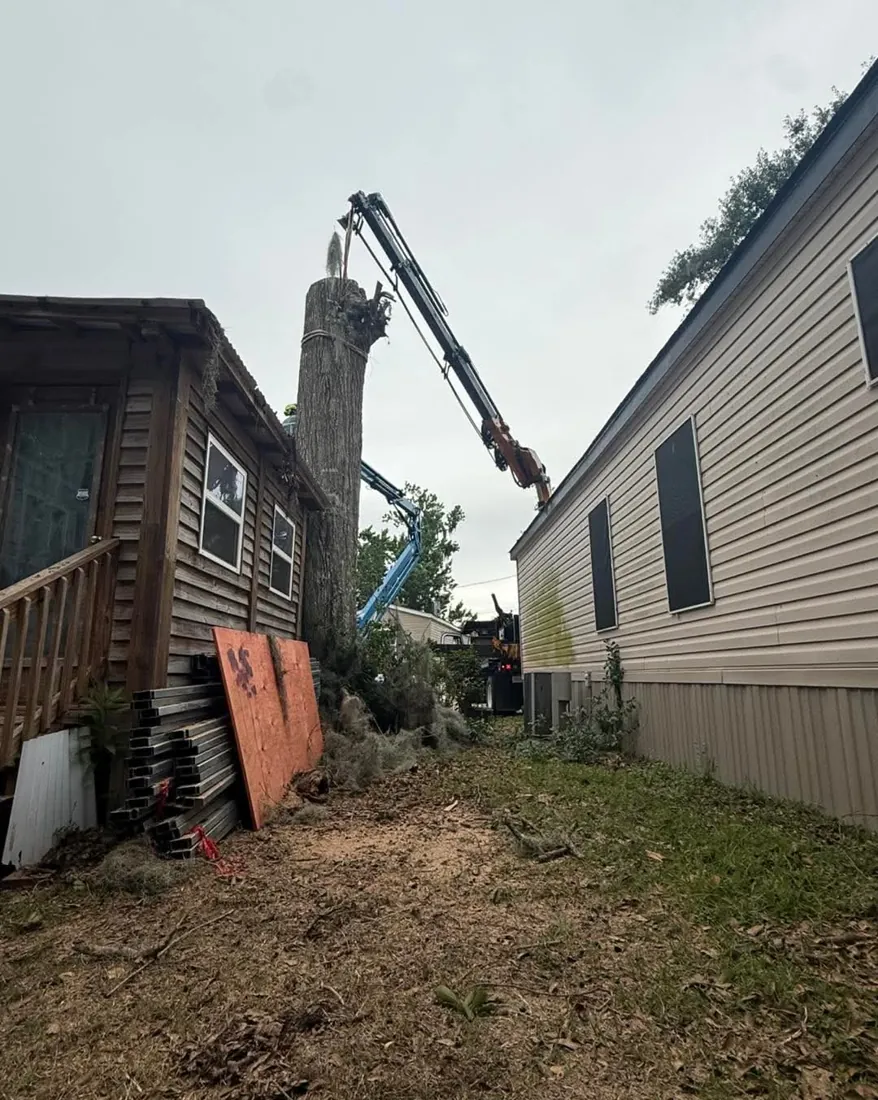
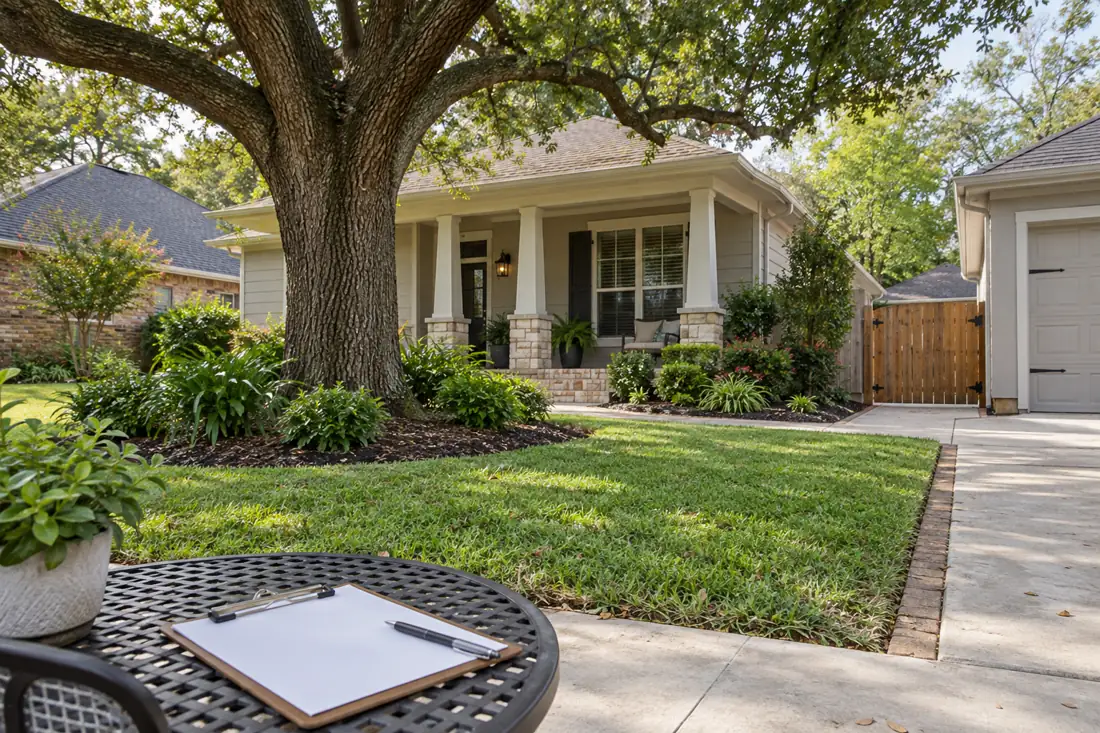
Vehicles may need to be moved from beneath branches, the equipment route and loading areas. Identify who controls each space and when it can be cleared. A vehicle outside the immediate trunk area can still obstruct safe work or access. Confirm the arrangement before the work window instead of relying on last-minute requests.
Site planning detail: A parked vehicle can block access, limit the drop zone and create avoidable property damage during tree work. At the site walk, identify vehicles in the driveway, street, rear parking pad and adjacent spaces, including those belonging to neighbors or tenants. Ask the crew what clearance the specific equipment, outriggers, haul truck and debris path require; do not invent a universal distance that would be safe for every job.
Coordinate relocation early through lawful channels and obtain any required temporary street-use permission. Do not move another person’s vehicle without authorization or allow work above an occupied parking area. Photograph the work zone before equipment arrives and mark surfaces or utilities that require protection. The written plan should distinguish necessary vehicle clearance from general convenience, state who will notify affected occupants, and confirm that the area is clear before work starts.
Site-specific planning checkpoint: Relocating parked vehicles should be part of the work plan whenever branches, chips, cranes or trucks may affect a parking area. Identify cars beneath the tree, on the proposed equipment route, beside debris staging and in adjacent public spaces. Ask the authorized owner or manager to arrange movement rather than assuming permission to tow or block vehicles. Account for accessible parking and emergency access during temporary closures. A site photograph is only a starting point; the controlled work zone may need to change if the weather or tree condition changes. Confirm where equipment can turn without entering private spaces or damaging curbs. The final walkthrough should include loose chips, tire ruts and visible impacts in the contracted parking area.
Move vehicles and plan parking access before rigging begins
Tree work beside a driveway or curb often requires more open space than the tree's trunk footprint. Ask the crew where its truck, chipper, crane or lift might stand, and which area must remain clear for debris movement or lowering branches. Relocate your own vehicles before barriers go up, and coordinate with tenants or neighbors if their cars obstruct the agreed work zone. Do not move vehicles you do not control or imply a contractor can close a public street without permission.
Map the driveway surface and nearby utilities, low branches, wires, curbs, and pedestrian routes before committing to a staging plan. A vehicle parked beneath an overhanging limb may be outside the equipment footprint yet inside the restricted drop zone. The contractor should determine work-zone boundaries and any necessary traffic measures; occupants should stay outside them. Emergency access, deliveries, school pickups, and disability access may require a different start time or sequence.
Confirm who will communicate temporary parking restrictions and how long they are expected to apply without promising an exact finish time. Take a factual pre-work photo of paving or landscaping if restoration is part of the scope. After the crew has cleared equipment, inspect the agreed driveway and access areas and report damage or debris promptly. A clear parking plan reduces conflict while keeping final clearance decisions with the people responsible for site safety.
Read the related preparing your property for a tree crew guide · Review public-sector tree-work services
Identify every space within the actual work zone
Moving a car from directly beneath the tree may not clear the entire operation. Equipment needs a route, trucks need turning room, and logs may be carried or loaded at a location away from the trunk. Walk the property map with the estimator and identify driveway, curb, garage and visitor spaces that could intersect these movements. Include spaces used by guests, tenants or delivery drivers.
Do not guess at the exclusion distance or establish your own work boundary based on a branch's apparent length. The contractor needs to assess the equipment method and surrounding targets. A marked parking plan should show spaces to clear and the ones expected to remain available, with room for that plan to change if a site condition requires a different safe setup.
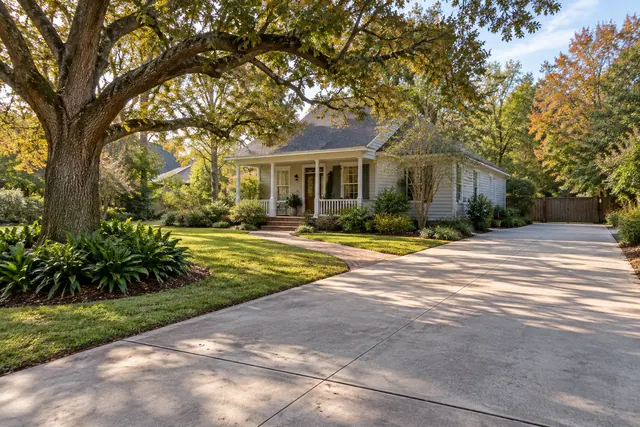
Find out who controls the parked vehicles
An office manager may be able to clear employee parking but not a neighboring tenant's reserved space. A homeowner may control the driveway but not the curb in front of an adjacent house. Identify ownership and the person authorized to request relocation before selecting the work window. For an association or managed building, check lease, parking and access requirements where applicable.
Communicate the affected spaces with a map and a reasonable lead time rather than a vague note asking everyone to move their cars. Do not tow, block or move a vehicle without proper authority. If a car cannot be cleared, tell the contractor before mobilization so the method or schedule can be reviewed. It is better to resolve one parking conflict early than expose crews and property to an improvised workaround.
Account for trucks, trailers and loading movements
A tree-service operation may include chip trucks, hauling trailers, cranes, lifts or other specialized machinery selected for the actual site. These vehicles may need a wider turning path than everyday passenger cars. Keep the proposed loading area and exit route clear, including street frontage used for backing or turning. Mark low branches, overhead wires and pavement edges for review.
Do not assume the crew will park entirely within the owner's driveway. If use of the street, right-of-way or shared drive requires permission or traffic controls, identify the responsible party. The actual equipment list and setup are professional decisions made after inspecting conditions. A workable staging plan also anticipates where another vehicle could unexpectedly enter during debris loading.

Preserve access for residents and emergency responders
Vehicle relocation should not trap an occupant behind an equipment route or block an emergency lane. Decide which entrance needs to remain accessible during the work and how deliveries, medical visits and essential services will be handled. At a multifamily property, notify residents about temporary closures and any alternative parking arrangement using the manager's approved communication system.
People who arrive after cutting starts should not drive through a barrier to reach a familiar parking spot. Use coordinated signage and the crew's site controls. Never promise uninterrupted use of a garage or front entrance when the site plan requires a temporary closure. Clear advance communication prevents frustrated drivers from trying to enter a work zone.
Consider public curb access and neighboring property
Street parking may be controlled by local rules, public agencies or another property owner. A contractor's request to clear a lane does not by itself confer permission to reserve it. Determine whether notices, permits or temporary traffic arrangements are required for the specific location. Document any affected bus stops, accessible spaces or service entrances in the planning discussion.
If the branch canopy extends over a neighboring carport or driveway, obtain the necessary owner coordination instead of assuming access. The safest plan may involve a different work window or method. Do not present a general website as legal advice about towing or public right-of-way control. The responsible authority and property parties must confirm what arrangements are lawful and feasible.
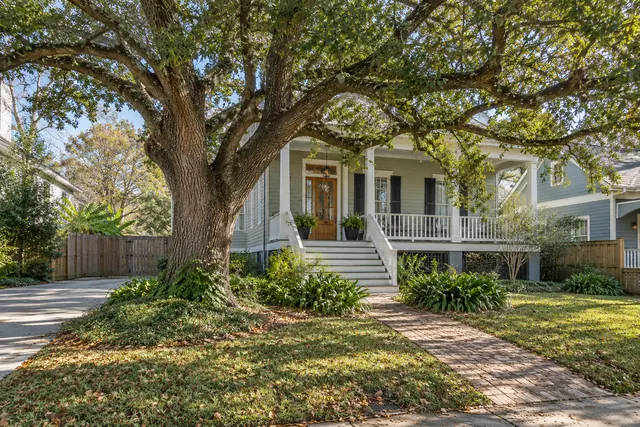
Moving Vehicles Before Tree Work
Parked vehicles can block the route before the crew ever reaches the tree. Identify the equipment approach, expected truck position and space needed for hauling before asking anyone to move a car. A branch over a driveway may create a separate concern from vehicles parked along the curb. Ask the contractor for its required clearances rather than guessing from the footprint of an ordinary pickup truck.
When a neighbor's vehicle is involved, communicate the requested time and location politely and through the appropriate property contact. You cannot assume the right to move or tow someone else's vehicle. Where a street restriction or permit is necessary, the responsible party should verify the actual local requirements before the work date. Avoid promises about road control or enforcement that have not been arranged.

Protect the approach and the neighbor's access
Consider school pickup, parcel deliveries, trash collection and scheduled building access when selecting a practical work window. A truck that fits the street may still obstruct a driveway turning radius or prevent emergency access. The site plan should name any route that must remain open. Changes in weather and equipment choice may alter staging needs, so confirm the arrangement again near mobilization.
After the crew releases the area, inspect the parking and driveway surfaces for visible debris or obstructions while remaining outside any active work boundary. Distinguish the contracted cleanup from additional paving or landscape restoration. Photographs can document an observed issue, but they do not prove preexisting surface condition without prior evidence. Clear expectations protect residents, neighbors and the contractor from avoidable misunderstandings.
Protect pavement, lawns and buried systems
Relocating vehicles creates room but does not prove that the remaining surface can support specialized tree equipment. An old driveway may conceal drainage piping or weak pavement, while a landscaped shoulder can become unstable after rain. Tell the estimator about known utilities, irrigation, septic lines, repairs and soft spots along the proposed machine route.
Ask what ground-protection measures are being considered and what their limits are. Mats can reduce some surface impacts but cannot guarantee that every buried system or slope is suitable. If equipment must sit partly on private lawn or an adjacent lot, agree on permission and restoration responsibilities in advance. Photographs of existing visible conditions help distinguish new disturbance from preexisting wear.

Parked vehicles belong on the access plan
A line of cars can occupy the same pavement a tree crew might need for a truck, chipper, loader or debris pickup. The first question is not simply whether a driver will move; it is which vehicles belong to residents, visitors or nearby businesses and who can actually reach each owner. Identify the affected parking spaces and a feasible alternate location before agreeing on a start window.
Cones alone do not establish a safe exclusion area. A professional must determine the work zone and vehicle protection required for the actual tree and equipment plan. Keep sidewalks, emergency access and neighbors in that discussion. The image illustrates a parking conflict, not approval to work over the cars shown.
Set a precise relocation and reopening timeline
Give occupants a specific latest time to clear designated spaces, but avoid guaranteeing when they may return before the contractor confirms the sequence. Mobilization, cutting, chip loading and final cleanup may require different closures. A temporary parking restriction might remain after the last limb falls if trucks still need to load or sweep the route.
Identify who tells residents or employees that parking has reopened. The crew must release its own exclusion area before ordinary traffic resumes, and the property manager may need to remove notices or barriers separately. If weather or equipment conditions change, communicate the revised arrangement promptly through the established contact rather than leaving drivers to interpret an empty parking space as permission.

Finish with a parking and access handover
Compare the completed site with the agreed vehicle and work-zone plan. Check that specified debris is removed from travel surfaces, loading areas are no longer controlled by the crew and any outstanding surface concerns are recorded. If driveway repairs or landscaping restoration were separately contracted, distinguish those from ordinary tree-work cleanup. No one should enter a restricted space solely to take a progress photo.
Keep the initial parking notice, updated instructions and completion summary with the project record. If a vehicle could not be moved or a work item was deferred, document the exception and next decision. A clear handover is particularly useful for managers who must explain the closure to residents, tenants or neighboring businesses after the crew leaves.
Plan for visitors who arrive during the work window
Even after residents move their cars, delivery drivers, cleaners, caregivers and other visitors may arrive at the usual location. Tell expected visitors which entrance or parking area is unavailable, and arrange alternatives where practical. A posted sign may help, but it cannot replace actual site control when equipment is moving or wood is being lowered.
If a vehicle enters the restricted zone unexpectedly, the crew must respond according to its safety plan rather than assuming the driver will immediately leave. Property contacts should not step into active operations to direct traffic themselves. Clear communication reduces conflicts without asking untrained occupants to manage the contractor's hazards.
Plan temporary parking restrictions without creating new hazards
Moving vehicles sounds simple until a narrow driveway, apartment lot or busy curb becomes the only place equipment can stage. Map the actual work footprint, loading route, overhead clearance and an unobstructed emergency path. Discuss the parking change early with the property manager or person authorized to direct occupants; a contractor should not assume it can tow cars or reserve public curb space. Where local rules require a permit or traffic-control approval, confirm the responsible party instead of using improvised barriers as a substitute.

Document exceptions when a space cannot be cleared
Sometimes a vehicle owner is absent, a reserved space is legally controlled by another party or an accessible parking requirement limits available alternatives. Record the affected location and inform the estimator promptly. The professional team can decide whether the work method or schedule must change, and the property manager can address any required permissions.
Do not assume the contractor can work around every obstacle or authorize someone else to move a vehicle. If the tree task is deferred, keep its status distinct from completed work and tell the affected occupants what remains restricted. That prevents a partially completed site from being represented as fully available for ordinary parking.
Confirm vehicle relocation before staging equipment. A tree crew cannot safely assume that cars can be worked around simply because there is room for a person to walk past. Record the necessary drop zone, chipper position, truck turning path, overhead clearances and safe pedestrian detours in the estimate walkthrough. Ask the property representative to identify who can move each vehicle, the earliest notification window and an accessible alternative parking area. Never promise towing or removal of someone else's vehicle without proper authorization. For apartments, schools or public areas, coordinate notices through the responsible manager and keep emergency access available. Photograph preexisting curb, pavement and parking-stop conditions before heavy equipment arrives where feasible.
Give drivers a specific alternative parking area and a realistic way to learn when the restriction ends. Account for visitors, deliveries, accessible spaces and vehicles that cannot be moved immediately. On the workday, the crew should recheck clearances before raising equipment or dropping material and stop if an unplanned vehicle enters a hazard zone. The completion handoff should include safe reopening of drive aisles, removal of debris and barriers, and an explicit note if any parking surface damage requires review.
Parking clearance is a physical work-zone decision
Parked vehicles can be exposed to falling material, block the wood-hauling route or prevent safe equipment setup even when they are not directly beneath the tree. Identify the actual owners of the cars and spaces before the crew arrives; permission to move or close a neighbor's parking space cannot be assumed.
Give the estimator a wide view of where vehicles usually sit and where a truck or chipper might need to stand. Ask who will notify residents, when relocation begins and what happens if a vehicle is not moved. A scheduled appliance, furniture or materials delivery creates a different timing conflict. The home-delivery guide explains how to reserve a separate access window and fallback plan without promising an exact work duration.
- Mark the intended parking and loading exclusion zones.
- Distinguish private parking permissions from public curb controls.
- Agree on who confirms vehicle clearance before work begins.
Treat Parked Vehicles as Part of the Equipment-Access Plan
Moving a vehicle is not only about clearing the driveway. Tree trucks and trailers may need room to turn, lower outriggers, unload equipment or maintain an emergency exit. Ask the field lead which spaces must be clear, how long restrictions are likely to last and whether curbside parking is subject to public rules or neighbor access. Do not assume a homeowner can reserve a public lane or sidewalk; authorization for traffic control and parking restrictions belongs to the appropriate authority.
Confirm the arrangement before the crew arrives, especially where a narrow street or shared drive could block deliveries, emergency access or another household. If a vehicle cannot be moved, have the crew reassess its drop zone and method rather than squeezing machinery into an unsafe path. A photograph of the cleared approach can help confirm readiness, but the crew still needs to check overhead conductors, ground conditions, turning radius and conditions not visible in a photo.
- Identify truck, chipper and trailer access separately from homeowner parking.
- Move vehicles beyond the planned work and debris-handling area when feasible.
- Coordinate shared-drive use and public parking restrictions with authorized parties.
- Keep an alternate parking and access plan for weather, deliveries or equipment changes.
Plan the workday around major deliveries and changing access needs
Questions about this project
Can the crew block a public sidewalk or road?
Required arrangements must be coordinated with the appropriate authority. Identify public routes and restrictions before scheduling. A private work agreement should not be treated as automatic permission to occupy or close public space.
When should parked vehicles be moved?
Set the timing and responsible contact before the work window. Vehicles may need to leave the tree zone, equipment route and loading area. Confirm where access must remain available during each phase.
Which property features should I point out?
Identify buildings, vehicles, fences, fixed fixtures, landscape features, utilities and occupied routes. Explain what can move and what must remain. Include existing damage and any buried features you know about along the access route.
Should people remain inside the work area?
The contractor and site contact should establish an exclusion area and access arrangements appropriate to the work. Keep children, pets, visitors and other workers outside the active zone until the responsible parties say it can reopen.
Can a business stay open during tree work?
That depends on the site and scope. Discuss occupied routes, exclusion areas, loading and work windows with the contractor and property representative. Do not assume normal access can continue through the active work zone.
Who should communicate with tenants or visitors?
Agree on that responsibility with the property representative. The contractor needs a clear site contact, while the owner or manager should use the property's established process to communicate access changes and work windows.
What access information helps an estimator?
Send the narrowest opening, overhead obstacles, turns and the distance between the tree and the loading area. Include photos of the entire route and identify steps, soft ground or features that must remain protected.
Should I remove a fence before the visit?
First ask the contractor to assess access and agree on any temporary opening. Identify who owns the fence, who can authorize the change and who will reinstall it. Do not assume the opening is necessary or included.
What should I compare besides the price?
Compare tree identification, work objectives, access assumptions, hauling, stump treatment, site finish and exclusions. Ask whether permits or other coordination are part of the scope and who can approve changes if conditions differ.
Does an online request book the crew?
No. A request starts the estimate conversation. The company still needs to discuss scope, availability and any site assessment. For a dangerous or urgent condition, call 504-458-8336 rather than relying on a form response.
What should I tell Tree Huggers about tree work and moving parked vehicles?
Explain the property address, the work you want and the specific concerns: vehicle ownership, work zone, loading access. Send safe photos of the tree, surroundings and access route. The contractor can then discuss the assessment and scope needed for this situation.
How do I request an estimate for this work?
Call 504-458-8336, text photos or use the estimate form on this page. Include the address, desired outcome and any timing constraints. The company will need to review scope and availability; an online request does not confirm a price, appointment or emergency dispatch.
Get a scope for your property
For a constrained street or driveway, send a wide access photo and identify vehicles or shared routes that need coordination.