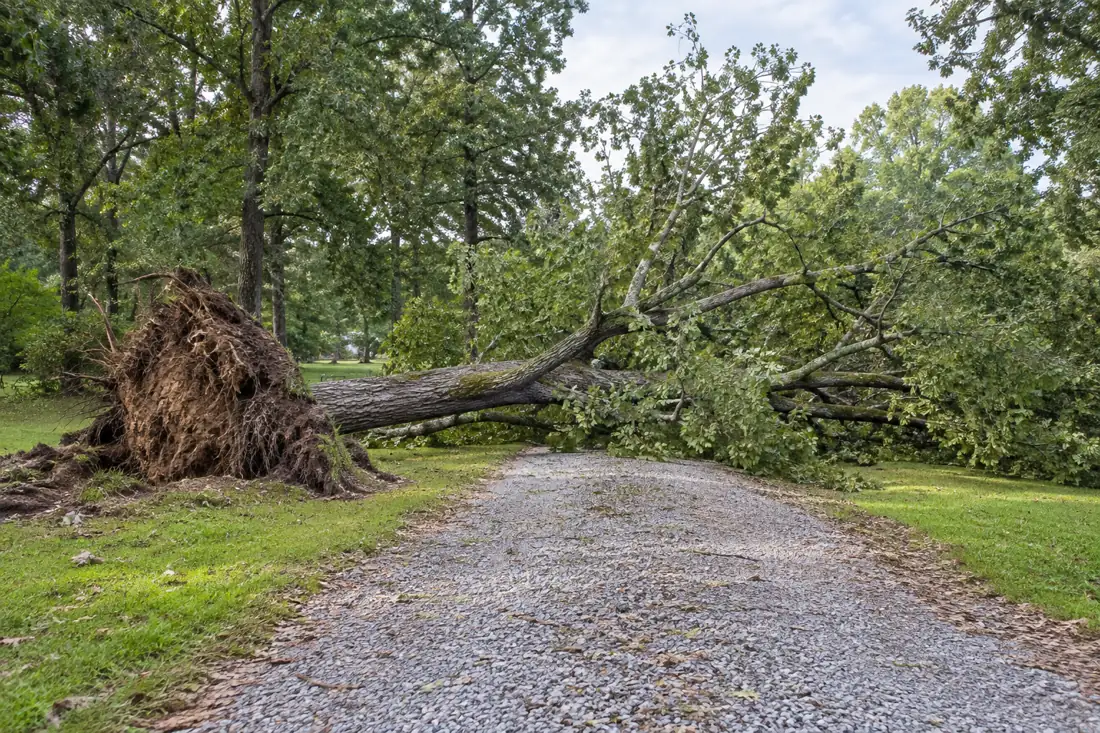
A private road can involve several owners, an association or a designated maintenance contact. Identify who can authorize work, which access must remain available and where debris may be staged. If utilities or public road connections are affected, additional coordination may be needed. A clear responsibility boundary matters before clearing begins.
Private-road storm response by access priority
Determine whether the road is the only exit and where emergency vehicles can turn. Photograph both approaches from safe locations, noting branches, overhead lines and places machinery can stage.
Assign closure authority and resident notifications before cutting. Clearing a controlled driving path can be a distinct phase from removing every remaining trunk section or hauling all debris.
Record shoulder condition, drainage, bridge or weight limits, fences and landscaping before equipment enters. Confirm the final agreed route is usable and list any work left for a later phase.
A fallen tree across a private lane can affect several households, deliveries or emergency response. First keep drivers and pedestrians away from wires and unstable trunks. Confirm who controls the road and which property owners or association representatives can authorize access before directing a crew. Look beyond the blocked point: overhead limbs, soft shoulders, drainage ditches and turn-around space may affect how vehicles and equipment can enter and leave. Temporary passage must not force traffic beneath branches that have not been assessed.
Provide the estimator with road width, available approaches, known gates, culverts and any weight or surface restrictions. Discuss whether the first phase is limited to opening a safe lane and which additional tree removal or hauling belongs in a later phase. Agree where large logs can be placed so they do not roll into ditches or block drainage. Communicate the reopening decision only after the responsible parties inspect the route and confirm the agreed work, not simply because a path appears visible from the street.
Storm Tree Work on a Private Road: Start With the Road and the Hazard
After a southeast Louisiana storm, first establish what is actually blocked and what remains unstable. From a safe location, note the road name or entrance, the nearest address, whether vehicles can pass, and whether trees or limbs are touching wires, leaning over the traveled way, or hanging above homes. Photograph conditions only if you can do so without entering the hazard area. Wind, saturated soil, and hidden cracks can make a standing tree unpredictable; apparent calm is not evidence that it is safe to approach.
Separate urgent life-safety needs from work that can wait for daylight and a proper assessment. A branch across a driveway may be inconvenient; a tree blocking the only route for an ambulance, or a trunk resting on a house, needs a different response. Call emergency services for an immediate threat to people, and report electrical hazards to the utility. Do not move a suspended limb, drive under it, or ask residents to clear it. Record who reported the condition and what access is affected.

Confirm Who Can Authorize Work on the Private Road
A road used by several households is not automatically public, and a gate or maintenance arrangement does not by itself show who may approve tree work. Check the deed, recorded servitude or access agreement, subdivision documents, and any association or maintenance agreement. In Louisiana, an access servitude can grant use without giving every user authority to alter neighboring property. Identify the road owner, the party responsible for maintenance, and any landowners whose trees or work area lie beyond the road boundary.
Before dispatching a crew, obtain written approval from the person or entity with authority over the road and confirm how adjoining owners will be contacted. If ownership is disputed, boundaries are unclear, or a tree stands on another parcel, pause non-emergency work until the relevant parties resolve permission.
Ask the contractor to describe the proposed work area and access route so authorization is specific, not assumed. Keep a record of approvals, scope changes, and decisions; that record helps prevent a safety response from becoming a property dispute.
Private-lane obstruction: confirm ownership, drainage and access
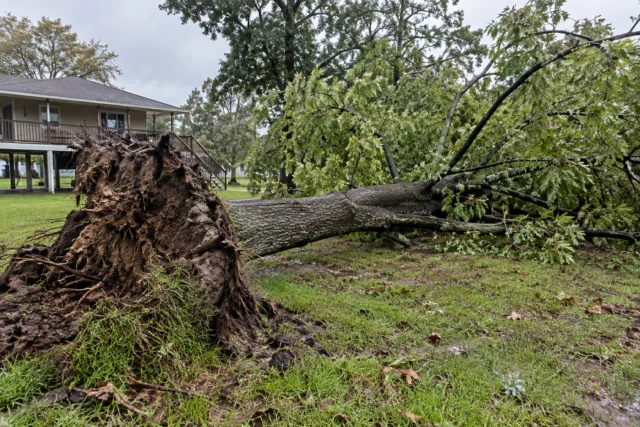
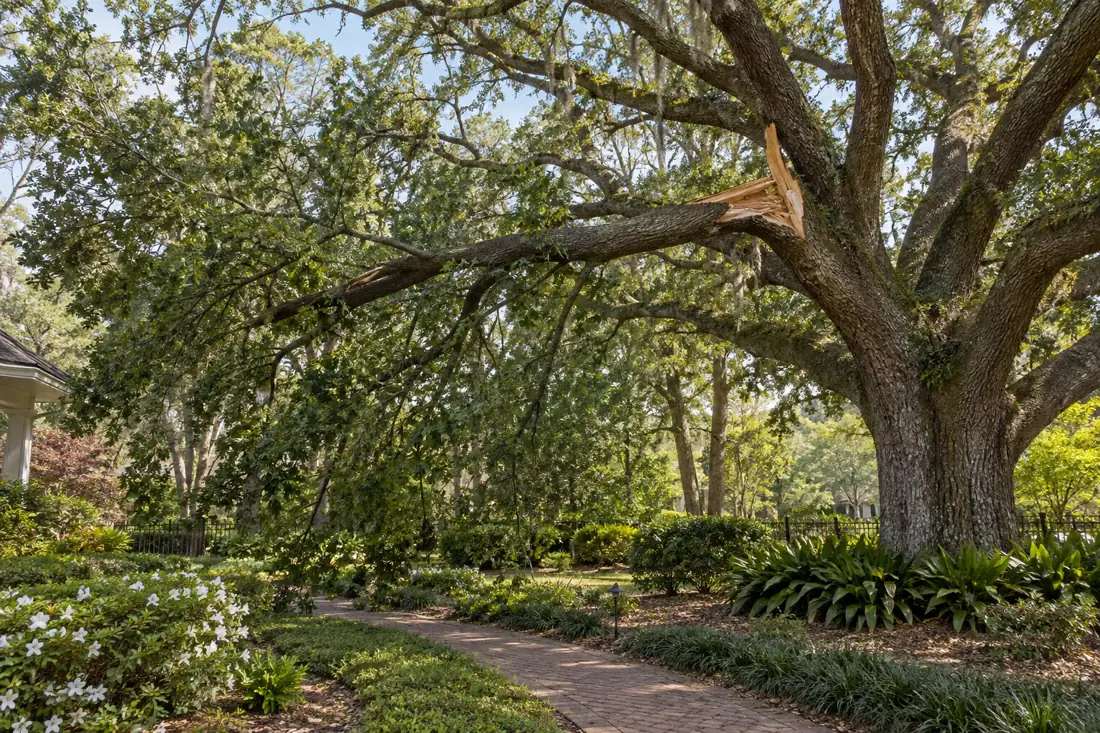
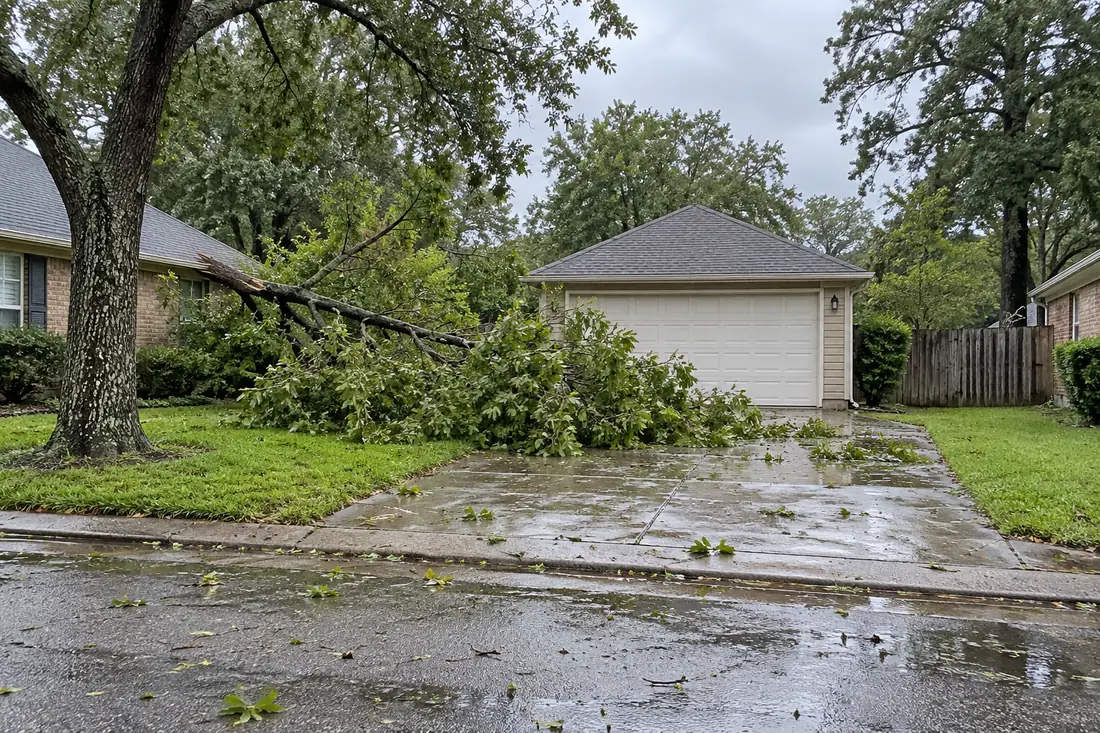
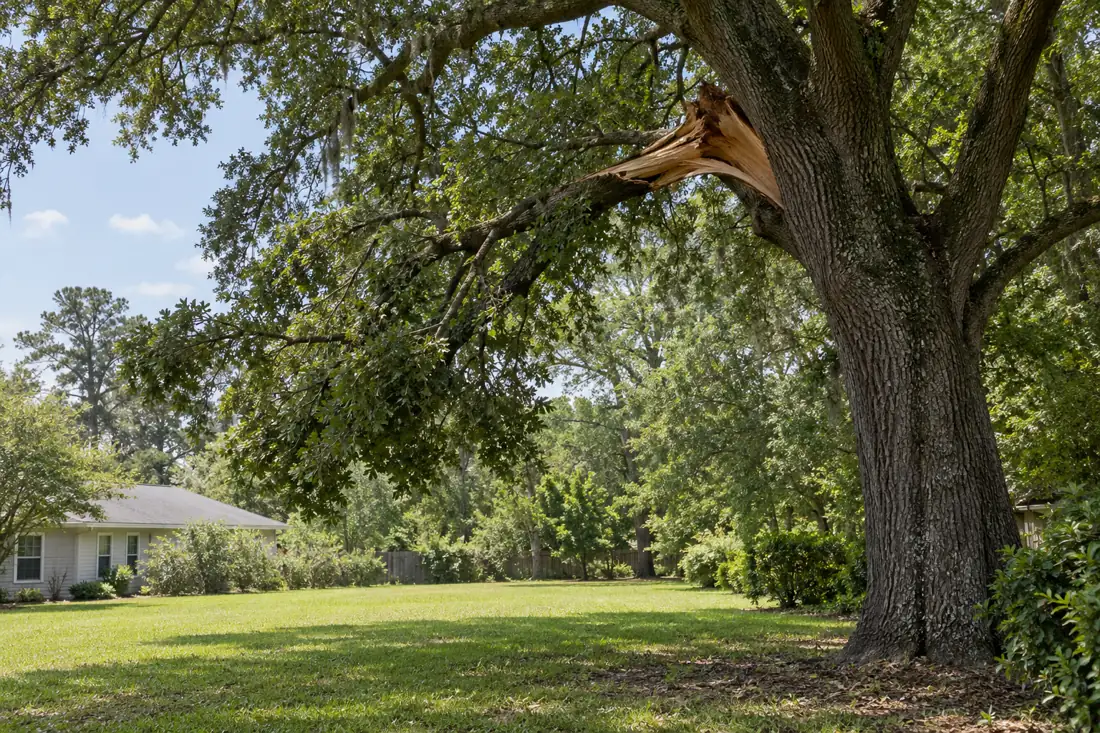
An illustration of a roadside limb does not show the actual legal boundary, whether a ditch is load-bearing or who maintains a shared private lane. Describe which driveway or address is affected, whether the branch is on the travel surface or still suspended above it, and what access emergency vehicles or residents need. From a safe location, a wider image can show the whole obstruction and the nearest turn-around. Do not try to drive under a hanging limb or pull it aside with a vehicle.
The written discussion should distinguish immediate obstruction removal from further pruning, ditch repair, culvert protection and material disposal. Identify the owner, association or other person authorized to approve work; a nearby resident's report may not establish that authority. Equipment placement near a wet shoulder can create more damage than the branch itself, so ask how the crew will protect road edges and how the lane will be reopened. The educational photographs are not proof of any real completed private-road job.
Confirm ownership and the route that must remain passable
For a private road, identify the owner, association or easement holder who can approve work and advise residents of restrictions. Map the fallen tree against driveway entrances, ditches, culverts, overhead wires and any location where responders must pass. Roadside soils may be saturated and shoulders may not support heavy equipment, so ask for an access and staging review before assuming trucks can reach the trunk.
If one lane can reopen before full hauling, the scope should distinguish controlled access restoration from complete removal. Do not cut around a suspect energized line or move a trunk that supports another hazard. Record the reopening decision, residual obstructions and the party responsible for pavement, drainage or fence repairs.
Set an Emergency-Access Plan Before Crews Arrive
Determine whether the private road is the sole route for fire, ambulance, or sheriff access, and identify pinch points where a blocked lane would isolate homes. Share the entrance location, gate instructions, road surface, low branches, and known obstructions with dispatchers or responders when needed. Do not promise that a contractor can restore passage by a particular time. If the road is impassable, tell affected residents to use emergency services rather than attempting to drive around a fallen tree or through a flooded shoulder.

Treat Every Overhead Line as Energized
Storm debris can conceal service drops, communication cables, and downed conductors among branches. Treat every line as energized, including a wire that appears slack, insulated, or disconnected. Keep residents, vehicles, and tree crews away from the area; do not touch a tree, fence, puddle, or vehicle that may be in contact with a line. Report the location to the serving utility and follow its instructions. If a wire is down or sparking, call emergency services as appropriate and keep others well back.
Before tree work near overhead services begins, ask the utility and the qualified tree-work lead to establish who will assess the hazard, arrange any required utility response, and decide when work can proceed. A tree contractor should not be asked to move or cut a limb that is bearing on a line unless the appropriate utility coordination and qualified personnel are in place.
Identify service drops to individual homes as well as lines above the road. Do not treat a verbal guess about a cable’s function or status as clearance.
Confirm route authority and the last safe access before clearing begins. A private road may be maintained by an association, several owners or a separate road servitude, so the person who calls about a fallen tree may not be authorized to approve work over the entire route. Identify the road steward and any emergency-access contacts before assigning responsibility for traffic control or moving equipment. Request safe photographs from both ends of the obstruction, including culverts, soft shoulders, nearby poles, gates and the space needed to turn a truck around. A crew should not be directed to drive onto a saturated shoulder or over a buried drain merely to reach the fallen trunk. Discuss whether access can be reopened in a narrow first phase and whether full timber hauling will need a separate scheduled visit after the surface stabilizes. Clarify which residents must receive notice, who will keep the route closed during cutting and who will confirm the final travel width. Preserve these decisions in the project record rather than treating clearing as proof that the road structure is undamaged.
Private roads: confirm authority and shared access before mobilizing
A fallen tree across a private lane may affect several households, deliveries, waste pickup and emergency access even though the obstruction sits next to one parcel. Determine whether a homeowners association, road maintenance agreement or individual owner controls the affected segment. A contractor cannot resolve property or easement disputes through an estimate.
Identify the lawful work-authorization contact and whether adjacent landowners must grant access for equipment or debris staging. Never ask residents to crawl under a trunk or drive around hanging branches; mark the closure until a responsible party confirms reopening.
Ask for a measured route plan that includes lane width, bridge or culvert limits if known, overhead lines, turning space and where trucks can load without blocking the only exit. Distinguish the minimum controlled clearance from full tree removal, log hauling and shoulder restoration. Rain-softened road edges and hidden drainage structures may limit equipment options.
Where a public road connection or utility is affected, coordinate with the proper authorities rather than assuming private-road ownership covers every access point. Record what part of the road is clear, who accepted the finish and which repairs remain.
Ask the response lead to preserve a usable corridor whenever conditions allow, while keeping people out of the tree’s fall zone and away from equipment. A narrow opening is not necessarily safe for a fire engine, and a cleared path may still have overhead hazards or unstable limbs.
Confirm the required vehicle type and turning space with local responders rather than guessing. If safe access cannot be maintained during the work, agree on a temporary closure, an alternate route if one exists, and a clear method for notifying emergency services.
Map Tight Curves, Soft Shoulders, and Turning Limits
Private roads in the region often have sharp bends, narrow bridges, ditches, soft shoulders, or limited room to turn around. Walk or inspect the route only where safe, noting gate width, overhead clearance, pavement edges, drainage crossings, and places where a truck could meet another vehicle. A loaded log truck, bucket truck, and emergency vehicle do not maneuver alike. Photos from both directions and measured clear widths can help a contractor assess access without sending heavy equipment onto a fragile road.
Ask the contractor what equipment is proposed, where it will stage, and how it will enter, turn, and leave without blocking homes or damaging shoulders. Confirm whether a spotter, traffic control, or temporary one-way movement is needed, and decide where residents can wait safely. Do not let a crew improvise a turnaround on a lawn, culvert, or neighboring parcel without permission. If the equipment cannot reach the hazard safely, discuss a smaller machine, a different staging point, or a revised scope instead of forcing access.

Establish the Right-of-Way and Work Limits
A road edge is not always the legal right-of-way boundary, and vegetation visible from the road may belong to an adjoining owner. Review available surveys, plats, deeds, servitudes, and maintenance agreements before defining the work strip. Marking a guessed boundary with paint does not create permission. Consider whether branches overhang the road, the trunk is outside the road corridor, or access for equipment would cross private land. Those distinctions can affect who must consent and what work is appropriate.
Have the person authorizing the job identify the permitted work limits on a plan, map, or accompanied site walk, with adjoining owners involved where their property may be entered or altered. Ask the contractor to flag any tree whose ownership or boundary position is uncertain before cutting.
Clarify whether the scope includes only debris obstructing passage or also hazardous trees that may fall later. Keep an agreed record of limits and exceptions; stopping for clarification is preferable to cutting beyond authority, even when the road is urgent.
Confirm authority and emergency access on a blocked private road
A private road may serve several owners under an easement or association agreement. Determine who can authorize removing a tree that crosses a shared roadway, and whether emergency vehicles have any unaffected alternate approach. The urgency of a blocked exit does not erase power-line clearance or property permission requirements. Describe where the trunk rests and who is affected without walking beneath broken limbs to measure it.
The complete arrival route matters more than the visible opening at the fallen tree. Mark bridges, low branches, sharp turns, shallow culverts, narrow shoulders and posted load limits. Soft grass can conceal a ditch or septic feature and may not support a loaded truck. Do not tell residents to drive around the obstruction on an unassessed embankment. Professional equipment placement must account for the road and the ground underneath it.

Check culverts, load-bearing shoulders and shared easements
Specify whether the first goal is controlled pedestrian access, safe vehicle passage after appropriate checks, full tree removal or complete debris disposal. A partly opened lane may still have unstable branches overhead or hidden wood in the shoulder. Utility conductors and damaged poles require utility coordination. Identify who manages warning barriers and communicates a real restriction to the other households rather than assuming a tree-cutting appointment automatically reopens the road.
Write down responsibility for authorization, cleanup, retained logs, ditch restoration and surface repair. Photograph the road and drain from safe positions before work so later rutting or blocked flow can be compared. Closeout should verify the agreed traffic clearance and that no remaining branches block driveways, culverts or emergency access. Record any hazards still pending professional evaluation rather than declaring the route safe by appearance alone.
Check Culverts and Drainage Before Moving Heavy Loads
A storm-blocked culvert can look like a simple pile of branches while water is backing up beneath the road. Note standing water, erosion, a sunken shoulder, exposed pipe, or a fast-moving ditch from a safe position. Heavy equipment on a saturated road edge can worsen a washout or collapse a crossing, cutting off access after the visible tree is removed.
Do not enter floodwater to inspect a pipe or pull debris. Report drainage concerns to the road manager and, where relevant, the property owner responsible for the crossing.
Ask the tree contractor to identify equipment routes that avoid questionable crossings and to stop if the road base shifts or water conditions change. Tree removal and culvert repair may need separate scopes, permits, or specialists; do not assume that clearing branches restores drainage capacity.
Agree who will inspect the crossing after debris is removed and what condition requires a road closure or further evaluation. If water is flowing over the roadway or the shoulder is undermined, keep traffic away until a qualified road or drainage professional assesses it.

Choose a Work Sequence That Controls Exposure
A useful scope separates immediate access work from later hazard reduction and cosmetic trimming. The sequence may begin with utility coordination, followed by removal of debris that can be handled without entering an unstable tree’s fall zone, then work on standing damaged trees. The actual order depends on site conditions and the crew’s assessment. Ask which hazards remain after each stage, what areas must stay closed, and how weather, saturated ground, or additional line hazards could change the plan.
Confirm that the people doing tree work are qualified for the specific conditions, including suspended limbs, storm-damaged trees, or work near services, and ask how the crew will communicate stop-work decisions. Do not select a contractor solely because they can arrive first, and do not direct residents to cut or pull material.
Have the responsible owner approve any change in scope, equipment access, or property entry. A practical decision may be to clear a safe passage first and schedule more complex work only after utilities and access conditions are addressed.
Plan Logging, Debris Handling, and Safe Reopening
Storm work can create heavy logs, tangled brush, and broken pieces that obstruct ditches or hide nails and sharp splinters. Before work begins, decide where material may be staged, whether any wood is to remain for the landowner, and who will remove brush and chips. Do not allow debris to be pushed into a culvert, wetland, neighbor’s yard, or road shoulder without permission. Clarify how the contractor will separate usable logs from waste and keep the travel lane clear during loading.
A cleared surface is not automatically ready for traffic. Have the work lead check for hanging branches, hidden fragments, equipment tracks, damaged pavement, and debris that could roll or wash into the road. Keep people and vehicles out while saws, loaders, or suspended loads are active, and reopen only when the responsible site lead confirms the work zone is clear and no known hazard remains within the agreed scope.
This is not a guarantee that every tree is safe; communicate any remaining concern and arrange a separate assessment.

Reopen Deliberately and Keep Residents Informed
Before reopening, the road owner or designated manager should make a deliberate check of the route, including entrances, curves, crossings, and any temporary staging area. Confirm that signs or barriers are removed only when safe, emergency vehicles can pass as intended, and residents know whether access is limited to one direction or vehicle type. If a utility hazard or unstable tree remains, keep the affected area closed and state the reason plainly. Record the reopening decision, the person responsible, and any conditions that still apply.
Send residents concise updates before work, when access changes, and when the road is reopened or remains restricted. Include the work window if known, the location of closures, a contact for road questions, and instructions not to approach crews or move debris. Avoid promising an exact completion time when weather, utility response, or hidden damage can alter the schedule.
Afterward, invite reports of missed debris, drainage problems, or new movement, while directing residents not to investigate hazards themselves. Review what went well and update the road’s contact and emergency-access information.
For a private lane, identify legal authority and physical capacity
A narrow private road can be a shared easement, individually owned access drive or association-maintained lane. Establish which party may authorize tree work and whether adjacent owners need notice before machinery enters. From outside any hanging-wood zone, show the length of the obstruction and the nearest safe turn-around. Photographs cannot establish road bearing capacity or right-of-way boundaries. A grassy shoulder may conceal a ditch or culvert that cannot safely support a loaded truck.
Ask the contractor to describe how essential residents and emergency vehicles will be accommodated during the work, where logs will be loaded and how the road surface will be protected. If a blocked lane also affects drainage, keep ditch and culvert restoration in the written scope rather than treating them as incidental cleanup. A road can appear clear in a photo while damaged shoulders, hanging limbs or a blocked gate still make it unsafe to reopen.
Site-specific information to include with your request
- Confirm the access owner or association and the authorized signer before booking the removal.
- Show gates, culverts, low wires and the safe equipment approach on a simple property sketch.
- Agree on traffic coordination, finish condition and the person who accepts road reopening.
Private-road photos that clarify both access directions
Storm work on a private road affects more than the visible branch. A contractor needs to know who controls the road, whether people can enter or exit, and where equipment can stage without blocking emergency access. Never stand in moving traffic to photograph debris.
- From a safe shoulder, capture the obstructed segment and nearest identifiable intersection or turn.
- If a second direction can be photographed safely, show the other approach rather than assuming the road loops.
- Use zoom for visible tree damage and note whether the source tree stands on adjoining property.
- Identify the association, owner or manager authorized to close the road and approve work.
Explain any emergency access limitation directly to the relevant authority. A request should separate clearing one travel lane, complete tree removal, hauling and later pavement or shoulder repair. Keep traffic and pedestrians away from unstable wood.
Questions about this project
Can the crew block a public sidewalk or road?
Required arrangements must be coordinated with the appropriate authority. Identify public routes and restrictions before scheduling. A private work agreement should not be treated as automatic permission to occupy or close public space.
When should parked vehicles be moved?
Set the timing and responsible contact before the work window. Vehicles may need to leave the tree zone, equipment route and loading area. Confirm where access must remain available during each phase.
Can the contractor use my neighbor's yard?
Only after the required permission and suitable access arrangements are in place. Identify the proposed route and who can authorize it. A quote accepted by one owner does not automatically grant access to someone else's land.
Does a tree estimate determine the property boundary?
No. Resolve an uncertain boundary or ownership question using appropriate property information and professionals. The tree contractor needs an authorized scope and access plan, but a visual work estimate is not a survey or legal determination.
How should extra work be approved?
Use the agreed approval process and identify the change, reason, scope, price or schedule effect as applicable. Confirm who has authority before treating an additional tree or task as part of the original job.
What completion records are useful?
Keep the agreed scope, tree or area identification, authorized changes, invoice and labeled photos where appropriate. Include unresolved items and a contact. Contract-specific records should follow the buyer's stated requirements.
How should several storm-damaged trees be described?
Use marked photos or a simple tree list showing locations, affected targets and access problems. Identify urgent routes or buildings separately from later cleanup. The contractor can then discuss assessment and a practical work sequence.
Can restoration be handled in phases?
Yes, when the parties agree on clear scopes. Initial hazard or access work, planned removal, hauling and building or landscape repairs may involve different stages and providers. Record the responsibilities and completion requirements for each.
What should I compare besides the price?
Compare tree identification, work objectives, access assumptions, hauling, stump treatment, site finish and exclusions. Ask whether permits or other coordination are part of the scope and who can approve changes if conditions differ.
Does an online request book the crew?
No. A request starts the estimate conversation. The company still needs to discuss scope, availability and any site assessment. For a dangerous or urgent condition, call 504-458-8336 rather than relying on a form response.
What should I tell Tree Huggers about storm tree work on a private road?
Explain the property address, the work you want and the specific concerns: road authority, emergency access, debris staging. Send safe photos of the tree, surroundings and access route. The contractor can then discuss the assessment and scope needed for this situation.
How do I request an estimate for this work?
Call 504-458-8336, text photos or use the estimate form on this page. Include the address, desired outcome and any timing constraints. The company will need to review scope and availability; an online request does not confirm a price, appointment or emergency dispatch.
Get a scope for your property
For a private road, clarify who controls the road and who can authorize closure, removal and debris staging before scheduling work. Mark the blocked segment, nearby houses, delivery routes, fire access and any trees still under tension. Safe photos from both approaches are more useful than close-ups taken beneath suspended limbs.
The scope should distinguish cutting a route open from fully removing and hauling material, explain access for residents during work and identify responsibility for road-surface protection. Where multiple owners or an association are involved, request a single written approval contact and document any separate restoration work.