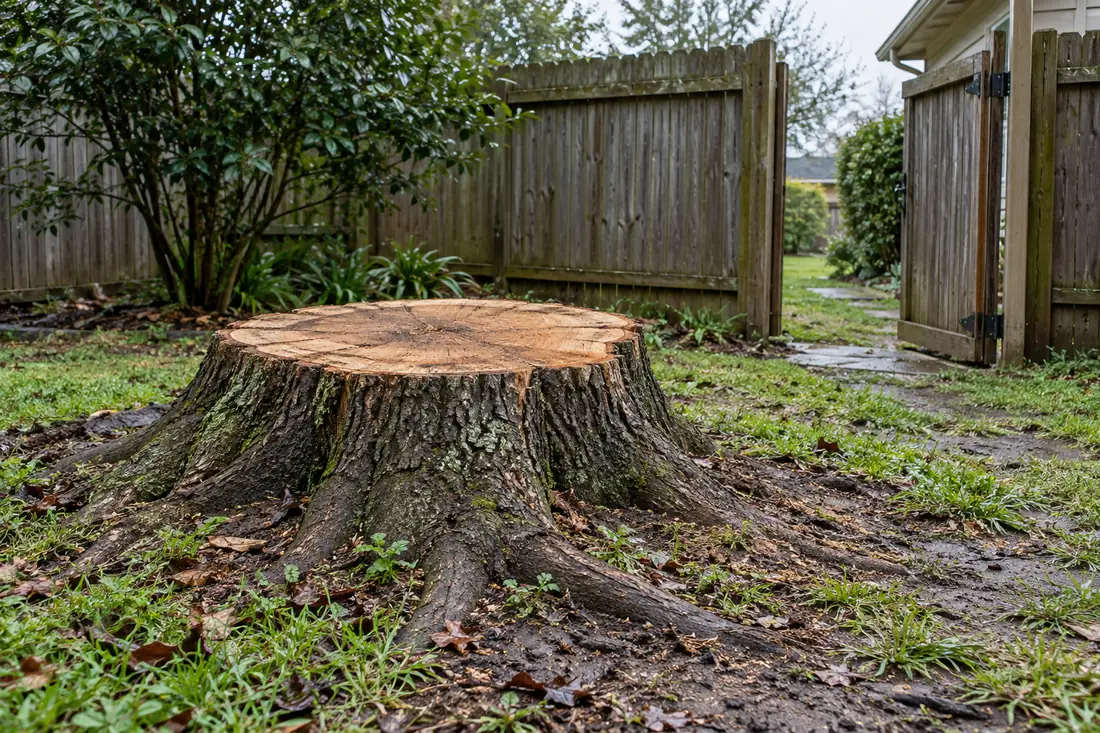
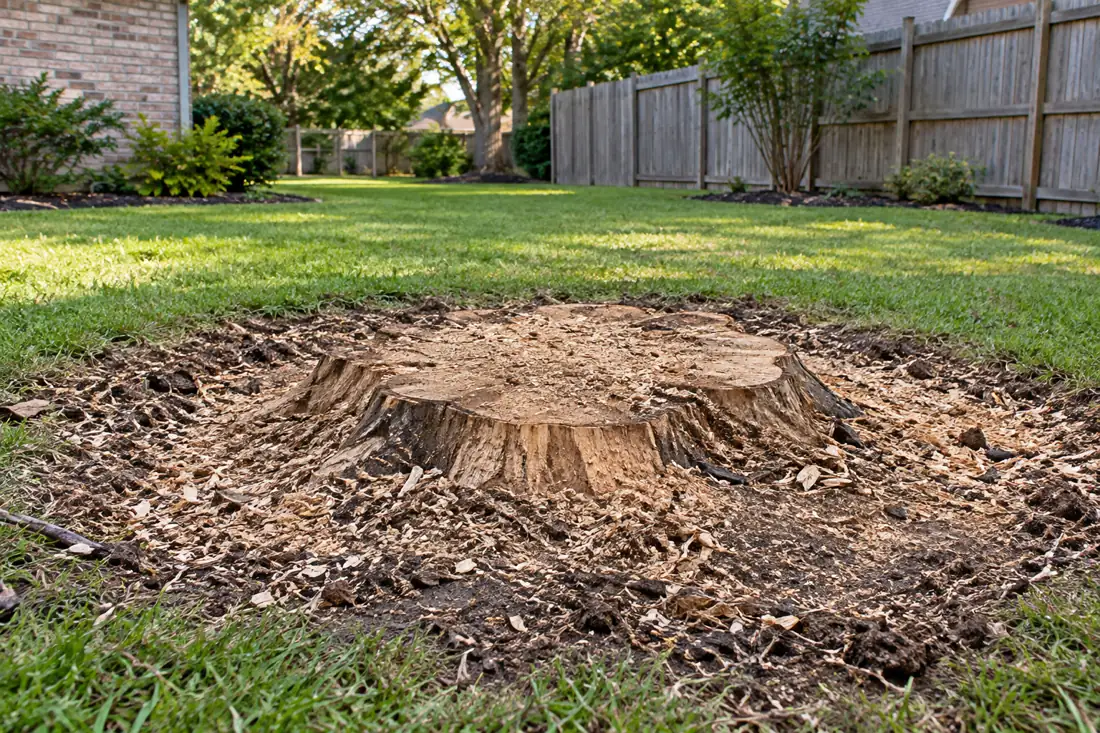
A planting plan should be discussed before selecting the grinding depth and finish. The old stump, remaining roots, chips and soil preparation affect the new planting area. Ask what the grinding contractor will provide and what the landscape installer will handle. A ground stump is not automatically a prepared planting bed.
What a finished stump-grinding surface does not prove
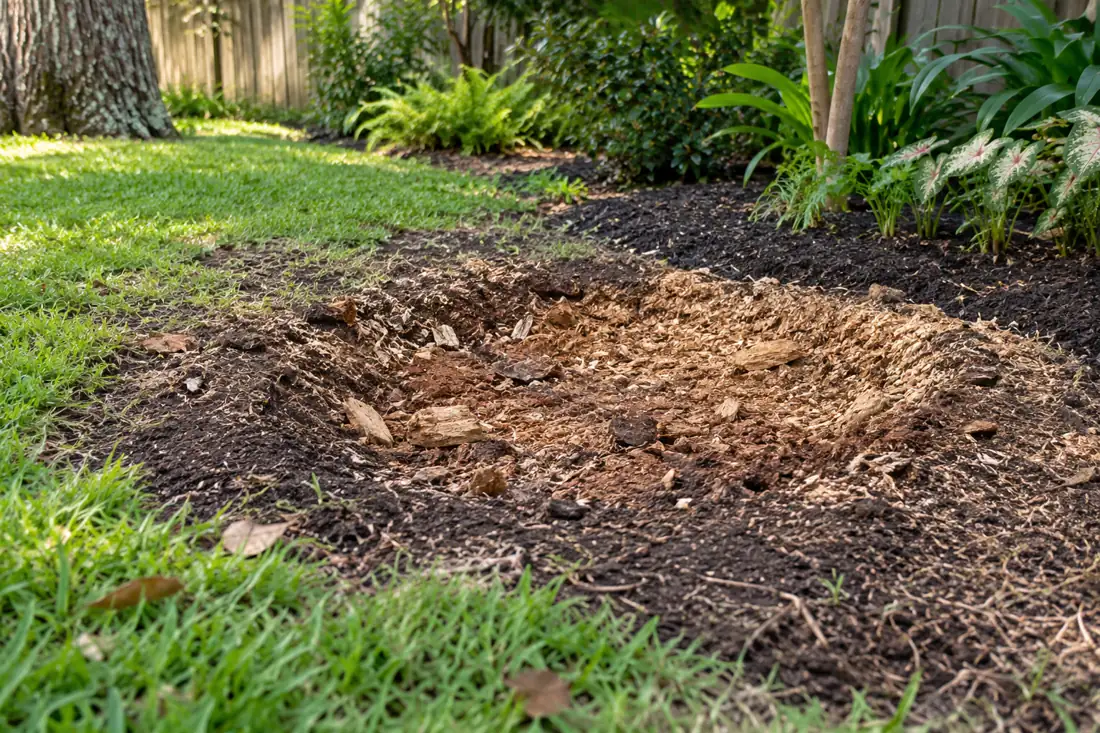
An apparently level patch after stump grinding may still contain shredded wood mixed into soil, lateral roots and a changing void as organic material settles. The educational diagram below shows the difference between removing the accessible stump and preparing a separate place for a new tree. It is a concept drawing, not a documented Tree Huggers job or an exact required grinding depth.
Before ordering a replacement tree, agree who will assess rooting space, buried utilities, drainage, chip disposal and soil suitability. A planting contractor may recommend a position away from the former trunk footprint. Document the grinding contractor’s finish separately from the landscaper’s soil preparation and planting responsibilities.

Hand the planting contractor a clear soil-preparation boundary
A stump grinder may leave shallow wood fragments, chips and lateral roots in a wide area beyond the visible former trunk. If the goal is a replacement tree, agree on the proposed species and mature planting space before deciding where the planting hole belongs. The new tree may be better located away from the old root mass, nearby utilities or poor drainage.
Separately list stump reduction, removal of excess grindings, soil evaluation, replacement fill and planting. Photographs of a smooth surface after grinding cannot establish that the ground has suitable aeration or rooting volume. The planting professional should confirm readiness before a new tree is purchased.
Start with a marked replacement-tree location, not an assumption that the old stump cavity will become the new planting hole. Grinding reduces accessible wood but usually leaves lateral roots and concentrated chips that can settle or complicate soil preparation. Ask a planting professional to assess light, mature canopy clearance, drainage, soil structure and utility conflicts before selecting the location.
Record the old stump footprint separately from the proposed planting circle, along with chip removal, finished grade and planting-soil responsibilities. A shifted planting location is a design decision, not proof that grinding was incomplete. Request separate completion photographs for stump reduction and planting preparation; illustrative images are not evidence of completed customer jobs.
A new tree is not the same finish as a new lawn
A replacement tree needs a planting location selected for its mature canopy, root space, utilities, sunlight and soil drainage. The old stump location can contain remaining lateral roots and concentrated wood chips even when the visible wood has been ground down. That means placing a new sapling directly over the old cavity may be inappropriate, while moving the planting point does not by itself indicate inadequate grinding. Consult the planting professional on species and site suitability before assuming a depth will solve the landscape design.
Ask for a handoff that distinguishes accessible stump reduction, excess-chip removal, soil amendment or replacement, and the planting contractor's own excavation and establishment plan. A sod installer instead needs a reasonably uniform soil bed and grade across a larger surface. These two endpoints create different scope requirements; documenting them separately avoids a situation where the grinding crew and landscape installer each assume the other will finish the same soil preparation. For the related but distinct decision, see Stump Grinding Before New Sod.


Understand what grinding leaves underground
A stump grinder removes accessible wood in the area reached by its cutting wheel. It does not excavate the entire root system, remove all decaying wood or create a uniform soil profile. Large lateral roots may remain beneath the lawn while the surface appears clear. This matters when planning a new planting hole, because buried roots and chips can alter how easily the soil can be worked.
Ask what depth can be achieved safely and whether any surface roots are in scope. The answer may change when utilities, nearby paving or other living trees limit access. Do not treat a ground-down stump as a structural excavation or as proof the root system is gone. Where a new plant needs an unobstructed root zone, discuss location and soil preparation with the person responsible for the planting.
Separate stump work from the new tree's planting specification. Ask the landscape installer to identify the new tree's actual planting position and required soil conditions before the grinding scope is finalized. The grinder may reduce the stump, but woody chips, decaying roots and an old root flare still affect drainage and settlement. If a new planting hole must be offset from the old center, mark it separately; do not imply that a flush mulch-and-chip surface is ready to receive a tree. Clarify who removes grindings, provides appropriate soil and checks the final grade.
Replanting begins with the next tree's needs
Identify the proposed species and planting location before deciding what a stump quote must include. The new tree may need different spacing, soil conditions or a shifted location rather than a hole directly over the old stump. Photograph the future planting area, nearby roots, shade, paving and overhead constraints and ask the landscape designer to confirm the planting plan.
Clarify which materials are to be removed after grinding and who will provide suitable soil and assess drainage. Woody chips and large remaining roots can affect excavation and backfill choices. A stump-grinding visit does not by itself certify a planting pit, tree selection or establishment plan; coordinate those details with the installer.
Learn what roots can remain underground after the visible stump is ground.
Decide what the new planting actually needs
Removing an old stump and planting a replacement tree are related projects, but they are not the same operation. Before discussing grinding depth, choose whether the space will hold another tree, a shrub bed or turf. A replacement tree needs enough suitable soil volume for its species and mature size, not merely a hole that matches the old trunk. The desired planting location may be beside rather than directly over the original stump.
Share the proposed plant type and approximate planting footprint with the grinding contractor or landscape professional. If those details are undecided, be candid about that uncertainty. It is usually more useful to request a stump-reduction scope that preserves future options than to promise a planting pit of unknown dimensions. A landscape professional can help evaluate species suitability, available space and long-term root conflicts.

Agree on the finish before a replacement tree is ordered
Ask the grinder to identify the wood-reduction area and expected finished grade, then ask the landscape installer to mark the proposed planting hole on that same plan. A level patch of chips does not prove buried roots or decomposing wood have disappeared. Confirm that loose grindings will not be substituted for planting soil and that the young tree’s root flare will not be buried beneath the finished surface.
Write down who removes excess chips, who supplies planting soil, who checks drainage and nearby utilities, and who chooses the final planting location. If another living tree is close, exposed roots may belong to the tree being kept. Do not assume all visible roots can be removed. Each contractor should understand where the other professional’s work begins and ends.
Take a safe overview photo after the grinding area is cleared and note any depth or equipment-access limits. Pass that information to the person installing the replacement. Moving a planting site away from the previous stump may avoid concentrated woody debris and is a separate landscaping decision, not evidence that grinding work failed.
Choose a replacement location thoughtfully
Planting directly in the center of an old stump cavity can concentrate loose chips, decomposing roots and inconsistent soil around a young plant. In many landscapes, shifting the new tree a suitable distance from the old location may provide better growing conditions. That decision depends on space, desired canopy, drainage, utilities, property boundaries and the mature spread of the species.
For an evidence-based starting point, Iowa State University Extension advises choosing a new planting site when possible. Its guidance recommends locating a replacement tree at least three feet from the old site, and ideally six to eight feet away, because remaining roots and ground wood can complicate establishment. These are planning distances, not a site-specific clearance rule: underground utilities, property boundaries, mature tree size, soil drainage and the actual remaining root zone must still determine where a professional recommends planting.
A new tree placed farther away still needs clearance from buildings, overhead wires and underground services as it grows. Do not use the old trunk position as evidence that the site is appropriate for a replacement of the same size. Map where its crown and root zone are likely to expand over decades. A healthy planting plan considers mature form rather than only how the nursery container looks today.

Decide where the replacement tree belongs before filling the old stump hole
Start by identifying why the first tree was removed and whether that condition affects the replacement location. If decay, chronic soil saturation, repeated utility conflicts or insufficient growing space contributed to the removal, replanting immediately in the same footprint may recreate the problem. Record sun exposure at the site, mature canopy clearance, nearby foundations and overhead lines. A replacement species should be selected for its eventual size and site needs, not simply because a small nursery container fits the old stump opening.
Grinding reduces the central stump but can leave significant wood, roots and fresh chips mixed into the soil. Ask the contractor what depth and diameter are feasible and whether chips will be taken away. A large quantity of decomposing wood can settle and change soil conditions, so an apparent planting hole is not automatically prepared for a tree.
Have the planting professional assess soil texture, drainage and compaction before prescribing additions. Avoid adding fertilizer or lime solely because a stump used to occupy the area; use a soil test when an amendment decision needs evidence.
Compare the center of the old stump with adjacent locations where unaltered soil may be available. Planting to one side can avoid buried woody material and give the replacement tree better room to develop, but an offset must still respect utilities, pedestrian paths and future canopy reach.
Sketch an approximate planting circle and check root flare depth against the finished grade. The planting crew should not bury the new root flare to match a settling chip-filled depression. Select a location based on the future tree, not a convenient hole.
Document the handoff between grinding, soil preparation and planting. The grinding proposal should state debris disposal and backfill limits; the planting proposal should specify species, planting depth, mulch placement, initial watering and establishment monitoring. A tree surviving its first week does not establish that it was planted correctly, and no contractor can guarantee growth without appropriate ongoing care. Keep before and after site photos, species identification and irrigation notes together so the owner can understand the sequence if settlement or decline appears later.

Remove excess chips before preparing soil
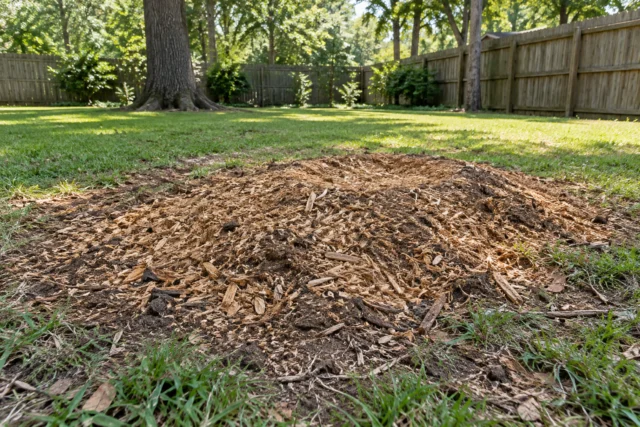
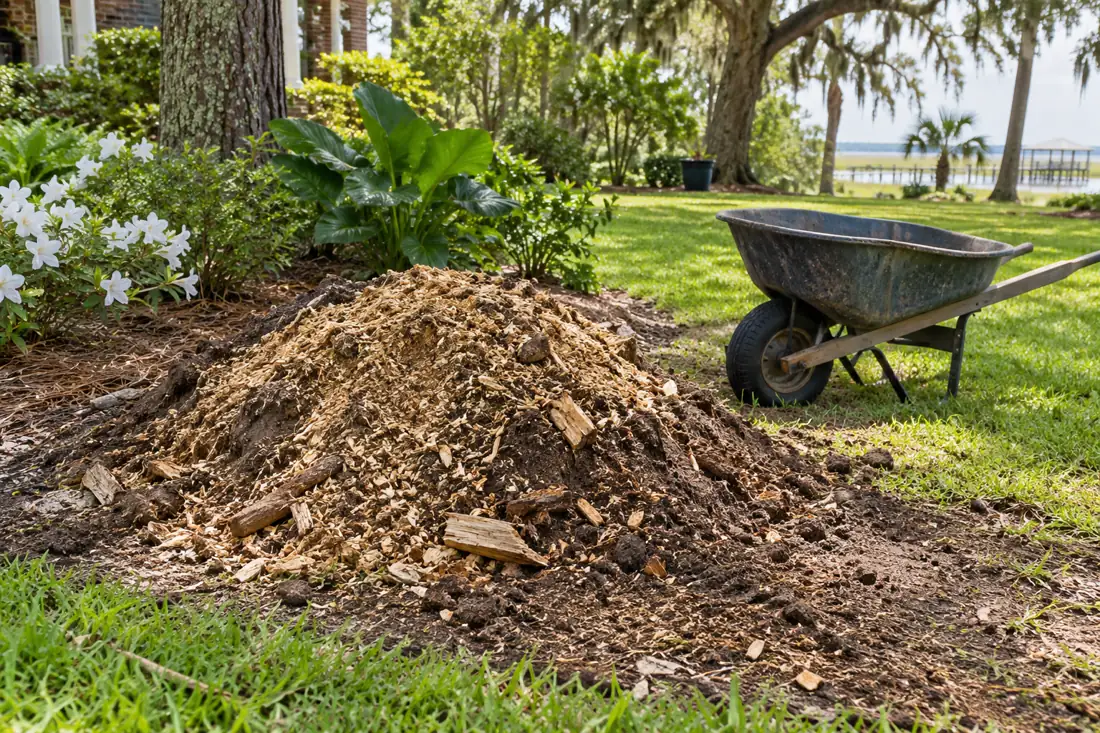
Grinding mixes wood fragments with dirt, and the resulting material can form a surprisingly large mound. A limited quantity may be useful as surface mulch elsewhere, but concentrated chips in a new planting hole are not equivalent to mineral soil. As they break down, the ground can settle and nutrient availability may change. Discuss whether excess chips will be hauled away or separated before the planting crew arrives.
Keep the future planting area free of thick, unblended wood debris and avoid burying the trunk flare of a new tree. The landscaper should determine appropriate backfill and grade from the actual soil conditions rather than relying on an automatic topsoil or fertilizer recipe. If the owner wants chips retained, agree on a location that will not bury drainage openings or the root collars of neighboring plants.

Specify what a future planting contractor needs after grinding
Grinding the old stump and preparing a new planting location are related but different tasks. Ask for the agreed treatment depth and horizontal footprint, whether the operator will leave chips or remove excess wood debris, and what material will fill any depression. Replanting into a large pocket of uncomposted chips can create settlement and moisture problems, so the next contractor needs to examine soil structure and remaining buried wood rather than assume a flat surface means the site is ready. The new tree's species, mature size, drainage requirements and root space should guide placement.
Before ordering a replacement tree, identify nearby active roots, irrigation lines, utilities, pavement, future drainage work and the extent of the old root network. The new planting spot may be offset from the old trunk rather than centered on its exact location. If the intent is only lawn restoration, a different finish may be appropriate. Write down the handoff between grinding, chip management, backfill, grading and planting so separate trades do not make conflicting assumptions or promise that every old root has been removed.
The finished grinding surface is not finished planting soil
A properly discussed stump-grinding finish should identify the surface left behind, not just the equipment used. The remaining area may look level while still containing loose wood particles, old roots and pockets that settle later. Before choosing a replacement tree position, inspect the actual ground-level grind zone, understand what material will remain and ask whether chip removal or backfill belongs in the requested scope.
A shallow patch of wood chips is not the same thing as a cleared planting hole. Buried wood can affect settlement and the physical space available for new roots. The most useful project photographs show the finished grade relative to nearby turf and the edges of the disturbed area.
Plan replanting as a separate decision after the stump is ground. A new tree may need a different location because of remaining roots, buried utilities, soil conditions or mature canopy clearance. Ask where a planting hole could realistically fit without treating the former stump center as automatically suitable.
If soil replacement or haul-away is required, make that explicit in the estimate rather than assuming grinding includes landscaping restoration. Afterward, avoid piling loose grindings high against nearby tree trunks, and watch for sinking as the area settles. Tree Huggers can discuss the requested grinding limits and site-access constraints; decisions about species, spacing and suitability should reflect the actual property.
Inspect drainage and soil structure
The old tree may have stood in a dry raised bed, compacted lawn or low area that collects water after rain. Those conditions matter more for a replacement tree than the apparent absence of the old stump. Observe whether water puddles after a storm and whether adjacent paving directs runoff into the spot. A planting plan should consider aeration, drainage, compaction and available soil depth.
A grinder's travel route can also leave tracks in damp ground, so soil evaluation should happen after the work area is cleaned up. Avoid treating a single surface photograph as proof that a site drains properly. Where persistent wetness or compaction is suspected, a qualified landscape professional can assess the cause before recommending species or amendments. A new tree cannot compensate for an unsuitable root environment simply because the old stump was reduced.

Protect nearby trees and their roots
Another tree may have roots passing through the planned grinding zone, particularly where canopies overlap or old planting beds are close together. Do not assume every exposed root belongs to the removed tree. If a living tree is close, ask how the grinding footprint will be limited to avoid unnecessary injury to its structural roots. A retaining wall or root flare can further constrain the accessible cutting area.
Avoid trenching through roots or automatically removing every woody obstacle before replanting. Some roots may belong to retained trees that need separate protection. A tree-care assessment can help determine whether the proposed new planting or grinding approach conflicts with those trees. The goal is not to make the soil visually spotless at the expense of existing mature canopy.
Coordinate utilities and future irrigation
Garden irrigation and landscape lighting may be installed before or after stump grinding, and the sequence can change how many lines are at risk. Identify valves, spray heads, private wiring, nearby gas or water service and any proposed new irrigation route. Marked public utilities do not necessarily include private sprinkler tubing. Locate systems appropriately before any cutting near suspected underground infrastructure.
If a new tree will need watering, plan a safe route for irrigation without putting new lines in the grinding path. It may be sensible to complete stump work before fresh pipe installation or sod, but the exact sequence should be set with the landscaper and the site constraints. Avoid guessing buried line locations from the direction a hose or meter appears to run.

Build a realistic project sequence
A dependable sequence starts with evaluating the old stump, access and utilities; continues through agreed grinding and chip cleanup; and then moves to soil preparation, planting and aftercare. These stages may involve separate professionals and different site requirements. Confirm who owns each step in writing. The tree contractor should not be assumed to supply nursery stock, irrigation design, soil testing or ongoing tree establishment unless those services are expressly included.
Allow for the possibility that site conditions revealed during grinding will change the planting plan. Buried concrete, large remaining roots or poor subsoil can justify moving the intended tree rather than forcing a root ball into an unsuitable hole. A coordinated project preserves flexibility and avoids treating a planting date as more important than selecting an appropriate growing location.
Request a clear grinding and replanting handoff
For an estimate, send the stump width, access measurements, photographs and intended future use. If a replacement species or planting position is already selected, include that information without assuming it dictates the safest grinding depth. Explain whether chip removal and soil preparation are expected from the tree-service crew or a separate landscaper. The proposal should identify the area to be reduced and any visible roots included.
After the work, record what was ground, what material remains and whether utility or access limits prevented a deeper cut. Pass that information to the planting professional. No online guide can guarantee that the existing soil will support a particular species or that grinding will eliminate future settling. A thoughtful handoff gives the replacement tree the best chance of being planted into conditions actually evaluated on site.

Plan early care for the replacement
After a new tree is planted, success depends on appropriate watering, a stable root-ball position, suitable mulch placement and attention during establishment. Those activities are not accomplished by grinding the previous stump. Ask the planting professional for instructions tailored to the species, soil and season. Avoid piling chips from the old stump against the new trunk or treating concentrated wood debris as a complete planting medium.
Check the area periodically for settling where the old roots and grindings remain. A depression may require carefully added soil, but avoid burying the root flare of the new tree while leveling. If persistent wetness, instability or poor growth appears, investigate the site conditions rather than guessing that every symptom comes from the old stump. A separate planting plan protects the investment made after the tree-service work.
Replanting Starts With the Soil, Not a Finished-Looking Hole
Grinding reduces a stump to chips and smaller fragments; it does not automatically remove the entire root network or restore the ground to suitable planting soil. Old woody material can continue breaking down and settling. If the site will support a new tree, ask how deeply the intended location will be prepared, what material will be removed or retained, and who will inspect soil structure and drainage.
Planting directly into a concentrated pocket of fresh wood chips is not equivalent to preparing a stable rooting area. A new tree may also need a different location to avoid existing roots, utilities or compacted soil.
The tree-work quote should distinguish grinding depth, chip haul-away, soil replacement, finish grade and the separate planting specification. The correct depth and species depend on the property and future use; do not infer them from a generic photo or guarantee that a tree can be installed in precisely the former stump footprint. Ask the landscape or arborist professional who will plant the tree to confirm site suitability and any required settling or remediation before equipment arrives.
- Mark the proposed new tree position and known underground services before stump work.
- Describe whether chipped wood stays, is hauled away or is replaced with suitable soil.
- Require a separate planting decision based on soil, species, drainage and site constraints.
The replacement tree needs a planting decision, not just stump disappearance
When grinding precedes replanting, the future tree’s location and rooting environment should be reviewed before the grinder arrives. The center of an old stump can retain large roots, woody residues and disturbed soil that may not be suitable for a new planting hole. Grinding the visible wood does not establish an adequate planting volume, a healthy soil profile or long-term drainage. A landscape or qualified tree-care professional should help determine whether to shift the planting location and how to prepare it.
Ask separately who removes concentrated chips, who replaces or amends soil when appropriate, and who evaluates grade and drainage before planting. Do not describe a patch of loose chips or an intact stump as a completed grinding finish. This replanting guide addresses biological site readiness; the sod-preparation guide addresses a level turf installation and has different acceptance criteria. If the planting design calls for excavation beyond an agreed stump-grinding envelope, identify that as a separate scope instead of quietly assuming grinding accomplishes it.
- Sketch the proposed new tree’s mature spacing from structures and existing roots.
- Document wood-chip handling and remaining old-root obstructions.
- Agree which provider accepts the planting hole, soil condition and final grade.
For the related but different decision, see Stump Grinding Before New Sod. Confirm the work required for this property before relying on a general example.
Questions about this project
Can I plant a replacement tree in the exact stump location?
Sometimes a nearby location is more suitable. The remaining roots, soil, space for future growth and proposed species must be assessed before deciding. Grinding alone does not create a finished planting hole, so involve the person responsible for planting.
Are fresh wood chips suitable as planting soil?
Do not treat a pile of grindings as finished planting soil. Ask who removes or redistributes chips and who prepares the planting medium to the installer’s requirements. The finish should be agreed before the landscape work is scheduled.
Does cleanup include every root and wood chip?
That depends on the written scope. Tree removal, stump grinding, chip hauling and root excavation are different tasks. Ask what material is removed, what remains and whether soil or landscape restoration is separately included.
What should a final walk-through check?
Compare the identified trees and tasks with the agreement. Check agreed debris handling, stump treatment, access openings and any listed restoration. Record unresolved items clearly instead of relying on a general impression that the property looks finished.
Is leaving the trunk untouched enough to protect a tree?
No. Roots, soil conditions and nearby work can matter even when the trunk is not cut. Identify retained trees before planning access, excavation and storage, and ask what site-specific protection is appropriate.
Can pruning undo construction-related root damage?
Do not assume it can. Share the work history and ask for an assessment of the current tree and site. Pruning, monitoring or other recommendations should address an identified need rather than substitute for protection planning.
When should tree work be discussed on a building project?
As early as practical, while the footprint, access, excavation and staging can still be coordinated. Identify retained trees and share drawings before clearing or other site activity creates avoidable conflicts.
Does stump grinding complete construction site preparation?
Not necessarily. Excavation, root removal, base preparation, compaction and grading may require separate work and acceptance criteria. Coordinate the tree scope with the contractor responsible for the next construction phase.
What should I compare besides the price?
Compare tree identification, work objectives, access assumptions, hauling, stump treatment, site finish and exclusions. Ask whether permits or other coordination are part of the scope and who can approve changes if conditions differ.
Does an online request book the crew?
No. A request starts the estimate conversation. The company still needs to discuss scope, availability and any site assessment. For a dangerous or urgent condition, call 504-458-8336 rather than relying on a form response.
What should I tell Tree Huggers about stump grinding before replanting?
Explain the property address, the work you want and the specific concerns: planting footprint, remaining chips, soil preparation. Send safe photos of the tree, surroundings and access route. The contractor can then discuss the assessment and scope needed for this situation.
How do I request an estimate for this work?
Call 504-458-8336, text photos or use the estimate form on this page. Include the address, desired outcome and any timing constraints. The company will need to review scope and availability; an online request does not confirm a price, appointment or emergency dispatch.
Get a scope for your property
Replanting after stump grinding calls for two related but distinct plans: reducing the old stump and preparing a biologically suitable place for a new tree. Include the former tree's size, the proposed planting location, nearby pavement and any reason the new tree must occupy exactly the same footprint.
Photograph the old stump, surrounding soil and available planting space without digging into unidentified services. Explain whether the previous tree showed disease, root failure or unusual decay; that history may change how the planting site should be evaluated.
Ask what grinding depth and footprint are proposed, how residual wood and chips will be handled, and who assesses drainage, soil quality and adequate rooting volume for the replacement. Grinding does not remove every old root and should not be represented as complete soil restoration.
A planting specialist may recommend shifting the new tree or preparing a broader area rather than placing it directly into fresh wood chips. The written scope should say whether backfill, soil amendments, tree selection, planting and later establishment care are included or separate.
A new tree needs rooting space, not merely a ground-down stump
A smooth finish from a grinder can still conceal remaining lateral roots, wood chips and soil that will settle. A new planting hole needs adequate rooting volume, drainage and an appropriate location for the mature tree; it should not automatically be placed in the old stump cavity. Discuss replacement selection and soil evaluation with a planting professional before specifying the grinder finish.
The new-sod preparation guide focuses on turf-grade restoration and chip management; the concrete preparation guide explains why a slab foundation requires its own excavation and subgrade acceptance. Neither process substitutes for a biological planting-site assessment.