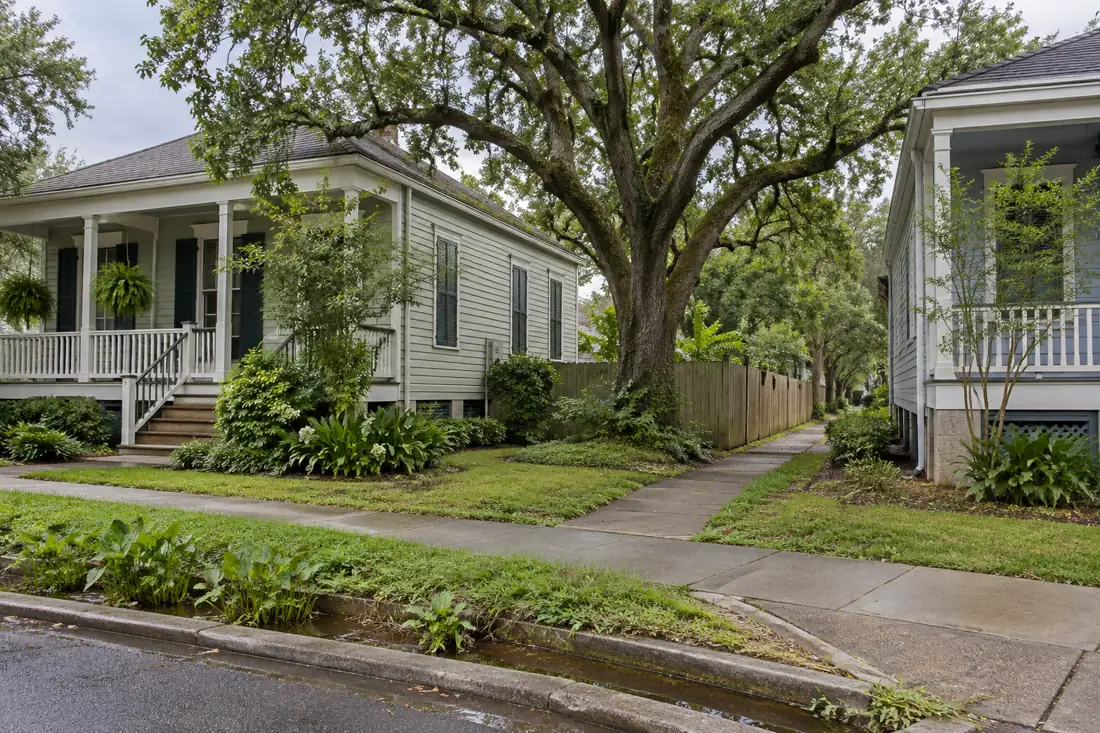
A sidewalk can place pedestrians and public infrastructure beside a private tree project. Confirm ownership, access requirements and any applicable approvals through the appropriate authority. The contractor needs a practical work-zone and loading plan. The estimate should identify which tree work and cleanup are included without implying control over all public property.
Site-specific planning checkpoint: Tree work beside a New Orleans sidewalk requires a plan for people who are not part of the tree project. Identify the tree’s location relative to the curb, sidewalk and property line, plus any utility poles, signs, accessible ramps or transit stops. Confirm ownership and any public-tree permits with the relevant authority. Draw the drop zone and material route so pedestrians are not directed beneath branches or across equipment tracks. If a temporary sidewalk closure or detour is necessary, ask who is responsible for approved arrangements and accessible passage; a verbal warning may not suffice. Mark existing pavement damage and vulnerable tree roots, and agree on protection before equipment arrives. The estimate should state whether debris removal, temporary barriers, pavement protection and permit coordination are included or handled separately. Preserve a clear record of the approved scope.
An active sidewalk may carry people who have no relationship to the project, including wheelchair users, children and customers entering neighboring buildings.
Identify the sidewalk frontage and actual work limits
A street-side tree in New Orleans can affect the house frontage, a public walking route, the curb and adjacent parking at the same time. Begin by marking the exact tree, the intended pruning or removal objective, and the section of sidewalk people use to pass the property. Include nearby ramps, doors, bus stops, bicycle routes and driveways in the first site photographs. The work area is often larger than the trunk's immediate footprint.
Confirm which areas the property owner controls and which may be subject to city, utility or other right-of-way authority. Do not assume a sidewalk tree is privately owned because its roots cross a private lawn. Permit or notification requirements depend on location and work details, so responsible parties should check the current applicable process before a crew blocks access or starts cutting.
Protect the pedestrian route, not just the tree
An active sidewalk may carry people who have no relationship to the project, including wheelchair users, children and customers entering neighboring buildings. Map curb ramps, crossings, bus stops, storefronts, adjoining gates and overhead limbs before work is priced. Tree ownership and permission to occupy public space must be confirmed separately; an adjacent homeowner may not control either question.
If the cutting or landing zone could affect the walkway or street, ask who will determine required approvals and an appropriate pedestrian-management plan. A homeowner cannot close a public sidewalk simply by giving consent. Do not advertise a detour, traffic control or public-space use as arranged until it is actually authorized.
Request an estimate that identifies the limbs and clearance objective, temporary restrictions, debris handling and the surfaces to protect. Ask customers for overview photographs only from safe positions; a better marketing or estimate photo is never a reason to stand beneath a damaged limb or enter moving traffic.

Keep pedestrians out of the working and drop zones
Falling branches, rigging lines, equipment tails and moving debris can reach well beyond a taped circle around the trunk. A qualified tree crew should define its exclusion zone from the actual work method and keep people out while cutting and lowering occur. On a busy street, this may require controlled pedestrian routing and a designated person to watch approaches rather than relying on a handwritten sign.
A temporary walking route must be evaluated for accessibility and the ability to stay out of traffic. Simply directing wheelchair users, parents with strollers or people with limited mobility into the street is not an acceptable default. If a safe alternative cannot be maintained, coordinate the necessary approvals or adjust work timing and method. Keep residents informed without promising that a public route can always remain open.
Check tree ownership and required permissions
Street trees may involve different maintenance responsibilities than trees set well inside a private parcel. Before requesting removal, locate the trunk relative to mapped boundaries and note nearby utility easements. Ask the appropriate local authority about relevant tree and right-of-way rules, especially if the proposed work affects a curb lane, pedestrian path or protected tree. The tree contractor should receive the confirmed scope, not an assumption about permissions.
Keep written approvals and permit conditions with the estimate, and make sure the person hiring the work has authority to act. If the ownership question is unresolved, an assessment or planning visit can proceed without committing to cutting. Avoid beginning work that could create an enforcement issue for a resident, tenant or contractor because one party thought another had already secured consent.

Map overhead service lines and street lighting
A sidewalk tree may have branches near power, communications, street lighting or a service drop to a house. Neither a homeowner nor an unqualified crew should treat these lines as harmless based on their appearance. Record where the conductors and support poles are located, keep clear during the site walk, and have the appropriate utility or qualified line-clearance professional handle work that falls within required electrical clearances.
Trim objectives should describe the needed outcome without dictating unsafe cutting around energized facilities. For example, restoring a pedestrian sight line and addressing a branch above a light fixture may require two different evaluations. Confirm coordination early, because the availability of utility crews or a safe method can affect schedule more than the physical diameter of the limb.
A sidewalk tree decision includes pedestrian access, not just the canopy
When tree work borders a public sidewalk, list the actual walking route, curb ramps, driveways, bicycle movements, tree pits and nearby building entrances. The area beneath a branch can be occupied even when the tree is wholly on private land. The contractor should determine what work boundary is needed and what permissions or pedestrian routing apply; the homeowner should not improvise a public closure with tape.
If roots have lifted paving, record the condition but avoid assuming the tree crew can repair or legally alter public sidewalk slabs.
Define the pedestrian passage before planning any cuts beside a sidewalk
A tree adjacent to a public sidewalk can affect walkers, strollers, wheelchairs, bicycles and drivers entering a nearby driveway. An overhead branch can be a clearance issue without the tree requiring full removal, while lifted pavement can have several possible causes that a tree crew cannot establish from a photograph.
Record where the tree stands, the sidewalk width, curb and street, and the specific obstruction or visible change. Do not enter traffic or step into an unstable root area for a better photo. A tree contractor does not automatically have permission to close public passage or alter public pavement.
Ask the proper city or parish authority who controls the planting strip, tree and right-of-way; responsibilities vary and a private owner should not assume the answer. A work plan should explain how pedestrians will be routed if passage must be interrupted, who secures any required approval, and how limbs or wood are controlled over the public area.
Keep tree pruning, removal, root assessment, concrete work and accessibility repairs in separate scopes. If roadside cutting will affect lanes or traffic control, consult the roadside work-limits guide rather than using a generic residential quote as a work-zone plan.
Plan vehicle parking and equipment positioning
On a narrow New Orleans block, equipment can affect delivery access, fire lanes, curb ramps and neighboring driveways. Document parked vehicles, utility boxes, trees and hydrants along both sides of the street. Ask where chip trucks, loaders or trailers could be staged without creating an unsafe turn or forcing debris across active pedestrian routes. A small tree does not automatically mean a small operational footprint.
Any required parking or lane restrictions should be coordinated through the current relevant authority rather than improvised with cones alone. The estimate should explain whether access assumes available legal space or a confirmed closure. Give affected neighbors practical notice once timing is established, but avoid collecting or publishing their personal contact information in public project documentation.

Prepare for Tree Work Beside a Public Sidewalk
A tree beside a New Orleans sidewalk is visible to everyone, but that visibility does not settle who owns it or may authorize work. Begin by documenting the address, tree position relative to the curb and property line, nearby streetlights, and any conflict with walking clearance. An uneven sidewalk might arise from several causes; do not assume removing roots or the tree is the appropriate remedy based only on lifted paving. Keep sidewalk repair and tree-condition assessment as separate technical questions.
If branches need pruning above a public route, the work zone must keep pedestrians away from falling material and active equipment. Do not suggest that walkers squeeze beneath an operation or cross through a temporary debris pile. Ask which party can coordinate required pedestrian detours, barricades or street-space use, and what permissions apply before scheduling. Work done on a private tree can still affect a public right-of-way, so the practical limits need to be confirmed rather than guessed.

Distinguish the tree zone from the pedestrian route
Map nearby overhead service lines, curb drains, parking spots, accessible paths, doorways and the flow of local business or residential activity. A truck parked along the curb may block a sightline or refuse collection even when the driveway is unaffected. Discuss a realistic loading route and the amount of branch material that can be removed immediately. Protect storm-drain openings from chips and keep ramps and crossing points unobstructed whenever they are not part of an approved closure.
The proposal should state which tree and limbs are included, the planned access footprint, who obtains any required approvals and how the sidewalk will be left. It should not represent tree trimming as a guaranteed fix for pavement heave or make unsupported statements about city responsibility. If the work involves roots near a public tree or infrastructure, request appropriate evaluation first. This gives the owner and contractor a practical way to avoid treating a complicated frontage as ordinary backyard pruning.
Inspect roots and sidewalk displacement separately
Raised concrete near a tree may indicate growing roots, settled subgrade, past construction or a combination of causes. A surface crack alone does not tell the whole story or establish that removal is necessary. Photograph the root flare, visible roots, displaced slabs and drainage conditions from safe standing positions, and ask a qualified professional to evaluate the tree when its stability or retention is in question.
Do not cut major roots or excavate under the sidewalk just to make a surface look level. The property owner may need a paving or municipal assessment alongside tree guidance. A coordinated plan can identify what is tree pruning, what is sidewalk repair and what belongs to another trade, with each contractor responsible for its portion rather than a vague promise to fix everything.
Protect storefronts, fences and nearby windows
Street-side work often sits close to porches, balconies, fences, parked cars and ground-floor windows. Before cutting, record each target area and discuss how the crew will lower or carry material away from it. Check for low awnings and signs that are not obvious from a satellite image. The safest method may depend on rigging geometry, branch condition and the available landing zone.
Move vehicles and small movable items only with appropriate permission. When an immovable structure limits access, the contractor should explain whether specialized equipment, staged cuts or a different approach is needed. These conditions belong in the scope and risk discussion so customers do not discover an access surcharge or changed method only after the crew arrives.

Coordinate work with neighboring activity
A residential block can become busy during school arrivals, deliveries, garbage pickup or community events. Ask the person arranging the work what recurring activity affects the frontage, and note predictable congestion windows without claiming an exact quiet period. The crew can use that information to evaluate schedule options and avoid blocking a sole entrance during an especially sensitive period.
Notify adjoining occupants of anticipated noise and temporary route changes when permission and circumstances allow, while leaving control of the exclusion zone with the qualified contractor. Communication should be factual: what area may be affected, the expected phase of work, and how people can seek an update. Do not promise uninterrupted access if safe cutting requires a closure.
Manage debris without clogging storm drains
Branches, sawdust and chips can move quickly toward curb inlets during a heavy rain. Identify the nearest catch basins before staging piles and avoid placing material on the gutter line or across a ramp. A debris plan should distinguish material chipped on site, pieces loaded directly, larger logs hauled separately and any wood the owner has requested to retain.
At completion, look beyond the tree's original position. Walk the sidewalk, gutter and safe access path for splinters, small branches and equipment residue. If a drain is already blocked by unrelated sediment, document the observation and refer it to the party responsible for drainage maintenance rather than assuming a tree crew should excavate or repair a public inlet.

Close out the project with useful records
A practical closeout package identifies the tree, work performed, any limitations and the condition of the pedestrian route after cleanup. Keep relevant authorizations, written scope changes and photographs of the finished frontage. If roots, sidewalk slabs or nearby utilities need separate evaluation, list those as follow-up items instead of presenting an incomplete situation as completely solved.
Before payment, compare the final outcome to the written estimate: which limbs were addressed, whether stump work was included, how debris was handled and whether temporary access protection was removed. Clear records help property owners plan future maintenance and reduce confusion if the city, a neighboring owner or another contractor later asks what happened along the frontage.
Preserve a usable public pedestrian route throughout the operation
Public sidewalk work should account for wheelchair users, curb ramps, children and sight lines, not merely whether workers can squeeze past a tree. Measure the actual route left open after equipment and barriers are placed. Do not assume a privately owned yard provides an approved public detour. The contractor and appropriate authority must determine any necessary pedestrian controls. Add specific stop-and-reopen points so people are not directed through a falling-limb zone or left with wood chips and tripping debris when a phase finishes.
- Identify ramps, bus stops, corners and driveways near the crew zone.
- Confirm lawful public-space control and an accessible route.
- Keep branch lowering and pedestrian movement separated.
- Inspect the route for loose bark, chips and damaged surfaces before reopening.
Questions about this project
Can the crew block a public sidewalk or road?
Required arrangements must be coordinated with the appropriate authority. Identify public routes and restrictions before scheduling. A private work agreement should not be treated as automatic permission to occupy or close public space.
When should parked vehicles be moved?
Set the timing and responsible contact before the work window. Vehicles may need to leave the tree zone, equipment route and loading area. Confirm where access must remain available during each phase.
How should extra work be approved?
Use the agreed approval process and identify the change, reason, scope, price or schedule effect as applicable. Confirm who has authority before treating an additional tree or task as part of the original job.
What completion records are useful?
Keep the agreed scope, tree or area identification, authorized changes, invoice and labeled photos where appropriate. Include unresolved items and a contact. Contract-specific records should follow the buyer's stated requirements.
Can the contractor use my neighbor's yard?
Only after the required permission and suitable access arrangements are in place. Identify the proposed route and who can authorize it. A quote accepted by one owner does not automatically grant access to someone else's land.
Does a tree estimate determine the property boundary?
No. Resolve an uncertain boundary or ownership question using appropriate property information and professionals. The tree contractor needs an authorized scope and access plan, but a visual work estimate is not a survey or legal determination.
Which property features should I point out?
Identify buildings, vehicles, fences, fixed fixtures, landscape features, utilities and occupied routes. Explain what can move and what must remain. Include existing damage and any buried features you know about along the access route.
Should people remain inside the work area?
The contractor and site contact should establish an exclusion area and access arrangements appropriate to the work. Keep children, pets, visitors and other workers outside the active zone until the responsible parties say it can reopen.
What should I compare besides the price?
Compare tree identification, work objectives, access assumptions, hauling, stump treatment, site finish and exclusions. Ask whether permits or other coordination are part of the scope and who can approve changes if conditions differ.
Does an online request book the crew?
No. A request starts the estimate conversation. The company still needs to discuss scope, availability and any site assessment. For a dangerous or urgent condition, call 504-458-8336 rather than relying on a form response.
What should I tell Tree Huggers about tree work beside a public sidewalk in new orleans?
Explain the property address, the work you want and the specific concerns: pedestrian access, public responsibility, work-zone limits. Send safe photos of the tree, surroundings and access route. The contractor can then discuss the assessment and scope needed for this situation.
How do I request an estimate for this work?
Call 504-458-8336, text photos or use the estimate form on this page. Include the address, desired outcome and any timing constraints. The company will need to review scope and availability; an online request does not confirm a price, appointment or emergency dispatch.
Get a scope for your property
Send safe street-level photos of the tree, full sidewalk width, curb, overhead utilities and any known access or permission documents.