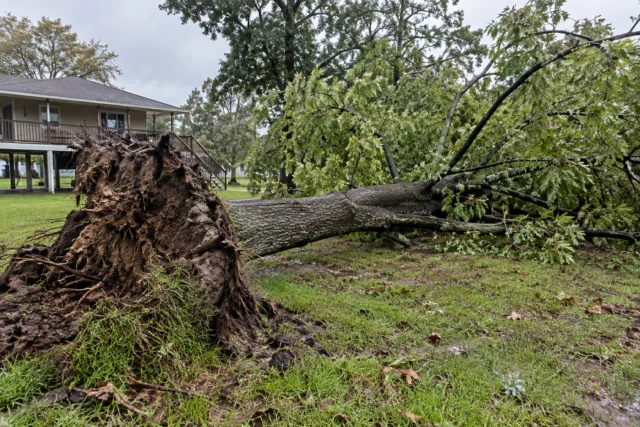
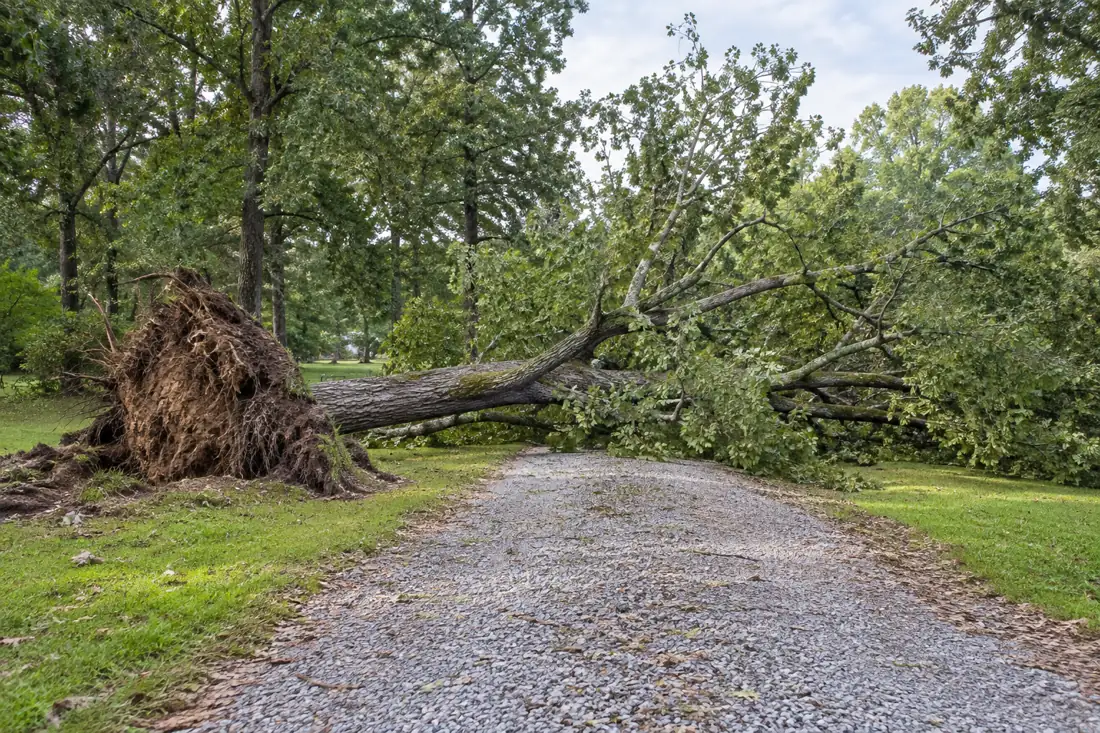
Fresh soil movement and a changed lean deserve attention even if the canopy still looks green. Keep clear of the tree and describe what changed and when. The root plate, surrounding soil and nearby targets require assessment; photos cannot establish stability. Avoid trying to pull the tree upright or cutting roots to make it easier to move.
How to interpret a lifted root plate without approaching it
A partially uprooted tree may still have portions of its roots holding in the soil while other roots and an attached mass of turf and earth have lifted. The drawing below exaggerates separation so the relationships are readable: it is not a photograph, a measurement of actual root depth or a substitute for a site assessment. A crack in saturated ground can extend beyond the area visible above the surface.
Observe from outside the potential fall area. Record the direction of a new lean, whether soil rose against the trunk and whether the condition changed after rain or wind. Do not step into the cavity, push earth back against the roots or cut supporting wood. A professional assessment must determine the condition and practical response.

Distinguish lifted root soil from ordinary ground irregularity
For a newly leaning tree, the critical evidence is a change at the connection between roots and ground. From a safe viewpoint, look for a fresh crescent-shaped crack, uplifted sod attached to roots or a void next to the base; these differ from an old exposed root running across a stable lawn. Never stand on the raised plate, tamp it down or cut roots to see deeper.
Report when the lean changed, whether there was wind or prolonged rain and which occupied places lie in the possible fall direction. Green foliage is not proof of adequate root anchorage. A qualified assessment should address immediate exclusion, support and possible removal without relying on a generated illustration as site evidence.
After heavy rain, saturated soil can lose some of its ability to resist root movement. If a formerly upright tree begins leaning or the ground heaves near its base, do not push the trunk back, pull on roots or dig around the root plate. Observe from a safe distance and keep people, pets and vehicles outside the possible fall area while a qualified professional evaluates the situation.
Photograph the canopy, trunk angle, any fresh soil crack and the lifted ground from a place that does not require walking under the tree. Note when movement was first noticed and whether recent wind, excavation or drainage change may have contributed.
Ask the assessor to distinguish the tree's current structural support from the longer-term health of its roots. The evaluation may consider root plate movement, soil saturation, crown loading, defects and nearby buildings or service lines. Stabilization, monitoring, pruning and removal are different options, and none should be chosen solely because a single root is visible.
For a tree touching wires or a structure, involve the appropriate utility or emergency authority before ordinary tree work. Do not represent an illustrative photograph as evidence of a real Tree Huggers job. Any site-specific repair recommendation should say what was observed, what remains uncertain and what must happen before occupants return to the affected area.

Partially Uprooted Tree After Heavy Rain
A tree that has started to tip after heavy rain is not simply leaning; its anchorage may have changed. In southeast Louisiana, prolonged rain can saturate clayey or compacted soils, weaken the ground around roots, and allow a root plate to lift. A tree may remain upright for hours or days while its support is compromised. Treat a new lean, raised soil, or exposed roots as a serious warning, even if the trunk and crown still look healthy.
First, move people and pets away from the tree and keep vehicles out of its likely fall area. Do not walk beneath the canopy to inspect the trunk, pull on branches, or try to push the tree upright. If the tree threatens a home, occupied building, road, or other essential access, move people to a safer location and contact qualified help promptly. A calm appearance is not proof of stability, and further rain or wind can change the situation.

Read the Ground From a Safe Location
Observe from indoors, from well outside the tree’s apparent fall area, or from another location protected by a substantial barrier. Look for a fresh mound or crack in the soil on the side opposite the lean, a depression near the trunk, or roots newly visible above ground. These changes can show that the root plate has shifted. Compare the tree with older photographs only if you can do so without approaching; an old lean alone does not explain fresh ground movement.
Note whether the lean is new or has increased, whether the trunk has split, and whether large limbs are hanging or newly broken. Record observations with a phone from a safe position rather than circling the tree. Do not enter a fenced area, walk under suspended limbs, or stand where the tree could fall while taking pictures. Share the location and observations with the responding arborist or emergency service so they can plan an appropriate assessment.
Record new soil movement without entering a fall zone
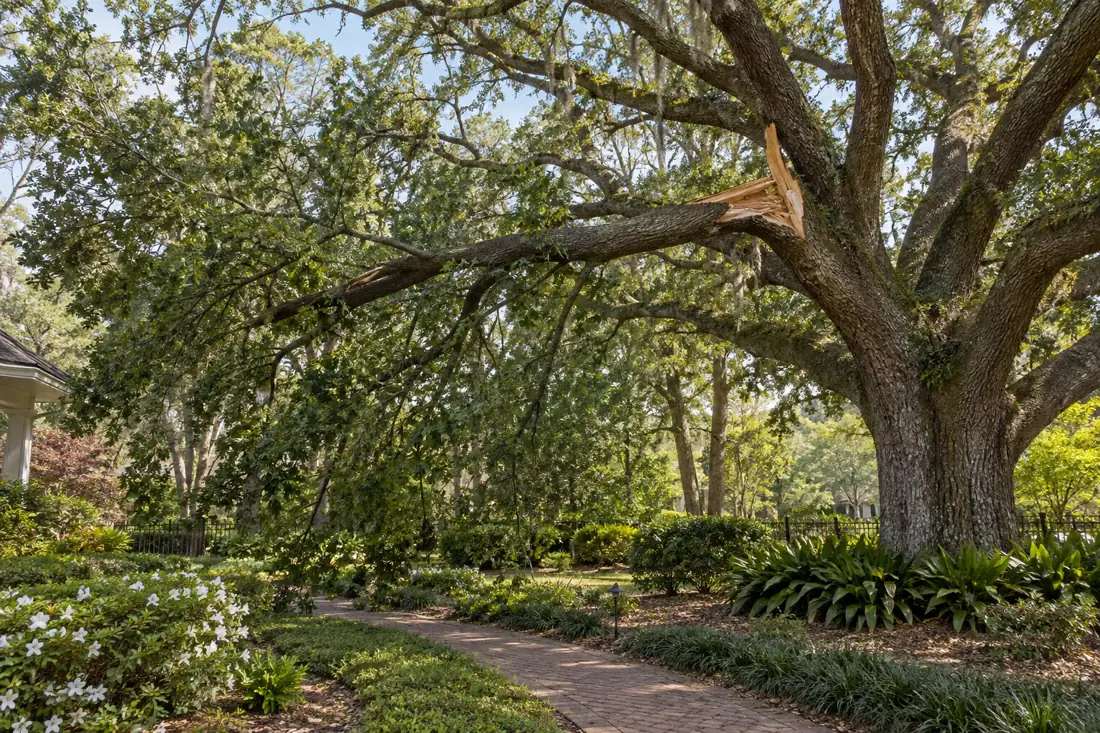
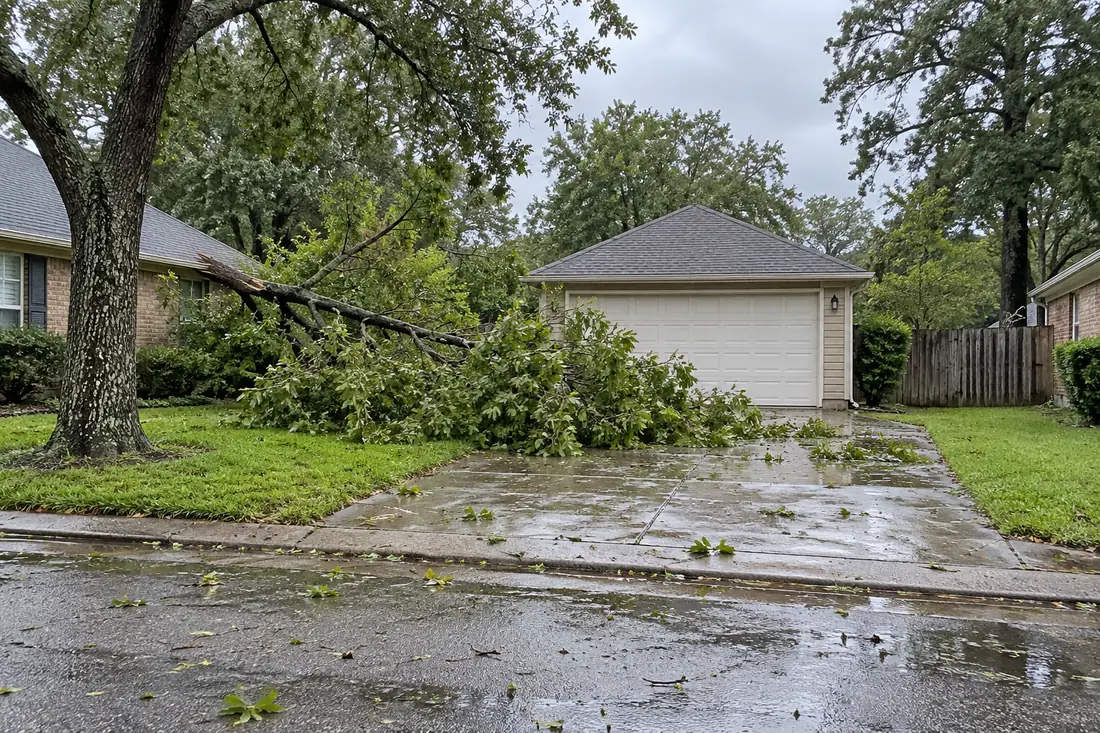
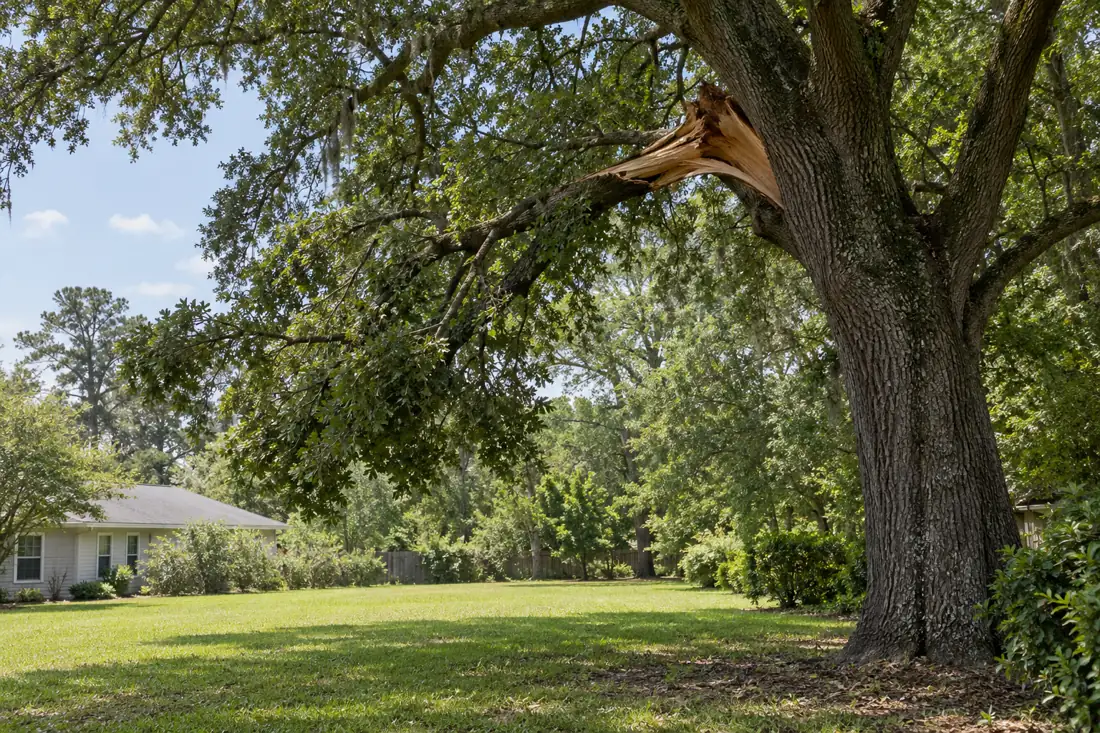
The illustrative leaning-tree photographs do not by themselves show or prove a lifted root plate. What matters in an actual report is the change: an edge of turf newly lifted, a soil crack that appeared after rainfall, visible roots in a new opening or a trunk position that differs from an older picture.
Describe the date and whether nearby paths, vehicles or buildings would be exposed if the tree moved. Only use comparison photographs taken from a location outside the likely fall zone; never walk around the root plate for measurements.
Photographs cannot establish remaining anchorage. Saturated soil, a long-standing lean and sudden root rotation require different interpretations, and the crown can remain green despite serious movement below. Keep the affected area clear and ask for qualified on-site assessment of the tree, soil and nearby targets. When requesting a scope, say whether the concern is a newly changing condition or an older observation, and avoid specifying that roots should be cut, braced or pushed back into place.
Distinguish a long-standing lean from fresh root movement
An old lean may be part of a tree's history; a newly tilted trunk with lifted soil is a different observation. If possible, compare photographs taken before and after the rain from the same safe location. Note new cracks radiating from the base, exposed roots, a heaved lawn, changing gaps around paving or the tree's shift toward a house or road.
None of these signs requires someone to stand in the possible fall zone. If the root plate is moving, keep the area clear and do not attempt to push, pull or brace the tree yourself.
Describe the rain history, drainage conditions and whether recent trenching, driveway work, grade changes or irrigation leaks could have affected the surrounding soil. These facts help a qualified assessor form questions, but they do not prove the cause. A green canopy does not guarantee root stability. A partly uprooted tree can remain upright for a period and then shift under additional wind, rain or unloading. Post-storm site conditions deserve the same attention as the visible trunk.

Understand the warning signs without disturbing the soil
Ask the professional to explain whether the immediate objective is restricting access, evaluating the failure risk, or removing the tree. The response may involve ground protection, controlled loading and debris handling in wet conditions. A conventional equipment route could be unsuitable near an undermined root plate or saturated drainage ditch. Discuss how the crew expects to stage safely and what parts of the property, roadway or neighboring land must remain unused during the operation.
Maintain a concise incident record with the date symptoms were first noticed, the access restrictions, safe photographs and people or structures potentially affected. For insurance questions, document observations without presenting your own diagnosis as a certified conclusion. Ask for a written scope that distinguishes removal, stump treatment, surface repair and any needed drainage or landscape work by others. A photo is a useful starting point, not a substitute for professional site judgment.
Control Access Before Conditions Change
Set a wide exclusion area around the tree and any large broken limbs, using existing doors, walls, or barriers to keep people out where possible. A tree can fail toward its lean, but failure direction is not reliably predictable: a torn root plate, wind, crown weight, or an unseen defect can alter movement. Do not calculate a safe distance from trunk height on your own. Ask the qualified responder to establish boundaries after assessing the tree and surrounding hazards.
Tell household members, tenants, staff, delivery drivers, and contractors not to enter the area, and provide a safe alternate route if one is available. Keep children and pets indoors or well away. If the tree blocks a public road or creates an immediate threat to occupied property, contact the appropriate local emergency or public-safety agency. Do not ask an untrained worker to guard the tree from close range; warning others should never require them to stand in the hazard zone.

Treat Nearby Utility Lines as Energized
A lifted root plate can expose buried service lines, pull on a nearby pole, or bring branches into contact with overhead wires. From a safe location, look for sagging, damaged, or fallen lines and disturbed ground near visible utility equipment. Treat every power line as energized, even if it appears damaged or is lying on the ground. Do not touch a line, tree, fence, vehicle, or water that may be in contact with it, and do not approach to see whether a cable is live.
Keep people away and contact the appropriate utility using its emergency reporting process when a line or utility asset may be affected. For an immediate electrical hazard, contact local emergency services as well. Tell the tree professional about overhead and underground utilities before work is planned. The utility and qualified specialists can coordinate access, isolation, and any required work around their equipment. Do not assume a line is safe because power is interrupted or because the tree crew has arrived.
Understand What Saturated Soil Changes
Heavy rain can reduce the soil’s ability to hold roots in place, especially where water collects, drainage is restricted, or equipment has compacted the ground. Southeast Louisiana properties may have low-lying yards, clay-rich soils, fill, ditches, canals, or shallow drainage paths; conditions vary from lot to lot. Saturation can make a root plate move before the trunk visibly breaks. Additional rainfall, gusty weather, or vibration from nearby work may increase uncertainty while the ground remains wet.
A dry-looking surface does not establish that soil below it has recovered, and standing water is not the only sign of saturated ground. Avoid driving or parking near the tree, digging around roots, or pumping water against the root plate. Those actions can add load, disturb already strained roots, or redirect water. Give the professional your observations about recent rain, ponding, runoff, and any known drainage changes. They can consider those site conditions alongside the tree’s structure and location.

Make a Risk-Based Decision, Not a Wait-and-See Guess
A partially uprooted tree may present different consequences depending on what lies within reach: bedrooms, sidewalks, neighboring property, vehicles, play areas, or overhead services. A small tree over an empty part of a lot is not the same exposure as a large tree beside an occupied building. Yet a seemingly limited lift can conceal extensive root failure. Keep people out of the potential impact area while a qualified professional determines whether the tree can remain or needs prompt removal.
Do not decide that the tree is safe because it has survived one storm, nor assume that every lean requires the same treatment. Ask the assessor to explain the visible signs of movement, likely failure pathways, nearby targets, and what uncertainty remains. Request a clear recommendation, including any immediate restrictions while work is arranged. If risk cannot be controlled by keeping people away and the tree threatens an occupied or public area, discuss urgent response rather than waiting for a convenient dry day.
Document a changed root plate without diagnosing tree stability
A fresh soil crack, lifted turf edge, exposed roots or sudden lean following saturation may indicate movement at the root plate. It does not take a dramatic fully overturned tree to warrant caution. Keep people, pets and vehicles clear of the tree's potential fall area, especially if it now leans toward a home, road or neighboring property.
Take an overview from stable ground showing the lean direction and surrounding targets, then a ground-level view of the disturbed soil only if that can be done without entering the hazard zone. Do not climb the tree, brace the trunk or attempt to re-seat roots.
A qualified assessment should distinguish an older exposed root from new movement, consider recent wind and rainfall, and determine what can be safely inspected. If the ground is saturated, even equipment access may change the plan. Ask how any required removal will avoid placing machinery or workers beside a potentially moving root plate.
The tree may need urgent professional attention, but a photograph and general advice cannot confirm whether it will stand or fall. Avoid claims that a single rainfall total, crack width or probing depth provides a universal safety threshold.
What an attached, lifting root plate changes
A leaning tree and a partially uprooted tree are not interchangeable conditions. Where soil and roots have lifted together at the base, the tree may have lost a substantial portion of its anchorage even though branches remain green. After heavy rain, soft ground can disguise the extent of movement.
From a protected location, note whether a fresh crack runs through the lawn, whether one side of the root mass is elevated, and whether the lean appears new. Avoid walking onto exposed roots, pushing the trunk, or standing beneath the direction of lean. A photograph from a safe distance showing both the tree and the surrounding ground is more useful than a close-up taken inside the potential fall zone.
Treat movement at the root plate as a reason to keep people, pets and vehicles away while arranging an appropriate site assessment. Do not assume a strap, stake or vehicle can stabilize a large tree; such attempts may add force to an already unstable system.
The conversation should distinguish immediate access control, any overhead lines, adjacent structures and the professional decision about whether further evaluation or removal is appropriate. If electrical lines are involved, stay clear and contact the utility provider. Explain the recent weather, when the lean was noticed and what changed around the roots.
Those observations improve the initial assessment without pretending a photograph establishes a precise failure probability.
Choose Qualified Help and Set Expectations
Contact a qualified arborist experienced with storm-damaged and uprooted trees. Describe the tree’s approximate size and location, the direction of lean, visible root or soil movement, nearby structures, and any utility concerns. Share photographs taken from safe positions, but do not approach to provide a closer view. Ask who will assess the tree, who will perform removal if needed, and how the team will manage access, falling material, people, and property around the work area.
Before work begins, ask for the planned scope and sequence, how the crew will coordinate with utilities, and what equipment may need to enter the site. Discuss fences, septic systems, irrigation, pavement, drainage features, and neighboring property that could be affected. Confirm responsibilities and arrangements in writing, including debris handling and any limits on restoration. Do not rely on unverified claims about safety credentials, coverage, or guaranteed outcomes; ask for relevant documentation and check details with the issuing organization when needed.

Plan Removal Around the Root Plate
Removal of an uprooted tree is a controlled hazardous operation, not ordinary branch trimming. The elevated root plate can shift or drop, the trunk can spring or roll, and loaded limbs may move unpredictably as weight changes. A qualified crew should determine the sequence, work positions, equipment, and exclusion zone based on the tree, ground, targets, and access. The plan may require coordination with utility providers or other specialists before cutting starts, especially where lines or services could be affected.
Do not attempt to cut the trunk into pieces, release branches, attach ropes, winch the tree, or move the root plate yourself. Cutting can change how forces travel through the tree and can trigger sudden movement. Stay outside the crew’s restricted area and follow instructions without entering to retrieve belongings or supervise from nearby. Ask who will stop work if conditions change, such as a line hazard, worsening rain, unstable equipment access, or unexpected movement of the root mass.
Stabilize the Root Mass and Manage the Site
After the tree is removed or made safe by qualified personnel, ask how the lifted root mass and remaining root cavity will be managed. A large plate of roots and soil can be heavy, unstable, and difficult to handle; its safe movement depends on site conditions and the removal method. The crew should control the work area until that hazard is resolved. Do not climb onto the root plate, stand beside it, or send equipment across ground that may still be soft or undermined.
The plan should address debris, soil displaced by roots, and damage to nearby features without creating a new hazard. Ask whether the cavity will be filled, what suitable material will be used, and whether compaction or grading is appropriate for the site. A void left beside a walk, driveway, or work route can cause a fall or equipment problem. Keep access restricted until the responsible professional confirms that the active removal hazard is addressed and identifies any remaining limitations.
A safe evidence record for a lifted root plate
The detail that matters in a partially uprooted tree is not how dramatic the canopy looks; it is whether soil and roots have newly moved as a connected mass. From outside the potential fall area, note where the turf has separated, whether one side of the root zone is raised, and whether cracks appear to continue across a path, driveway or garden bed.
Compare with a pre-storm property photograph only when an existing image is available. A lean visible in an old picture is not evidence of new instability, while a raised soil plate can be important even if the trunk appears nearly upright.

Restore Drainage and Watch the Ground
Once immediate hazards are controlled, restore the site so water does not collect in the root cavity or wash loose soil toward a building, sidewalk, ditch, or neighboring lot. The right approach depends on existing grades, drainage routes, soil, and underground services. Ask a landscape or drainage professional, as appropriate, to assess the area before changing slopes or digging. Do not block a swale, fill a drainage path, or redirect runoff across property lines simply to make the disturbed ground look level.
After restoration, check the area from stable ground following heavy rain for renewed ponding, erosion, settlement, or exposed services. Keep people away from soft depressions until they are repaired, and report any suspected line damage to the relevant utility. If nearby trees show fresh soil cracking, new lean, or lifted roots, apply the same safe-distance precautions and arrange professional assessment. Keep notes about the work and subsequent ground changes so future site managers can respond with useful information rather than guesswork.
Recognize a connected lifting root plate instead of assuming exposed soil proves uprooting. For a partially uprooted tree, the important field signs are a changed lean, tension cracks, rising soil or attached roots lifting together on one side, often with compression or sinking on the other. An isolated stump, loose mound or ordinary surface root is not the same condition. Keep all people away from the tree and especially from the moving root-plate zone; it may shift or spring back when wood is cut. Do not push, brace, excavate or probe it yourself. Send safe overview photographs and the timing of observed movement to the estimator, and request a qualified onsite plan. Educational illustrations must never be labeled as photographs of a customer's incident.
Avoid digging around exposed roots, applying soil or water to conceal cracks, or pulling a tree back toward vertical. Keep children, pets and parked cars away while a qualified professional evaluates the tree and the surrounding ground. The contractor will need to consider root attachment, nearby targets, waterlogged access and the load path if removal is appropriate. The illustration on this guide must not be treated as proof that a lifted root plate is present at any reader's property.
Site-specific information to include with your request
- From a safe position, take a wide view showing the trunk, soil disturbance and nearby targets without entering the lean direction.
- Record the date of rain, when movement was first noticed and whether drainage or grading recently changed.
- Ask the assessor to address both immediate exclusion and what happens to the disturbed root mass and ground afterward.
Document changed lean or lifted soil from a safe distance
A newly leaning tree after heavy rain can have an unstable root plate even when the canopy still looks green. The useful comparison is the tree's position relative to fixed objects and the amount of visible ground movement, not a dramatic close-up. Do not walk onto disturbed soil or beneath the leaning crown.
- Take a wide view from unaffected ground showing the trunk, canopy and direction of lean.
- From a separate safe position, use camera zoom to show raised sod, exposed roots, or fresh cracks in the ground.
- Include a fence line, driveway edge, or other stationary reference if it is already visible from the safe position.
- Tell the contractor when the movement was first noticed and whether the area is still saturated; do not guess the root's stability.
Keep people and pets out of the possible fall area. A photo cannot verify whether the remaining roots can support the tree. In the request, describe access restrictions and any nearby structures so the assessor can decide what information or site visit is needed without promising a response or dispatch time.
Why a Partly Lifted Root Plate Is Not a Normal Lean
Heavy rain can soften or saturate soil, but an uprooted root plate is a specific physical failure condition rather than an ordinary leaning tree. Look only from outside the likely movement zone for fresh soil cracks, a raised mass of attached roots and soil, exposed root connections or disturbed turf opposite the direction of lean.
The root plate and trunk may remain under stored mechanical force; they can move as wood is cut, water drains or another branch changes the load. The safe response is exclusion and qualified assessment, not probing the lifted earth or attempting to push the tree upright.
For the inquiry, describe when the change was first noticed, whether rain or nearby excavation occurred, and what structures, roads or utilities the tree could reach. Photographs taken from a safe distance should include the full tree and the ground disturbance, not close-up views obtained by stepping beneath or behind the lifted plate. Ask the contractor to identify the extent of any immediate exclusion area and whether utility or emergency coordination is needed before approaching with machinery.
- Do not walk across a cracked or lifted root zone or stand behind an unstable root plate.
- Provide a full-tree view and a wide image of ground movement from safe positions.
- Ask for an explicit exclusion, equipment and communication plan before any release of load.
See the related guidance on keeping an access route safe after a tree falls
Distinguish a moving root plate from an ordinary leaning tree
A partly uprooted tree can be dangerous even while leaves remain green. Look from a safe, distant position for freshly lifted soil, a gap opening beside the trunk, a changed lean, torn roots or nearby surfaces shifting. The critical issue is whether the root plate and attached trunk still have reliable support; photographs alone cannot establish stability, and a tree that temporarily stops moving may still fail. Keep children, vehicles and occupants away from the likely fall area rather than approaching to measure the gap.
Describe when the change appeared, whether the soil was saturated, and what structures or access routes are within reach. Do not cut tensioned limbs, add a cable, pull the tree with a vehicle or stand on the raised soil. The tree-debris pickup guide covers a different situation after unstable attached wood is assessed, safely cut and placed for collection.
This page concerns an attached, potentially moving root system and the need for site-specific assessment. A future photographic illustration must show the connected lifted root plate accurately; a normal flared trunk or loose cut log cannot be passed off as the condition.
- Report the change in lean and exposed ground from a safe location.
- Mention roofs, wires, doors, sidewalks and occupied spaces that could be struck.
- Use urgent phone contact for immediate concerns; a form alone does not confirm dispatch.
For the related but different decision, see Tree Debris Removal. Confirm the work required for this property before relying on a general example.
Questions about this project
Should I wait for a form reply about a dangerous tree?
For an urgent condition, call to discuss availability and the next step. A form does not confirm dispatch. Keep clear, and contact emergency services or the utility when there is immediate danger or an electrical hazard.
Does emergency work always include full cleanup?
The initial authorized work may focus on stabilization or restoring access. Ask what is included and what follow-up removal, hauling or repairs need a separate scope. Confirm the plan directly with the contractor.
Can tree equipment use any driveway?
No general assumption should be made. Pavement condition, edges, support, buried infrastructure and the proposed equipment all matter. Ask the contractor to assess the intended setup and route for the particular property.
Do mats guarantee there will be no ground damage?
Ground protection is one part of a site-specific plan. It does not remove every load, soil or access limitation. Discuss the proposed measures and any restoration responsibilities in the written scope.
Is a free work estimate the same as a written risk assessment?
Not necessarily. Explain whether you need pricing, condition advice, a documented assessment or a combination. Ask what the visit includes, who provides it and what limitations apply to any findings or recommendations.
What history should I share?
Share known storm damage, prior failures, construction, root disturbance, flooding, pruning and recent changes. Include the timing and nearby property use. Useful history supports the evaluation without replacing inspection of the current tree and site.
How should several storm-damaged trees be described?
Use marked photos or a simple tree list showing locations, affected targets and access problems. Identify urgent routes or buildings separately from later cleanup. The contractor can then discuss assessment and a practical work sequence.
Can restoration be handled in phases?
Yes, when the parties agree on clear scopes. Initial hazard or access work, planned removal, hauling and building or landscape repairs may involve different stages and providers. Record the responsibilities and completion requirements for each.
Which photos should I text first?
Send a wide tree view, the base if safely visible, nearby targets and the equipment route. Add the address, desired work and any recent change. Identify each tree clearly if the request involves several.
Can photos confirm that a damaged tree is stable?
No. Photographs may omit defects, support conditions and other important details. Use them to prepare for the contractor's assessment, and avoid entering hazardous areas to obtain a better view.
What should I tell Tree Huggers about partially uprooted tree after heavy rain?
Explain the property address, the work you want and the specific concerns: root plate movement, wet ground, changed lean. Send safe photos of the tree, surroundings and access route. The contractor can then discuss the assessment and scope needed for this situation.
How do I request an estimate for this work?
Call 504-458-8336, text photos or use the estimate form on this page. Include the address, desired outcome and any timing constraints. The company will need to review scope and availability; an online request does not confirm a price, appointment or emergency dispatch.
Get a scope for your property
A tree that begins leaning after heavy rain deserves a different level of caution from a tree that has grown at an angle for decades. From well outside its possible fall area, note whether the angle changed suddenly, soil is newly heaved at the root plate or a crack opened between soil and trunk.
Photograph the whole tree and the ground profile with context, without approaching to place a ruler in a gap. Record any nearby building, path, street or overhead service affected by a potential fall. Do not push the trunk, walk onto lifted roots or cut branches to test its stability.
Request a prompt qualified assessment that addresses the new movement, saturated soils, exposed targets and what cannot be determined from photographs. Until the area is evaluated, keep people and vehicles out of the suspected fall zone and notify the utility if conductors might be involved.
The written scope should distinguish inspection, temporary access controls, any recommended removal or stabilization work and the handling of displaced soil or debris. A partially uprooted tree should not be depicted or described as safely recoverable merely because some roots remain attached.
Root-plate movement is not the same as a split trunk
A heaved root plate usually means soil and attached roots have moved together; a split union is a structural fracture above ground. The affected side of a lifted root plate, the direction of changed lean and the saturation of nearby soil are useful observations from a safe distance. Do not stand on the lifted ground, dig into the void or pull on the trunk to test it.
For a recent lean with no clearly exposed plate, compare the leaning-after-storm guide. When the dominant damage is fractured wood, the thunderstorm split-tree guide describes a different inspection and rigging discussion. The correct request is an assessment of actual support and exposed targets, not a promise that every leaning tree can be straightened.