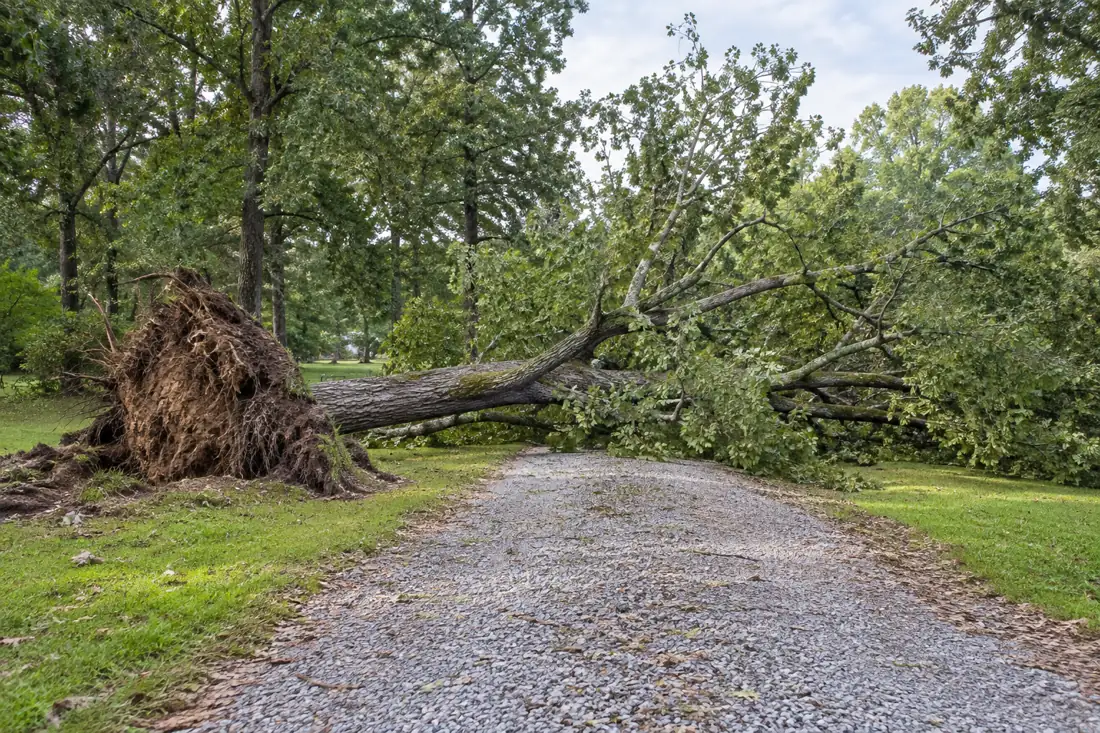
Signs the lean may be new
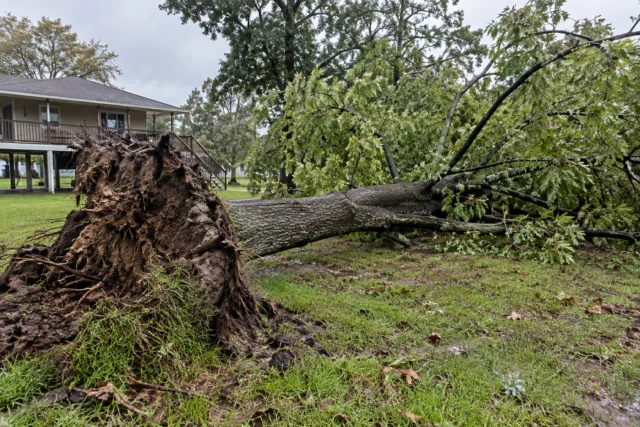
Soil heaving on one side of the trunk can indicate root plate movement.
A new storm lean is a change to investigate, not a DIY straightening job
After a storm, compare the current trunk angle with older photos or nearby fixed features. Look from a safe location for displaced soil, lifted turf, new cracks at the base, exposed roots, or a canopy that has shifted toward a driveway or building. The most important detail is often whether the lean appeared suddenly, not whether the tree is perfectly vertical. Do not walk beneath a tree that may be moving.
Exclude people and cars from the potential fall area while the condition is reviewed. Do not pull the trunk with a vehicle, attach a winch, or cut selected branches in hopes of balancing it. Those actions can shift loads unexpectedly and put the person handling the equipment in the danger zone. If electrical conductors are near the tree, the utility must manage the line hazard.
For the inquiry, provide the date and approximate weather conditions, a broad photograph showing the whole tree and the nearby occupied area, and a safely taken detail of visible ground movement. A site review should address anchorage, defects, likely targets and whether stabilization is reasonable. A newly leaning tree is not automatically salvageable or automatically beyond repair; the evidence determines the decision.
Fresh root damage may mean the tree has lost important anchorage.
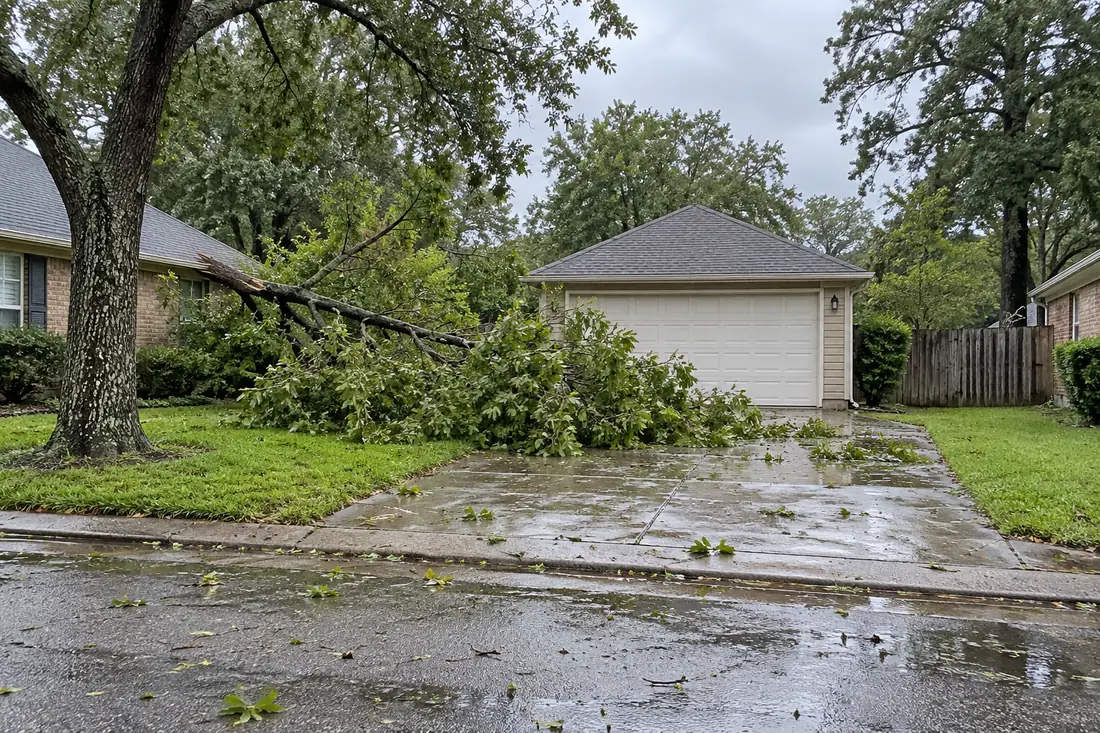
A canopy suddenly closer to a roof, line or neighboring tree can indicate movement.
Old lean and new lean are different
Some trees naturally grow at an angle and compensate over many years. A sudden change is more concerning because the root system and trunk have not had time to adapt. Comparing older photos can help determine whether the lean is new.
What to do right now
Keep people out of the possible fall zone, especially if soil is moving, roots are lifting or the tree is leaning toward an occupied structure. If power lines are involved, keep clear and contact the utility or emergency services as appropriate.
Start with people and the current affected area
If a tree has changed position after a storm, keep people away from the area it may affect and contact the appropriate provider promptly. Use emergency services where people face an immediate threat and contact the utility if lines are involved. Do not approach the base or stand beneath the canopy to decide whether the lean is serious enough for a call. Describe what can be observed from a safe place and explain what cannot be seen.
Tell Tree Huggers whether the tree is near an occupied room, entrance, roadway or other used space. Mention any new movement or material falling that you have already noticed without returning to watch it closely. An online request does not confirm dispatch or establish that the area is safe to use. The first useful outcome is an understood current condition and an appropriate response arrangement, rather than a homeowner test of how much movement the tree can withstand.
Distinguish known history from a recent change
Some trees have grown at an angle for a long time, while a newly changed position raises a different assessment question. Share what you actually know. An older photograph of the same tree and nearby fixed features can help show a visible change, provided its date and context are retained honestly. Do not infer that an old lean is harmless or that a particular angle alone establishes the right response.
If no earlier image exists, explain when the concern was first noticed and what made it stand out. A branch newly contacting a roof or a changed gap beside a fence may be part of that description. These observations support the professional review but do not replace evaluation of the tree and site. The ISA recognition guide identifies lean and ground changes as information worth professional attention. Keep the observation separate from an unsupported conclusion about which roots failed or whether the tree can remain.

Report the ground without disturbing it
From a safe viewpoint, describe fresh lifting soil, a separation near the base or exposed roots if visible. Do not excavate, pull roots or walk onto a raised root area to measure it. The tree and surrounding ground need to be assessed in their current condition. A photograph may show a surface change without revealing the complete anchorage or concealed condition below it.
Explain recent heavy rain, flooding, drainage changes, digging or nearby paving. Give approximate timing and location rather than treating one event as proof of cause. Texas A&M Forest Service flooding guidance provides broader context for storm-related tree concerns, but the actual property still needs its own review. If an access route crosses soft or disturbed ground, tell the company before a method is discussed. Ground information can affect both the assessment question and the practical plan for any work that follows.
What changed when the tree leaned?
A trunk that has stood at an angle for years raises different questions from a tree that shifted after saturated soil and wind. Compare dated photographs to see whether the base, nearby paving or root-zone soil moved. A fresh crescent of raised soil, a widening gap or roots pulling from the ground deserves a qualified on-site evaluation. Do not try to straighten, cable or pull the tree yourself.
A tree’s lean angle alone does not assign a failure probability. The decision may depend on anchorage, species, site disturbance, targets and weather exposure; ask the professional to explain the observations and limitations.
Describe contact with buildings, trees and utilities
A leaning tree may be touching another tree, roof, fence or overhead infrastructure. Tell the provider what is in contact and what appears to remain unsupported, without trying to separate the pieces. Do not assume another tree or building is safely holding the load. A branch resting on a structure is a different condition from a tree leaning toward one without contact, and the distinction matters to the first response conversation.
If a line is involved, keep clear and coordinate with the utility. Do not move a branch away from a cable or assume the line is safe because nearby service is off. Share any instructions already received from responders or the utility. For a tree resting on a building, see the tree-on-house first-response guide. The company needs a truthful description of the current setting before confirming what tree work can be assessed or performed and which other provider’s responsibilities must be addressed first.
Do not attempt to straighten or unload the tree
An owner may hope that pushing, tying, cutting roots or removing a branch will stop movement. Do not use those actions as tests or improvised repairs. Changes to a damaged tree can alter the situation unexpectedly and place people in the affected area. Ask the qualified provider what assessment and management are appropriate for the actual condition rather than selecting an intervention from an unrelated online example.
The recommendation may involve further evaluation, work-area restrictions, a particular tree-care approach or removal planning. Ask what findings support it and which limitations remain. A new lean in a mature tree should not be treated as the same problem as staking a newly planted tree. Avoid accepting an unconditional promise to straighten and permanently secure a storm-shifted tree without an appropriate assessment. The goal is a suitable response to the current structure and site, with the owner kept out of hazardous trial-and-error work.
Give the assessment a clear question and deliverable
Tell the provider whether you need urgent review of a changed condition, a written assessment for a manager or pricing for recommended work. Confirm what the visit includes and who performs the evaluation. A work quote and a condition report may be different services. If another organization needs a particular document, explain the intended use before the appointment rather than assuming a pricing visit automatically produces it.
Provide known history, older photographs, prior major failures and any existing support-system records. Ask how the tree’s position relates to nearby targets and current use of the property. If further investigation is proposed, ask what decision it is intended to inform. Keep the assessment’s limitations with the findings. The owner should understand the next step and any interim arrangement without interpreting the report as a guarantee against future movement or assuming that a recommendation based on one visit applies indefinitely after another change.
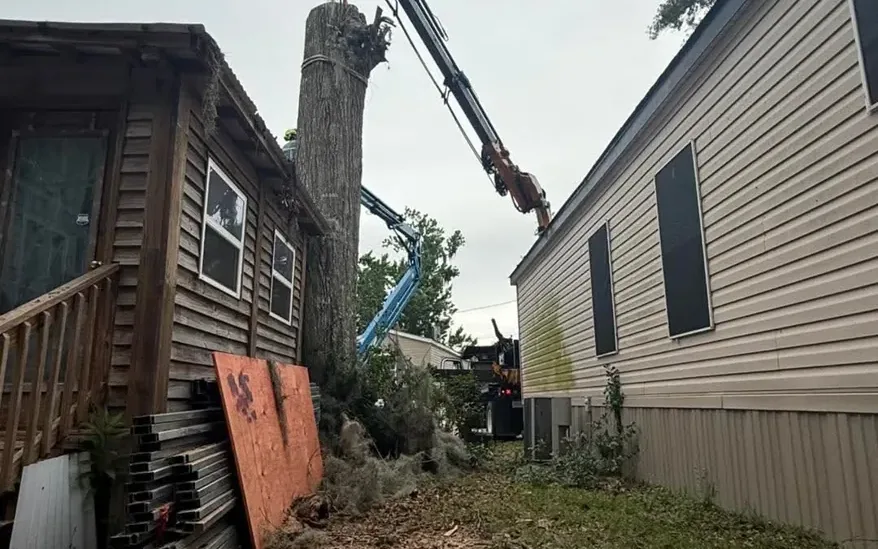
Plan access and removal only after reviewing the condition
If work is proposed, show the complete approach route and identify gates, parking, fragile surfaces and shared access. Do not enter the affected area to clear it in anticipation of the crew. Ask what preparation is appropriate and which parts require the provider’s own handling plan. Permission for another property or public route must be confirmed independently of the tree-work quote.
Clarify debris handling, stump work and the finished condition if removal is selected. If the tree has damaged a roof or fence, coordinate the repair provider’s role separately. An urgent removal scope should still identify what is included and what remains. Keep the authorized contact reachable if new findings require a decision. This helps the work proceed against the actual condition rather than a method chosen before the provider could review the lean, ground and surrounding property together.
Report a meaningful update when conditions change
Keep safe original pictures and the timing of any observations with the service request or assessment. If you notice another movement or failure from an already safe place, tell the provider promptly. Do not revisit the tree repeatedly to compare a ruler mark or inspect a rope. Ask which changes require earlier contact and which situations belong with emergency or utility services. A management plan should not depend on the owner performing hazardous close inspection.
For Tree Huggers, send the address, safe whole-tree and base views if available, the change timing and nearby targets. Explain access limits and any other provider already involved. Use tree-risk assessment for the condition question and storm-damage service for the work discussion. A useful response connects the new observation with an appropriate review and practical arrangements. It does not require the owner to decide the tree’s stability from a picture or test its roots before asking for help.
Document a new lean after a storm without entering danger
Some trees lean naturally for years; a new change after heavy wind is a different concern. Try to establish whether the angle is recent by checking older photographs or familiar fixed references, but do this only from a safe location. Fresh soil lifting around the base, new cracks in the ground or newly exposed roots can indicate movement that deserves prompt professional review. Do not attempt to push the trunk upright or investigate by stepping into the area beneath it.
The ground around a tree may remain saturated after the weather clears. Drainage changes, previous trenching and shallow roots can influence stability, yet none of these observations alone establishes a diagnosis. Tell the tree professional when the storm occurred, whether the lean appears to be increasing and what is located in the direction of the lean. Include utility lines, walkways, adjacent buildings and any blocked access routes.

Movement at the root plate changes the urgency
If the tree is touching electrical infrastructure, avoid the area and contact the utility or emergency service appropriate to the situation. For other apparent hazards, keep people, vehicles and animals away from the potentially affected zone until it can be assessed. A close-up photo is not worth approaching an unstable tree. Wide views from a protected position can convey both the tree’s orientation and the space around it.
An evaluation should distinguish a stable longstanding lean from fresh root-plate displacement and consider available options. The outcome may be monitoring, restriction of the surrounding area or removal depending on the actual condition. Ask for the proposed work area, access needs, debris handling and any separate stump or restoration work. Treat a new lean as a site-specific problem rather than using an online angle threshold to decide.
Tree Leaning After a Storm questions
Does a new lean after a storm deserve review?
Yes. Report the changed condition promptly from a safe place and keep people away as appropriate.
Does an old lean prove the tree is harmless?
No. Share the history, but the current structure, site and nearby targets still need appropriate evaluation.
Should I push the tree to see whether it moves?
No. Do not push, pull, climb, cut roots or attempt improvised restraint.
Can an older photograph help?
Yes, if it shows the same tree and context. Retain known dates and avoid inventing certainty about the history.
Should I dig around lifted soil?
No. Describe visible ground changes without disturbing the area or approaching an unstable tree.
What if another tree is holding it?
Do not assume the support is secure. Report the contact and keep clear of the affected area.
What if power lines are involved?
Keep away, contact the utility and share any instructions with the tree provider.
Is straightening a mature shifted tree like staking a new tree?
Do not treat them as the same situation. The actual condition requires an appropriate professional recommendation.
Does an estimate include a written assessment automatically?
Not necessarily. Confirm the required purpose, provider and document before arranging the visit.
What should a proposed removal scope clarify?
Identify access, permissions, material handling, stump work, separate repairs and the decision-maker for changes.
Should I repeatedly approach to monitor the lean?
No. Use a professional management plan that does not depend on hazardous close inspection by the owner.
What should I send with the request?
Send the address, safe views, timing and nature of the change, nearby targets, access limits and any utility involvement.
Let’s plan your tree work.
Send the property address, safe tree photos and the result you need. Include access restrictions and the person who can approve the work.
Changed lean versus established lean
A tree that has leaned gradually for years presents a different information problem from one that suddenly tilts after rainfall. Describe the direction and timing of change, whether the soil lifted or cracked, and which occupied spaces lie beneath the possible fall path. Do not approach the base to take a close-up photograph or try to judge stability from foliage.
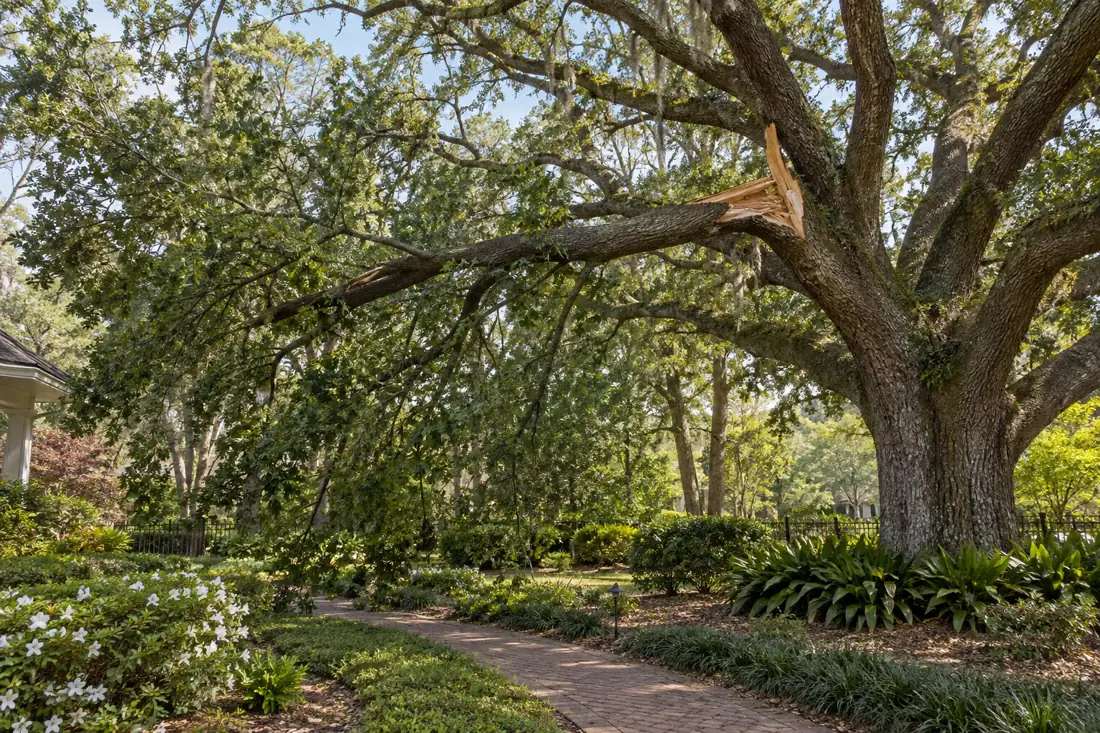
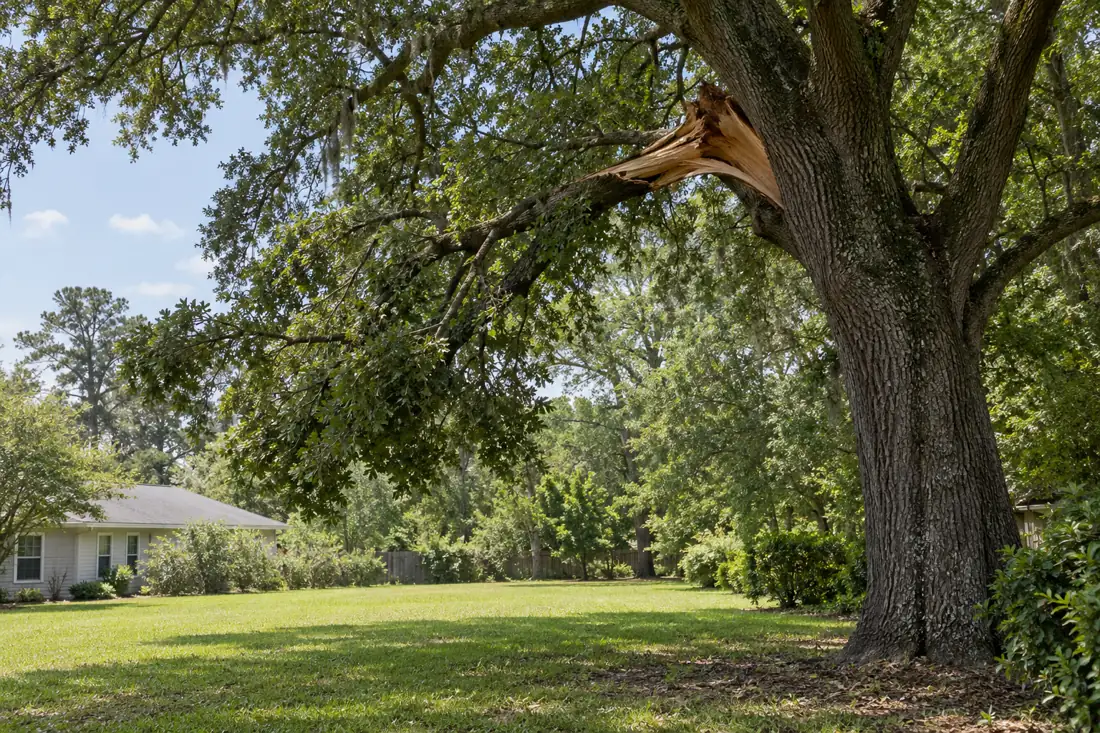
For fresh soil movement, read the partially uprooted tree guidance before considering ordinary pruning. If the crown or trunk is visibly fractured instead, the thunderstorm split-tree guide identifies a separate set of load and access questions. A qualified in-person assessment must distinguish these conditions.