An existing support system should not be treated as permanent proof that a tree is safe. The tree, attachments and supported structure can change. Tell the assessor when the system was installed if known and why it was recommended. Ask what inspection, maintenance or further evaluation is appropriate for the current condition.
Cabling is a managed system, not a permanent safety certificate
An existing support cable may reduce the motion or load on a particular union, but the installation does not stop a tree from growing or eliminate all failure modes. From the ground, note hanging or visibly slack hardware, damaged anchors, changes in branch position and new cracks near the supported union. Do not tug on a cable, climb to inspect an anchor or assume visible tension proves the assembly is functioning correctly.
A qualified inspection should review the tree’s current structure as well as the support hardware. Ask what the original objective was, whether growth has changed loads, and whether a pruning or replacement recommendation follows from a documented condition. Some older systems may require changes; others may be serving their intended purpose. Do not treat a calendar date alone as proof that a cable must be replaced.
For property managers, maintain an inventory listing the supported tree, approximate hardware location, date of the last assessment and any limitations communicated by the professional. Plan follow-up access before a storm, not while limbs are moving. A report should distinguish maintenance of the hardware from a broader tree-risk assessment and clearly state that cabling does not guarantee a tree or branch cannot fail.
Locate the prior installation record or written recommendation if available and photograph the cable anchors from safe ground positions without climbing. Note changes since the system was installed: additional growth, broken limbs, altered crown loads, storm exposure or visible hardware movement. Cable and brace systems are designed for particular structural concerns; finding a cable does not establish that all parts of the tree are stable or that the system is currently suitable. Never tighten or replace hardware as a homeowner experiment.
Ask the assessor to evaluate both the tree and the support arrangement, including the reason for the original installation, condition of attachments and whether the supported union has changed. Request a written follow-up interval based on the current findings rather than treating the hardware as maintenance-free. If there are new cracks, root movement or sudden leaning, communicate those symptoms before the visit and keep people away from the potentially affected zone. Document whether monitoring, adjustment, replacement, different support or removal is recommended and why.
Understand what the support system was intended to manage
A cable or brace in a tree is usually installed to address a particular structural condition, such as a weak connection between stems or a long limb with a specific loading concern. It is not a general certificate that the tree is safe. Before scheduling an inspection, locate the original recommendation, installation description and any diagrams showing which unions or branches are supported. This history helps distinguish intentional hardware from an abandoned or poorly understood alteration.
If the paperwork is missing, start with safe ground-level photographs of the tree and visible attachment points. Identify the property, the approximate age of the installation if known and any previous work. Do not climb to read hardware markings or tighten a cable yourself. A professional needs to establish what the system actually supports, whether its design remains appropriate and which parts of the tree may have changed since it was installed.

Look for changes that justify an earlier professional visit
Inspection timing should reflect the tree's condition, the type of support and what the property beneath it is used for. A newly opened union, broken limb, visible wire damage, displaced hardware or major storm impact can justify prompt reassessment rather than waiting for a routine visit. From a safe location, record obvious changes with an overview photograph so the professional can identify the exact tree and attachment area.
If a supported limb appears unstable, keep people and vehicles away from its potential fall area. Do not pull on the cable, use a ladder beneath the branch or assume that the presence of hardware prevents movement. The professional may determine that the tree needs an assessment of both structural condition and the support system. A check of nuts and wires alone cannot replace examination of the wood holding the anchors.
Treat support hardware as an inspected system, not a permanent fix
Tree cabling or bracing can sometimes reduce a particular movement or loading concern, but the hardware does not make damaged wood healthy. Ask for the original installation details, support objective, component type, anchor locations, and any inspection history. If no records exist, describe that uncertainty instead of inventing an installation date or claiming the system meets a specific standard. Hardware may be hidden above the visible canopy, so ground photographs alone cannot confirm its condition.
Inspections should consider the supported union, surrounding wood, cable tension or movement, connections, and changes in the canopy. Storm damage, vigorous new growth and decay can alter how forces move through the system. No one should climb to inspect or adjust hardware without appropriate qualifications and safety measures. A plan based only on whether a cable is still visibly present misses the condition of the tree supporting it.

Treat cable inspection as a continuing tree-risk decision
Support hardware is not a permanent guarantee that a forked tree will remain sound. Ask the inspecting professional to identify the supported union, the intended function of the system and any visible changes to attachment points, cable tension or surrounding wood. Old photographs and earlier inspection notes help distinguish movement from a stable feature; they do not replace seeing the installed system.
Do not attempt to tension, cut or climb to inspect a cable yourself. A qualified tree professional should determine inspection needs using the system's design, condition and any applicable manufacturer guidance. Growth, storms, corrosion and changes to the supported branch can affect the original objective. If the hardware is missing or damaged, keep the potential fall area clear until evaluated.
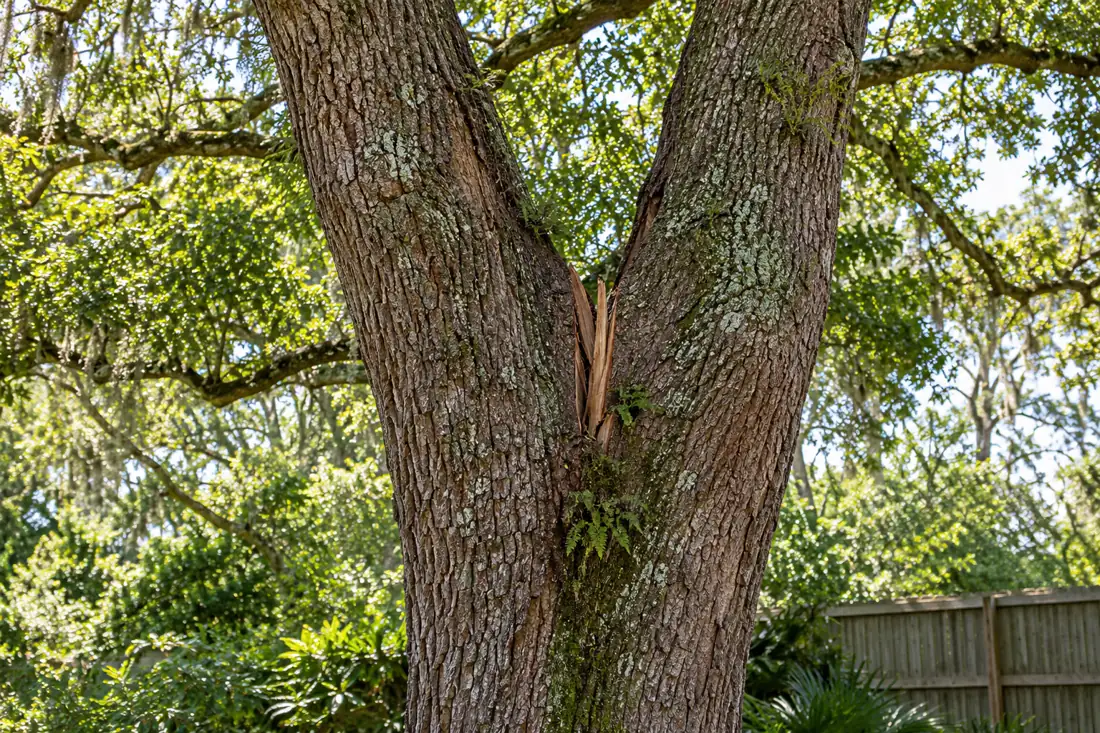
Request a written recommendation that separates hardware maintenance from pruning, decay assessment or possible removal. Record when another inspection is advised, the conditions that should trigger an earlier review and who will retain the records. The photograph supplies general union context rather than a claim that the pictured tree contains the user's support system.
Confirm that tree growth has not changed the design assumptions
Trees add wood and change their shape over time. A cable installed years earlier may now connect branches with different spacing, mass or growth around the attachment than existed at installation. Nearby pruning, storm damage or removal of adjacent trees may also change wind exposure. Ask the inspector to compare current structure with the original intent, including whether the supported stems remain healthy and whether loads have shifted.
Document Existing Cabling Without Touching the Hardware
Cabling and bracing are supplemental supports, not a permanent certificate that a tree cannot fail. A follow-up review should start with the original reason for the support, any available installation paperwork and the changes seen since installation. If the system's age is unknown, record that uncertainty plainly.
Photographs from the ground can establish which tree and general crown area are being discussed, but they may not show the condition of anchors or hidden decay. Do not climb, pull on a cable or use a ladder to inspect it yourself. Note any new crack, storm damage, sagging limb or hardware that visibly changed position.
Ask a qualified assessor what components can be inspected within the proposed visit and whether pruning, adjustment, removal or further investigation is warranted. A useful written record includes the assessment date, observations, recommendations and the next review trigger, rather than a blanket assurance that the tree is safe.

A tight-looking cable is not automatically a correctly functioning system, and some supports are designed to allow controlled movement. Hardware buried in expanding bark may be difficult to assess visually. The inspection should distinguish acceptable growth from interference, corrosion or anchor problems. Owners should avoid applying an improvised 'more tension is better' rule because adjustment or replacement must suit the specific design and tree condition.
Document support hardware and the tree around it
An existing cable or brace is not a permanent certification that a tree is secure. Begin an inspection request with the tree location, any known installation records, the purpose of the support and the most recent professional review if available. From the ground, photograph the whole crown and identify new changes such as a sagging branch, unusual movement, bark damage or visible hardware concerns.
Do not climb the tree, tug a cable or attempt to tighten hardware yourself. A photo of one connector without the supported branch context can be misleading.
Support systems interact with tree growth, load paths and attachment condition. A qualified professional should assess whether the original structural concern still exists, whether the installation is appropriate, and whether any associated pruning or additional assessment is warranted. Rust-colored staining or visible movement can be observations worth mentioning but are not reliable stand-alone diagnoses.
Trees continue to grow around attachments, and hidden defects may need closer inspection. A routine visual visit should not be represented as a laboratory measurement or a complete prediction of failure risk.
Write the inspection scope in a way that a property manager can follow later. Identify which tree and support system are involved, what components are to be inspected, and what documented recommendations will be delivered. If pruning, hardware adjustment or replacement is recommended, ask for those as distinct, approved work items rather than assuming they are included in the inspection fee.
Establish how equipment will access the tree and protect nearby landscaping, fences, parking or occupied routes. Overhead lines require the relevant utility safety process, not improvisation by building staff.
Keep installation and follow-up records together. Photographs from comparable ground positions can illustrate growth and obvious external changes, while professional reports should record inspection limitations and next review needs. Notify future property managers that support hardware exists, especially if the tree becomes part of a sale or maintenance transfer.
The goal is a documented ongoing decision process rather than an unsupported 'cable is good' checkbox. When conditions change after a storm, arrange a fresh qualified assessment instead of relying on the last routine inspection.

Treat a support cable as equipment requiring future inspection
A cable, brace, or other tree support system is not a one-time cure for a structural defect. Hardware can move, loosen, become embedded, corrode, or be affected as limbs grow. An inspection should establish the location and type of support, the condition of the connected branches, whether the attachment points remain appropriate, and whether the original structural concern has changed.
Owners should not climb to tighten or test cables or assume that a cable seen from the lawn proves the tree is stable. Photograph any obvious change from a safe vantage point and note when the system was installed or last professionally checked, if records exist.
After storms or a visible shift in the supported limbs, have the system reviewed before allowing normal activity under a questionable attachment. A qualified tree professional can decide whether replacement, adjustment, additional evaluation, or a different approach is appropriate; the owner should not choose cable tension or hardware size from a generic website description.
Also examine the surrounding use of the property. A supported union over a playground, house entrance, or regularly used patio has different consequences from one over an unoccupied open area. Keep installation drawings, inspections, repair notes, and follow-up recommendations together for future owners and contractors.
Record follow-up triggers and a responsible contact
Create a simple inspection log: tree identifier, approximate location, known installation history, observations, photographed concerns and the next recommended review. Look for obvious external changes after high winds from a safe location, including newly separated branches, fresh cracks and hanging material. Treat a sudden change as a reason to keep people away and request evaluation, not a reason for a property owner to pull on a cable or tighten a fitting.
Discuss what the support system is expected to achieve and how the decision would change if the tree deteriorates. Sometimes targeted pruning, revised support, restricted access or removal may be considered, depending on the actual defect. Keep maintenance expectations in writing for future owners and property managers. A tree with hardware still requires ordinary tree care, and no support system is a guarantee against failure.
An inspection record for existing cabling or bracing
Gather the original support recommendation and installation record if available, along with dates of earlier inspections or storm incidents. From the ground, photograph any visible hardware and the supported union without climbing, pulling on the cable or attempting adjustments. Ask whether attachments, tree growth and the structural concern still justify the system, and request the specific follow-up interval recommended from current findings.
Preserve the inspection report so a future owner or contractor knows which tree, attachment and condition were reviewed; hardware alone is not evidence that a tree is safe.
Discuss a tree-condition assessment before support-system work

Identify the type of cable, brace and anchorage
Flexible support, static cable and threaded bracing may have different installation and inspection requirements. A tree can contain more than one component, each intended to address a different movement or connection. The professional should identify the hardware type, manufacturer or standard when reasonably possible, inspect visible defects and explain any areas that cannot be safely reached or assessed during the visit.
Photographs showing where a cable meets a branch can be useful, but owners should not attempt close-up documentation at height. Ask whether hardware has signs of corrosion, abrasion, broken strands, deformation or bark inclusion. A missing identification tag is not by itself proof of failure, just as a shiny cable is not proof of adequate anchor holding strength. Good records make future inspection more precise and reduce the chance that a later crew cuts through a component inadvertently.
Assess the supported wood, not just the metal
The anchor region and adjoining wood are part of the system. A cable with intact metal may still be ineffective if the branch has decayed or a stem union is splitting. The tree professional should examine visible cracks, cavities, included bark, response growth, root concerns and canopy health in relation to the original risk. When hidden conditions matter, additional investigation may be recommended instead of a firm conclusion from the ground.
Ask the inspector to explain what the support is expected to do after a defect is identified. It may limit some motion or loading, but it does not regrow structural wood or guarantee performance in extreme weather. If the tree has deteriorated substantially, modifying the support may be less appropriate than reconsidering pruning, exposure controls or removal. This distinction prevents maintenance from becoming an automatic renewal of a questionable earlier decision.

Review nearby pruning and potential conflicts
Branches supported by cables may still need normal tree-care decisions, including selective pruning of deadwood or clearance from buildings. A crew should know the hardware layout before cutting, rigging or moving limbs. Removing a large branch without understanding the support configuration can change loads or leave another component in an unintended position. An inspection scope should account for recent work by other providers and any planned construction around the tree.
If a supported branch overhangs a roof, parking or walkway, describe that exposure when requesting a visit. The arborist may recommend targeted reduction, changes to access below or additional examination, depending on actual findings. Do not order severe crown reduction simply to 'protect the cable' without a structural explanation. The objective is a coherent tree-management plan in which pruning and support complement each other only when justified.
Account for storms and different levels of urgency
Following severe weather, the first question is whether the tree or surrounding area presents an immediate danger. Check from outside the potential fall zone for freshly broken limbs, unusual leaning, changed gaps at unions and visible support damage. Stay away from downed lines and branches resting on structures. Even if the cable remains attached, a storm may have altered the supported wood or another portion of the crown.
Communicate the date and observed effects of the storm, not an assumed force measurement or unsupported claim that the system 'held.' If property access is restricted, photograph from the nearest safe public or authorized location. A professional can decide whether ordinary follow-up, additional testing or urgent site controls are warranted. Do not treat every windy day as proof of failure, but also do not postpone assessment when new structural movement is obvious.

Make inspection findings actionable and traceable
An effective report identifies the tree, property location, inspected components, visible conditions and any inspection limitations. It should state whether the system remains appropriate to its purpose, whether maintenance is recommended and what further decisions are needed. Where replacement or modification is advised, request an explanation of the reason and a defined scope. A generic invoice saying 'cable checked' provides little continuity for the next person responsible for the tree.
Ask for site photographs taken during the visit when practical and permission allows, with labels linking them to the correct support. Separate observed conditions from conclusions that depend on hidden wood or inaccessible anchors. Record any temporary restrictions suggested by the assessor. If the company that installed the hardware is unavailable, the current professional should document what can be established rather than inventing the system's original specifications.
Plan maintenance without owner-made adjustments
Do not twist cables, add clamps, drill new anchors or remove support hardware as a homeowner maintenance task. Changes can release stored forces or damage wood, and the correct action depends on the system and tree. Maintenance may involve professional adjustment, hardware replacement, reassessment of the underlying defect or no immediate physical intervention. Inspections should inform these choices instead of treating a routine visit as a sales opportunity for more components.
Keep access clear for the professional where practical, but avoid digging, lifting limbs or climbing to assist. If gates, neighboring parcels, overhead utilities or fragile landscaping affect access, disclose them beforehand. Ask whether the work requires a follow-up visit after another contractor completes related pruning. A maintenance schedule should be specific to the inspected system and site rather than a universal promise of durability.

Preserve records for the next responsible owner
Tree support is an ongoing management decision. Store the original proposal, installation date if verified, subsequent inspections, photographs and work orders in one file. A property manager, purchaser or new maintenance company should be able to identify which tree carries hardware and why. Note any outstanding recommendation that has not yet been completed; otherwise a future owner may assume an old cable has been fully reviewed simply because it is still present.
When contacting Tree Huggers, provide the tree location, safely taken photos, known installation history, recent changes and the reason an inspection is needed. Request an appropriate professional assessment or referral where specialized review is necessary. Do not describe the system as guaranteed protection against storm damage or use an internal asset rating as a customer review. The practical result should be a clear, current decision about condition, access and next steps.
Questions about this project
Does a cable make a tree permanently safe?
No support system should be treated as a guarantee against failure. The tree and hardware need appropriate review, and new damage or changed conditions should be assessed rather than assumed to be contained.
What should I ask about a proposed support system?
Ask what condition it addresses, why the tree is suitable, what limitations apply and what inspection or follow-up is recommended. Keep those recommendations with the tree's work and maintenance records.
Does healthy-looking foliage mean a tree is structurally safe?
No. Leaves do not establish the condition of roots, trunk or branch connections. Explain visible defects and recent changes, and ask for an assessment appropriate to the tree and nearby targets.
Should I test a cracked branch or trunk?
Do not pull, shake, climb or cut damaged material to test it. Keep clear of the affected area and describe the condition from a safe location. Qualified assessment and an appropriate work plan are needed.
Is a free work estimate the same as a written risk assessment?
Not necessarily. Explain whether you need pricing, condition advice, a documented assessment or a combination. Ask what the visit includes, who provides it and what limitations apply to any findings or recommendations.
What history should I share?
Share known storm damage, prior failures, construction, root disturbance, flooding, pruning and recent changes. Include the timing and nearby property use. Useful history supports the evaluation without replacing inspection of the current tree and site.
How should extra work be approved?
Use the agreed approval process and identify the change, reason, scope, price or schedule effect as applicable. Confirm who has authority before treating an additional tree or task as part of the original job.
What completion records are useful?
Keep the agreed scope, tree or area identification, authorized changes, invoice and labeled photos where appropriate. Include unresolved items and a contact. Contract-specific records should follow the buyer's stated requirements.
Is leaving the trunk untouched enough to protect a tree?
No. Roots, soil conditions and nearby work can matter even when the trunk is not cut. Identify retained trees before planning access, excavation and storage, and ask what site-specific protection is appropriate.
Can pruning undo construction-related root damage?
Do not assume it can. Share the work history and ask for an assessment of the current tree and site. Pruning, monitoring or other recommendations should address an identified need rather than substitute for protection planning.
What should I tell Tree Huggers about tree cabling inspection and follow-up?
Explain the property address, the work you want and the specific concerns: existing hardware, changed structure, inspection history. Send safe photos of the tree, surroundings and access route. The contractor can then discuss the assessment and scope needed for this situation.
How do I request an estimate for this work?
Call 504-458-8336, text photos or use the estimate form on this page. Include the address, desired outcome and any timing constraints. The company will need to review scope and availability; an online request does not confirm a price, appointment or emergency dispatch.
Get a scope for your property
An existing cabling or bracing installation needs a history, not merely a photograph showing the hardware remains in place. Record any installation or inspection date you actually know, changes in the supported limbs, new cracks, damaged bark, visible corrosion or recent storm loading. Take ground-level photos of the whole tree and, if safely visible, the support location; do not climb to inspect bolts, cables or attachment points. Include the occupancy and structures below the supported limbs, because the consequences of failure matter to the review.
A follow-up request should ask the qualified tree professional to review the tree's current structure, the condition and suitability of the installed system, and whether continued support, adjustment or a different risk-management approach is appropriate. State that old hardware is not proof of safety and do not attempt to tighten, move or cut it yourself.
Obtain a written finding explaining recommended follow-up and any areas that should remain unused pending inspection. A maintenance interval depends on actual tree and hardware conditions, not a universal guarantee.