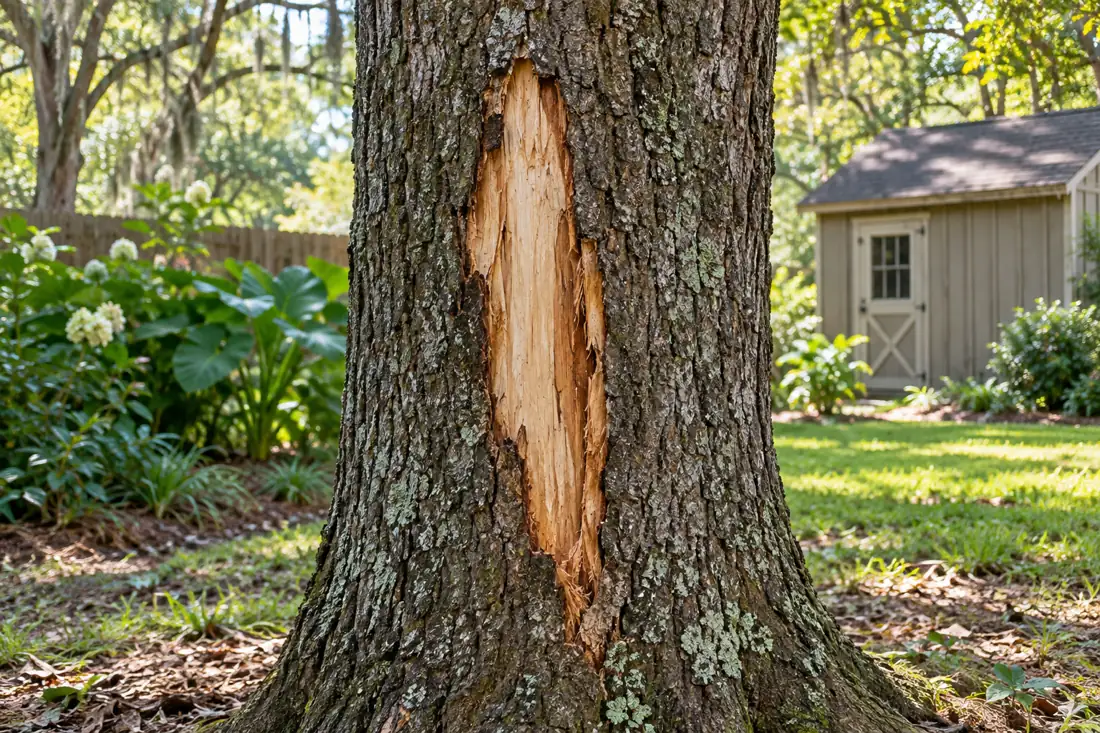
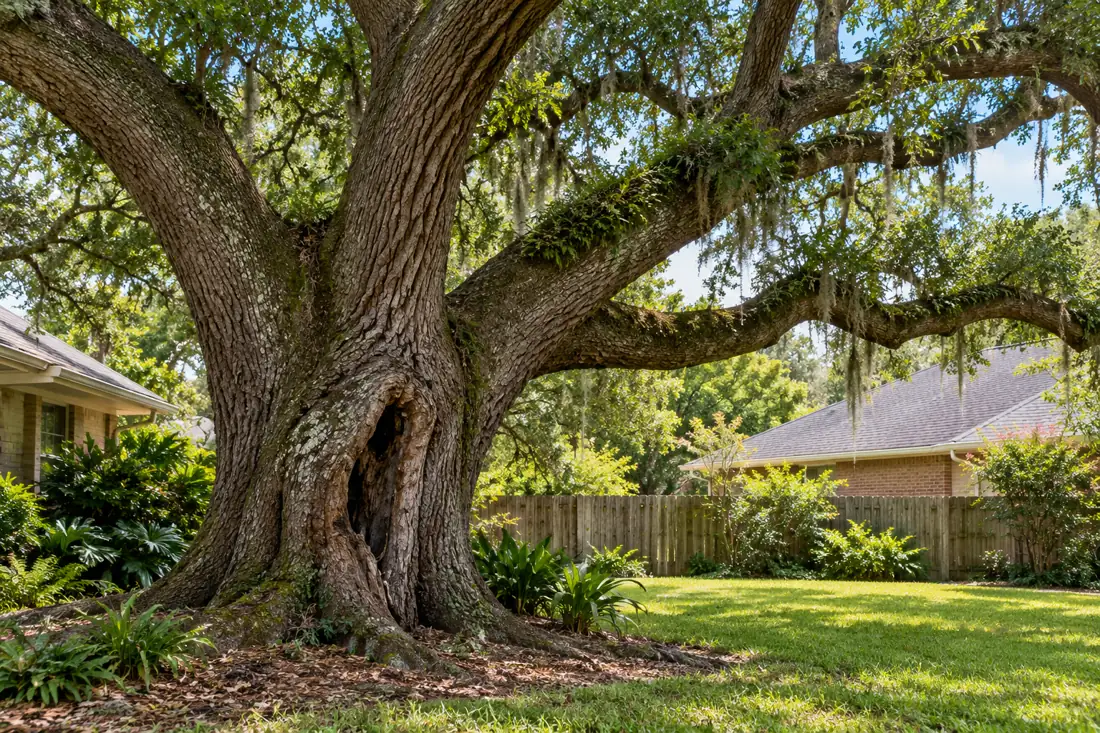
A split live oak is not automatically a removal, but the location and extent of the split matter enormously. A small crack in a minor branch union is different from a fresh opening through a major co-dominant trunk.
A fresh split in a live oak is a condition change, not a pruning request
Keep people and vehicles away from the area beneath the affected stems while arranging a qualified assessment. From a safe position, record whether the split is at a branch union, extends into the main trunk or has changed after wind or rain. Do not insert a tool into the crack, pull on the limb or climb the tree to estimate how deeply it opens.
Useful photos show the whole crown, the shared union and the surrounding ground, not just a close-up of bark. Questions for an evaluator include whether decay is present, how the stems load the union and whether a proposed support system would reduce a specific risk. Cabling is not a cure for a failed trunk, and its suitability depends on assessment.
The follow-up decision should identify whether a temporary exclusion area, selective pruning, support, more testing or removal is appropriate. A preservation goal is legitimate, but no photograph or simple rule can guarantee that a split oak is safe. Keep a dated record of any subsequent movement so a change can be communicated quickly.
Questions that matter
How much sound wood remains? Is the split active and widening? What weight is being carried above it? Are there people, buildings or vehicles below?
Possible responses
Some trees can be reduced through pruning and supported with cabling or bracing. Others may have lost enough structural capacity that removal is safer. Text clear photos of the split and entire canopy for review.
Treat a newly opened split as a changed condition
If a major oak union has opened, keep people away from the affected area and report the change promptly. Tell the company whether the split appeared during a storm, whether part of the tree has already fallen and what occupied spaces are nearby. Do not pull the stems together, cut a relief branch or try to secure the tree with a rope. Those actions change the condition and may place you beneath material that can move unexpectedly.
The first conversation should establish what happened and which services are appropriate, not produce an instant preservation guarantee. A photograph can show that an opening exists, but it cannot establish all the wood carrying the remaining load. If utilities or a damaged building are involved, contact the appropriate emergency or utility service and remain clear. The Texas A&M Forest Service storm guidance emphasizes professional help for hazardous storm-damaged trees. Use that principle when deciding how to observe the split safely.
Describe the split without trying to measure its strength
Explain where the opening is: in a small limb, at a major fork, through a trunk section or near the base. Give a whole-tree view as well as a closer view taken from a safe location. If the opening is only visible from a dangerous position, say so rather than approaching it. Identify any recent change in the canopy, branch position or ground around the tree that you can already observe without entering the affected area.
A note such as “the left stem moved outward after last night’s wind” is more useful than an unsupported diagnosis that half the tree is rotten. Share older photographs if they help show a change, keeping their dates and original context. Do not insert a tool into the opening or stand under the union to get a width measurement. The assessor can determine what investigation is appropriate within the agreed scope and what uncertainty remains after the inspection.

Ask whether the remaining structure supports a preservation plan
A preservation discussion needs to address more than whether the split can be physically pulled closed. Ask which stems and supporting parts are involved, what other defects were observed and what uses of the surrounding area matter. If additional investigation is recommended, ask what question it is intended to answer and how the result will influence the decision. Paying for a test is most useful when you understand the decision it can actually inform.
The recommendation may include further assessment, management of the affected area, appropriate pruning, a support-system discussion or removal. Those are potential categories, not a prescription for this tree. Ask the provider to explain why the proposed approach suits the observed condition and what limitations apply. A written recommendation should distinguish known findings from assumptions. Avoid treating a favorable result from another split oak as proof that this oak has enough suitable remaining structure for the same intervention.
Understand what support hardware can and cannot promise
If a support system is proposed, ask what specific movement or structural concern it is intended to address. Confirm who designs and installs it, what related pruning is proposed and what follow-up is required. The project should be described as a tree-care intervention with limits, not as a permanent repair that restores every part of the original structure. Existing hardware should also be identified during assessment rather than assumed to be effective because it is still visible.
Do not install improvised straps, chains or bolts while waiting for advice. Ask whether the area needs to remain restricted until the recommended work is completed and whether another inspection is needed after a significant change. Keep the installation record and subsequent inspection notes with the tree’s history. For a broader comparison of ongoing support responsibilities and removal, see cabling versus removal. The decision should consider the whole tree and property, rather than the price of hardware by itself.
Keep pruning objectives distinct from emergency guesses
An owner may hope that removing a large limb will immediately unload a split union. That is a question for the people assessing and planning the work, not a safe do-it-yourself experiment. Ask what pruning objective is recommended and how the proposed cuts relate to the actual defect. A vague instruction to take weight off everywhere can conceal very different amounts and locations of cutting, making it hard to understand or compare the intended result.

A split-tree question needs a documented change history
When an owner notices a split or a line opening in a live oak, the time sequence matters. Record the earliest photograph and whether the feature appeared after a storm, a fallen limb, digging or another known change. Describe the location without standing beneath a questionable branch or trying to pry the opening to measure it.
The assessment should address the actual union and the load and surroundings relevant to that tree. Hardware may sometimes be discussed for an individual situation, but neither a cable nor a reduction cut automatically makes a damaged attachment safe. Ask what evidence supports each option and which limitation remains afterward.
If retention is proposed, clarify who inspects the tree again and what observed changes would trigger a new review. If removal is recommended, document which tree and work limits the recommendation covers. Separate the decision about the tree from subsequent stump, debris and landscape restoration choices.
Ask the provider to identify whether the work is intended to address a particular branch, restore storm-damaged structure or support a longer preservation plan. Keep necessary immediate actions distinct from later maintenance. If the tree cannot be retained at an acceptable level of risk, a pruning quote alone should not be mistaken for a complete answer. Conversely, a damaged limb does not establish that every other part of the tree must be removed. The written recommendation should connect the proposed work to the findings.
Discuss the property consequences of either choice
Preservation may require continuing inspection, access to the tree and changes in how the area is used. Removal may require equipment access, debris handling and later landscape work. Compare those actual responsibilities before selecting a proposal. If a garage, rental unit or neighbor’s yard lies beneath the split, explain how the space is normally occupied and who can authorize temporary restrictions or access. Do not assume everyone affected has the same information as the owner requesting the estimate.
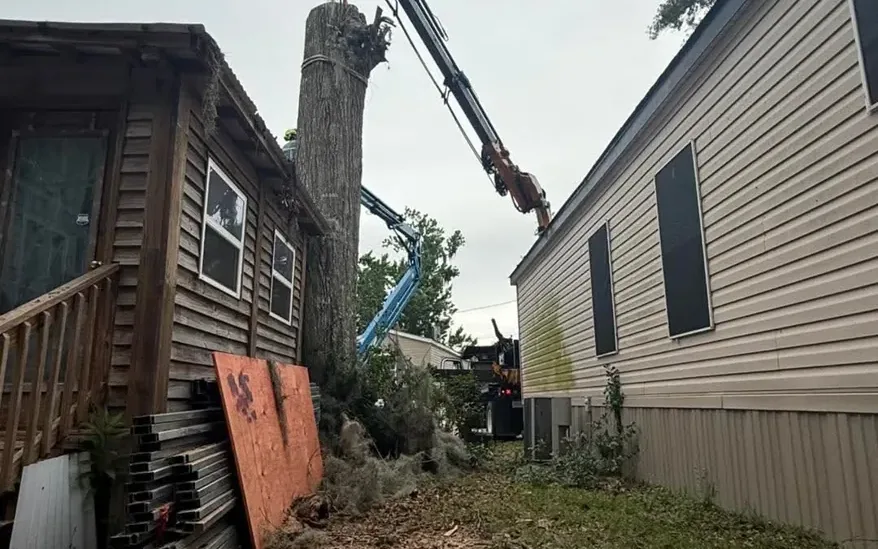
For a removal proposal, show the contractor the available route and retained features. Ask about stump treatment and the handling of material that may already be on the ground. For a preservation proposal, ask what follow-up would require another visit and who will keep the records. A realistic comparison includes the owner’s ability to carry out the recommended management, not just the first invoice. If project requirements or site use change, request a fresh review rather than relying indefinitely on an older decision.
Document changes without repeatedly approaching the tree
Keep any safe initial pictures and notes about the event in one place. If you notice a further movement or new failure from an already safe position, report it to the provider. Do not return beneath the split every day to compare a ruler mark or inspect a rope. Ask what changes warrant contacting the company sooner and what should be handled by emergency or utility services. A monitoring arrangement must not depend on the owner doing hazardous close inspection.
An absent owner should appoint a reachable property contact and share any area restrictions with occupants. Give that contact the same description of the concern and the current work status. After an assessment, retain the findings, recommendations and any interim arrangements. After work, retain the actual work record and follow-up guidance. This helps prevent a later contractor or manager from treating an old split as a newly discovered feature or assuming that a visible cable explains every remaining concern.
Start with a clear request for this split oak
Tell Tree Huggers the address, when the split was noticed, whether it appears to have changed and what is nearby. Send safe photographs showing the whole tree and affected union when available. Explain whether you are seeking urgent availability, a preservation assessment or removal pricing. If you already have a written report, say what it recommends and ask how it should be shared. Do not send unrelated private documents to make the initial request more complete.
A site discussion may lead to a more detailed evaluation before a firm recommendation is made. Ask who will provide that evaluation and whether it is part of the estimate. Use tree-risk assessment for the condition question and high-risk removal for removal planning where needed. The next step should be an appropriate assessment and a controlled work plan, with a candid explanation of what can be known. A promise made before reviewing the split is not a substitute for that process.

A split live oak needs an evidence-based decision
Describe where the split begins, whether the two stems appear to have shifted and what people, vehicles or buildings lie beneath the affected union. A historic bark seam is different from a fresh opening, so older photographs can help document change without asking anyone to stand under the fork.
Whether a split is manageable depends on its geometry, remaining sound wood, load, roots and the possibility of safe work access. Cables or pruning should never be presented as guaranteed repairs from a photograph. Ask for a clear explanation of alternatives, the limits of any support system and the reasons for recommending removal if retention cannot be justified.
What to document when a live oak develops a split
A split may be restricted to bark, involve a major branch union or extend into load-bearing wood. Those situations have very different implications. From a safe position, take one wide photograph that shows the whole crown and one closer view that shows the split relative to the trunk; do not climb or place your hand in an opening to judge its depth.
Note any change in the gap, fresh wood exposure, unusual movement or recent storm loading, and keep people away from the potential fall zone until the concern is evaluated.
The arborist's written assessment should identify the affected union, signs of decay or included bark, the loads that union carries and the targets beneath it. Cabling or bracing can sometimes provide supplemental support, but hardware is not a guarantee against failure and requires ongoing inspection. Removing a compromised limb may change the remaining crown's balance; that tradeoff needs a site-specific discussion. Do not treat a phone photograph as sufficient proof that reinforcement or removal will work.
If work proceeds, document the agreed objective, temporary access restrictions and follow-up plan. Retain before-and-after views taken from comparable safe positions, plus details of any installed support and the recommended reinspection interval. After severe wind, reassess if the opening widens or new damage appears. The outcome should be a clear management plan, not merely a receipt showing that work occurred.
Practical handoff checklist
- Keep people and vehicles outside the possible impact area.
- Capture the split's location without touching or climbing the tree.
- Ask about alternatives and the residual risk of each.
- Record any support installation and its future inspection needs.
For related context, see the tree cabling and support options guide. This planning information is not a substitute for an on-site professional assessment.
Can a Split Live Oak Be Saved? questions
Can every split oak be saved with a cable?
No. Suitability depends on the actual structure and site. A support proposal needs an assessment, stated limitations and follow-up requirements.
Should I tie the stems together while waiting?
Do not attempt improvised restraint. Keep clear and ask the appropriate professionals how the condition should be managed.
Can photos show enough for a final preservation decision?
Photos help identify the concern but cannot establish all remaining structural capacity or concealed defects.
What split information is useful in a call?
Explain where it opened, when it appeared, any visible change and what people or property are nearby.
Should I cut a branch to reduce the load?
Do not experiment on a damaged tree. The assessment and work plan should determine any pruning objective and handling method.
Is an old seam the same as a fresh split?
No. Report known history and recent changes so the assessor can distinguish observations from assumptions.
Do existing cables guarantee the oak is contained?
No. Existing hardware and the current tree condition need appropriate review.
What if the split is only visible from underneath?
Do not enter the affected area for a picture. Describe the limitation and let the professional plan an appropriate assessment.
Should tenants know about the concern?
Yes. The responsible property contact should communicate appropriate restrictions and keep occupants informed of the work status.
What should a preservation proposal include?
Ask for the concern addressed, proposed work, limitations, inspection responsibilities and changes that require an earlier review.
What should a removal scope include?
Identify the tree, access, protection of nearby features, debris handling, stump work and the authorized contact.
Does an inquiry confirm immediate dispatch?
No. Call about urgent availability and use appropriate emergency or utility services when required; the company must confirm arrangements.
Let’s plan your tree work.
Send the property address, safe tree photos and the result you need. Include access restrictions and the person who can approve the work.