A busy street affects truck positioning, pedestrians and the time available for loading. Discuss the street conditions during the estimate and identify who controls any public space involved. Traffic arrangements should be coordinated through the appropriate channels. The plan must account for people outside the property as well as the tree itself.
Practical scope and safety guidance: A busy street introduces jurisdiction, pedestrians and sight lines that an ordinary backyard estimate does not address. Mark the target tree, curb, sidewalk, bus stop, driveway, loading area and any overhead lines before selecting where equipment will stand. A tree company quote does not itself authorize a public lane, parking or sidewalk closure. The property contact should clarify which permits or traffic controls might apply and who would obtain them.
Do not take riskier roadside photographs to improve the estimate: a safe view that shows the curb relationship is enough for an initial inquiry. Consider school arrival times, transit access, deliveries and refuse collection separately, since a short closure can still interrupt them. The final scope should identify the authorized operating window, exclusion perimeter, debris-truck route and reopening condition for pedestrian areas. If access from a rear lot is proposed, verify ownership and actual travel width first.
Photograph the tree from the property side and identify the sidewalk, curb, driveway, bus stop or traffic lane affected by a proposed operation. Record delivery periods, school travel, pedestrian volumes and whether an accessible route would be interrupted. A contractor should not assume that a curb lane, public sidewalk or neighbor's frontage may be closed because it is convenient for equipment.
Confirm which local or roadway authority controls any needed permit, signage, flagging or temporary traffic plan before setting a date. Avoid using cones as the sole protection when limbs could move into an occupied travel path.
Ask for a written sequence showing where equipment stands, where material will swing or fall under control, and how cars, cyclists and pedestrians will be kept beyond the work area. Identify the person who coordinates approved closures and how residents or tenants receive accurate notice without unsupported time guarantees.
The estimate should distinguish tree work from traffic control, pavement protection, debris transport and temporary restoration. Before reopening, inspect the curb line, storm drains, crosswalk or accessible path, remove chips and small branches, and document any preexisting damage visible in photos. A clear reopening standard matters as much as the cut itself on a busy street.
Map the street edge before scheduling
Start with a sketch that shows the trunk, curb, driveway entrances, nearest intersection, sidewalks, street parking and any overhead lines. A tree may stand entirely on private land while a vehicle, outriggers or material-handling path would extend beyond it. Photograph the view toward approaching traffic from both directions, but do it from a safe location. The contractor needs to understand where people are likely to appear, not only where the tree stands.
Separate observations from assumptions. A lane that looks quiet during a midday estimate could be busy during school pickup, commuting or deliveries. Note posted restrictions, bus stops, bicycle lanes, accessible crossings and areas where vehicles commonly turn. Do not promise that cones or a private property manager can authorize use of public space. Record who owns the decision and what arrangements require confirmation with the appropriate road or property authority.

Protect pedestrians and accessible travel
A sidewalk next to a work zone is an active route, not leftover space for branches and debris. Discuss the people who rely on it, including mobility-device users, children, shoppers and visitors unfamiliar with the property. Ask the contractor to identify whether the safe plan can keep the route usable or whether a properly approved alternate arrangement is necessary. The responsible parties, rather than passersby, must determine a suitable boundary.
Look for informal pedestrian shortcuts through a parking area or across a vacant lot. People may approach from behind trucks, parked cars or the far side of a building. A work plan should address those directions as deliberately as the main entrance. Public warnings and any required traffic-control measures need to match the site and applicable approvals; a sign alone does not replace a physical separation or professional control.
Distinguish private property from public access
A tree rooted inside a property boundary can still require use of public space for equipment, debris or loading. Identify the curb, sidewalk, bus stops, parking restrictions, hydrants and drainage before discussing the work plan. The public-facing portion of the job can need separate permissions or qualified traffic arrangements.
Do not assume cones or a quick unloading stop satisfy street requirements. Ask who controls the right-of-way, who obtains any necessary approvals and whether the sidewalk must close. Pedestrians should never be sent through an active drop or loading zone. The work sequence must consider people outside the property.

Pedestrian and traffic arrangements require coordination
Provide wide street-level photos showing the tree, driveway and both directions of traffic, taken from a safe position. Note school arrival periods or delivery schedules if relevant. Avoid stepping into the road or standing beneath unstable limbs. An online map supplies context but cannot prove working clearance.
Compare bids for what is included: tree operation, loading, hauling, permitted road use and pedestrian controls. A cheaper total may reflect a narrower scope. Ask how the curb ramp and sidewalk will be checked before reopening.
Confirm authority for curb and lane use
A property owner's permission to remove a tree does not necessarily include permission to place equipment in a roadway. Before the work date, distinguish private parking, a shared driveway, a public sidewalk and any publicly controlled lane or shoulder. Ask who will obtain and document authorizations if the proposed operation affects those areas. Make responsibility explicit in the estimate so it is not discovered after a truck arrives.
If a roadway arrangement cannot be approved, the contractor may need a different position, smaller equipment, another removal technique or a revised schedule. Those alternatives can change access, duration and debris handling. A useful written scope identifies the proposed assumptions and the conditions that could trigger an adjustment. Never ask a crew to improvise a public road closure solely because the booked work window is short.

Choose a workable time around local activity
List the times when the frontage must remain accessible: school traffic, employee shifts, business openings, refuse service, deliveries, public events and emergency access. The best work window is the one that can be authorized and managed safely, not simply the quietest hour seen during a drive-by. Ask whether setup, branch lowering, loading and final sweeping can all fit within the stated window.
Break a large job into phases if needed. For example, site preparation and notices may precede the main tree operation, while loading and cleanup continue after the last section is down. Identify which areas must stay closed through each phase. Do not automatically reopen a sidewalk as soon as cutting ends; the ground crew may still be moving logs, equipment or vehicles across that route.
Treat a busy road as a separate operating environment
A tree near a roadway can expose passing drivers, pedestrians, cyclists and transit users to moving equipment and falling material even when the trunk is entirely on private property. Do not step into traffic to take measurements or attempt to design a lane-closure plan. Provide photographs from safe positions showing road frontage, sidewalks, driveways and possible equipment approaches. Note relevant parking or delivery restrictions. Qualified crews and road authorities must determine whether permits, barriers or traffic control are needed.
Ask the contractor how people outside the parcel will be excluded from the active cutting and loading area. Work windows may need to account for school traffic, public access or utility operations. Confirm who is responsible for approvals and what will happen if restrictions are not granted. An estimate should separate removing the tree from restoring public-facing landscaping, sidewalk edges or curbs if they are affected. A clear work zone, lawful traffic management and intact accessible routes matter as much as clearing the yard.
Evaluate truck footprint and material travel
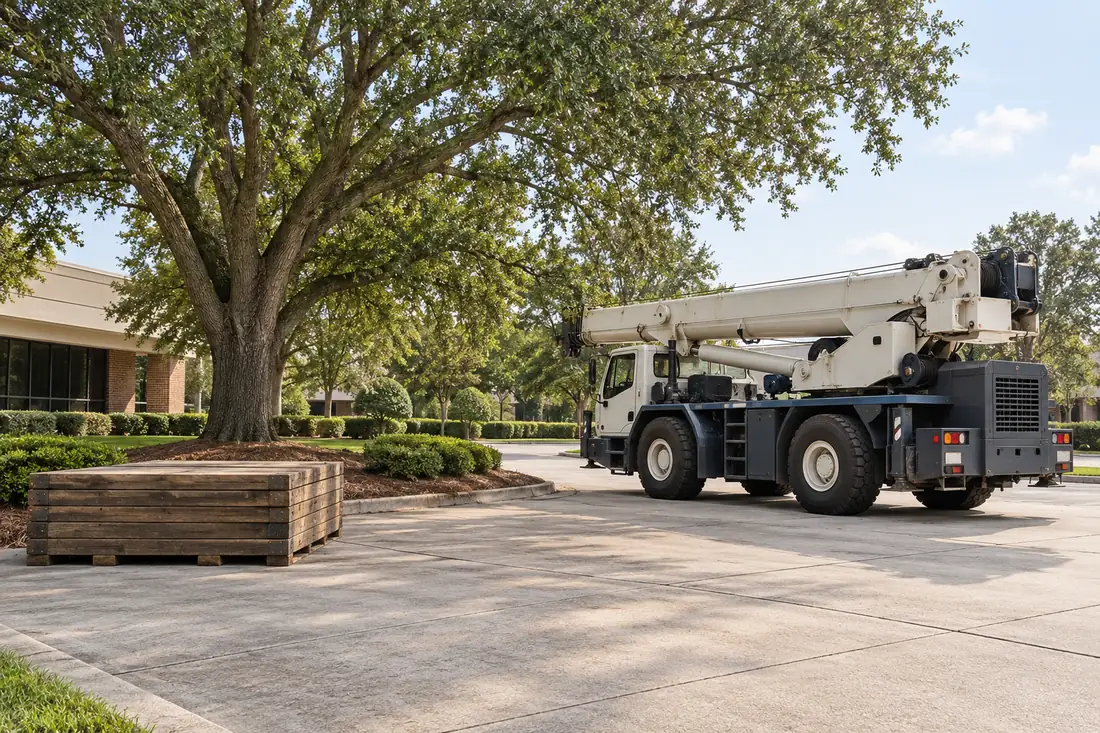
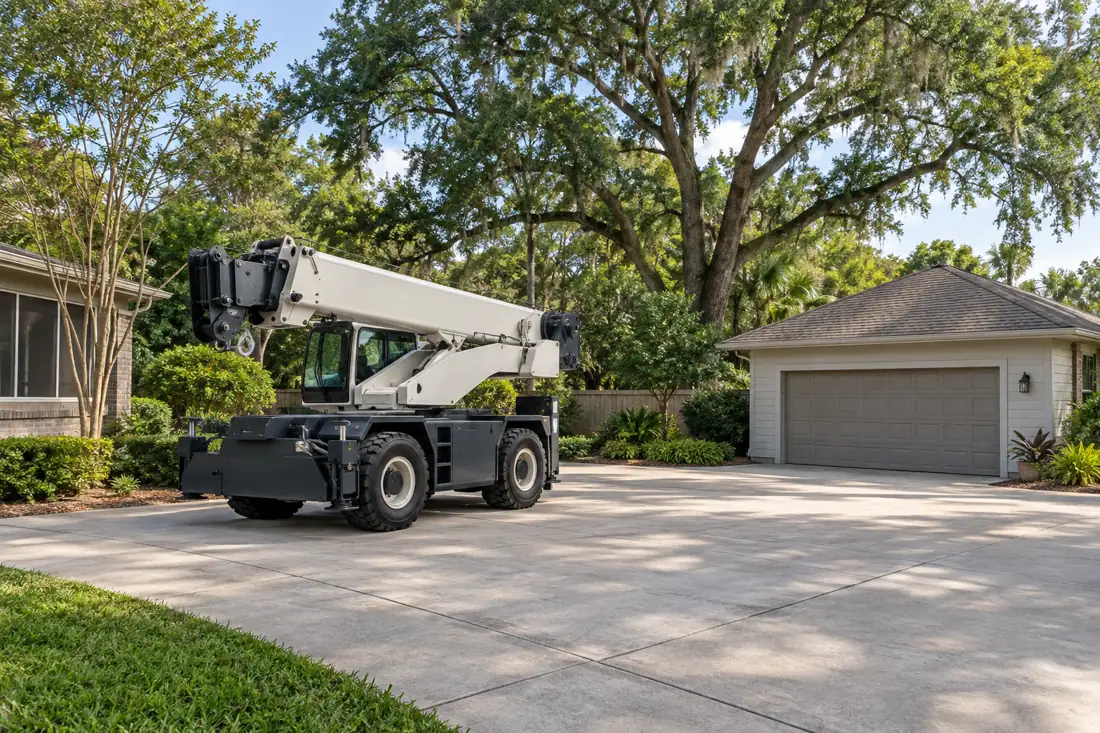
A tree-service truck needs more than a parking rectangle. The team must account for doors, loading, turning, stabilizers where applicable, overhead clearances and the space necessary to maneuver wood without crossing an occupied route. A crane or lift's published reach does not prove that a particular position or configuration is suitable. The qualified crew should assess ground conditions and setup geometry on site.
Follow the branch or log from the tree to its final loading location. If it would pass near parked vehicles, an entrance or a neighboring parcel, flag that interface during the estimate. A smaller piece size may help with handling but can alter the duration and crew requirements. The owner should share gate restrictions and fragile landscaping without trying to design the rigging or equipment operation.

Identify utility and visibility hazards
Overhead conductors, service drops, communications lines and pole-mounted equipment may be difficult to judge from the ground. Include their approximate location in site photographs without guessing at voltage or clearance. Notify the contractor of any known utility conflicts before a method is chosen, and let the qualified parties coordinate the appropriate utility involvement. Tree work around electrical hazards is not a homeowner task.
Streetlighting, tree shade, blind bends and parked vehicles also change what approaching drivers and pedestrians can see. A temporary work zone can reduce that visibility even when equipment stays on private ground. Ask how setup and loading will affect sightlines at entrances and crossings. Confirm the responsible traffic-control plan before work starts rather than relying on crew members to wave vehicles around an obstruction.
Coordinate with neighboring properties
A busy frontage often serves more than one address. Nearby tenants may depend on the same access lane, a shared lot or a loading area. Identify the people with authority to approve temporary changes and the users who need practical notice. The discussion should cover expected dates and affected spaces without making unsupported promises about exact completion times or noise levels.
Keep communications specific: where vehicles should not park, which entrance remains available, whom to contact about a changing delivery, and when updates will be provided. Businesses may have late arrivals or vendors unfamiliar with the plan. A single accountable site representative can collect questions and relay them to the contractor. That avoids conflicting directions from several occupants while the crew is setting its exclusion zone.

Include changing conditions in the plan
Weather, saturated ground and traffic can alter the practical method after the estimate. High winds, storms or poor visibility can make a previously workable operation inappropriate. The contractor should retain responsibility for deciding whether conditions permit the work and for explaining any necessary postponement or scope change. A scheduled date is not an obligation to continue in unsafe conditions.
Check for changes shortly before the appointment: new roadwork, parked equipment, blocked gates, fresh pavement, utility work or an unexpected delivery. Share those changes promptly and avoid moving barriers or entering the active work zone to solve them yourself. The useful owner action is to keep the contractor informed and help arrange access, not to make technical cutting, lifting or traffic-control decisions.
Verify debris loading and street cleanup
Logs, brush and chips require a route to the loading vehicle, which may consume as much street-side space as the cutting phase. Confirm what material will leave the property, what may remain at an agreed location and whether stump grinding is separate. Ask who removes small debris from the entrance, sidewalk and curb area, and whether a second haul trip or different equipment could be required.
Agree on a completion check that includes pedestrian surfaces, storm-drain openings and parking spaces affected by the work. The scope should distinguish ordinary cleanup from repairing pre-existing pavement damage or restoring landscaping beyond the agreed operation. If public infrastructure is affected, the appropriate authority may have additional requirements. Take final site photographs only after the responsible crew has released the work area.

Prepare an estimate that answers the right questions
Send a wide photograph showing the tree and street together, a second view along the sidewalk, a close view of visible defects, and images of the proposed equipment access and loading area. Give the address, the desired outcome and any restrictions you know. Avoid climbing, pulling branches or entering traffic to capture a better picture. Photos support an estimate but cannot replace a site assessment where conditions demand one.
Ask the contractor to describe the included work, access assumptions, public-space coordination responsibilities, cleanup scope and how changes will be approved. If alternatives are possible, compare them on the same completion standard rather than price alone. Keep records of authorizations and agreed notices with the property file. A sound plan protects the public as well as the tree-work crew and gives everyone a clear basis for the day of work.
Questions about this project
Can the crew block a public sidewalk or road?
Required arrangements must be coordinated with the appropriate authority. Identify public routes and restrictions before scheduling. A private work agreement should not be treated as automatic permission to occupy or close public space.
When should parked vehicles be moved?
Set the timing and responsible contact before the work window. Vehicles may need to leave the tree zone, equipment route and loading area. Confirm where access must remain available during each phase.
Does a machine's maximum reach prove it can do my job?
No. Loaded reach, configuration, section handling, obstacles and setup conditions all affect suitability. A contractor needs to evaluate the particular tree and property before confirming an equipment plan.
Can specialized equipment replace a site assessment?
It does not remove the need to assess tree condition, targets, access and support conditions. Ask how the contractor will confirm that the proposed machine and method fit the actual scope.
Can a business stay open during tree work?
That depends on the site and scope. Discuss occupied routes, exclusion areas, loading and work windows with the contractor and property representative. Do not assume normal access can continue through the active work zone.
Who should communicate with tenants or visitors?
Agree on that responsibility with the property representative. The contractor needs a clear site contact, while the owner or manager should use the property's established process to communicate access changes and work windows.
How should extra work be approved?
Use the agreed approval process and identify the change, reason, scope, price or schedule effect as applicable. Confirm who has authority before treating an additional tree or task as part of the original job.
What completion records are useful?
Keep the agreed scope, tree or area identification, authorized changes, invoice and labeled photos where appropriate. Include unresolved items and a contact. Contract-specific records should follow the buyer's stated requirements.
What should I compare besides the price?
Compare tree identification, work objectives, access assumptions, hauling, stump treatment, site finish and exclusions. Ask whether permits or other coordination are part of the scope and who can approve changes if conditions differ.
Does an online request book the crew?
No. A request starts the estimate conversation. The company still needs to discuss scope, availability and any site assessment. For a dangerous or urgent condition, call 504-458-8336 rather than relying on a form response.
What should I tell Tree Huggers about tree work with a busy street beside the property?
Explain the property address, the work you want and the specific concerns: traffic exposure, public space, loading window. Send safe photos of the tree, surroundings and access route. The contractor can then discuss the assessment and scope needed for this situation.
How do I request an estimate for this work?
Call 504-458-8336, text photos or use the estimate form on this page. Include the address, desired outcome and any timing constraints. The company will need to review scope and availability; an online request does not confirm a price, appointment or emergency dispatch.
Get a scope for your property
For work beside a busy street, supply wide views from safe public or permitted areas showing the roadway, sidewalk, sight lines, drive entrances and tree position. Do not step into traffic to document a limb. Tell the estimator about school pickup, deliveries, peak customer hours and pedestrian access.
Ask who determines the need for traffic control, agency permits or a temporary lane or sidewalk closure and who is responsible for securing them. A proper written scope separates tree cutting, debris loading, road-surface protection and reopening checks rather than assuming ordinary driveway access will be enough.