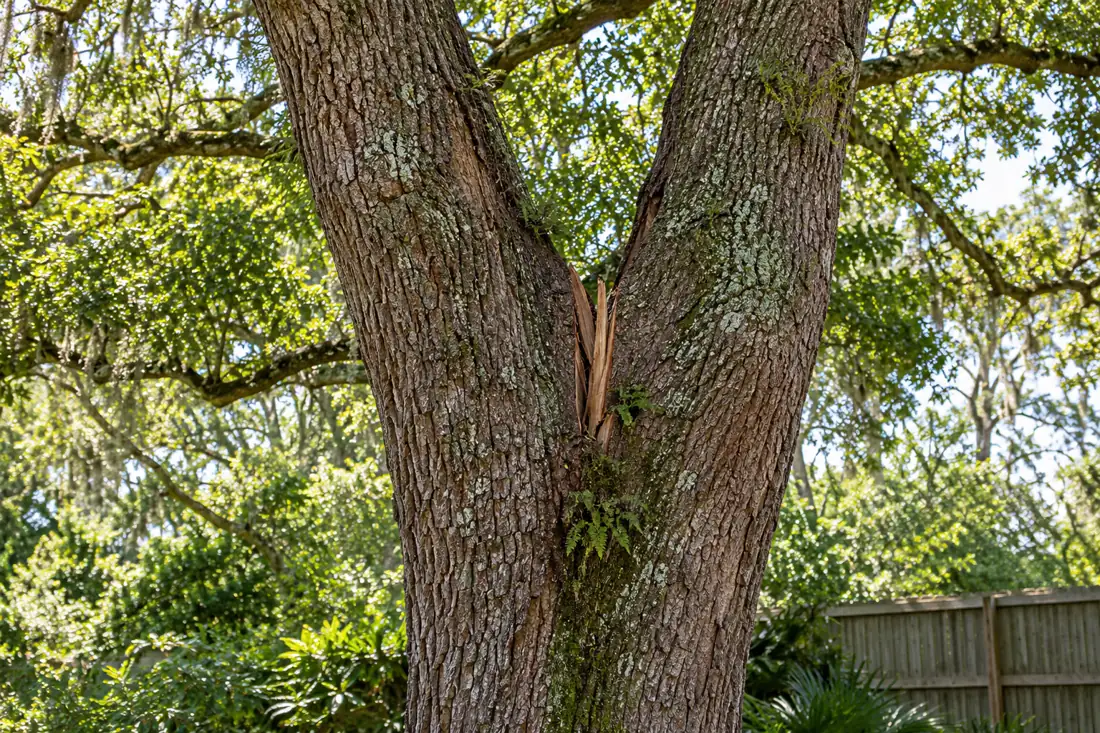
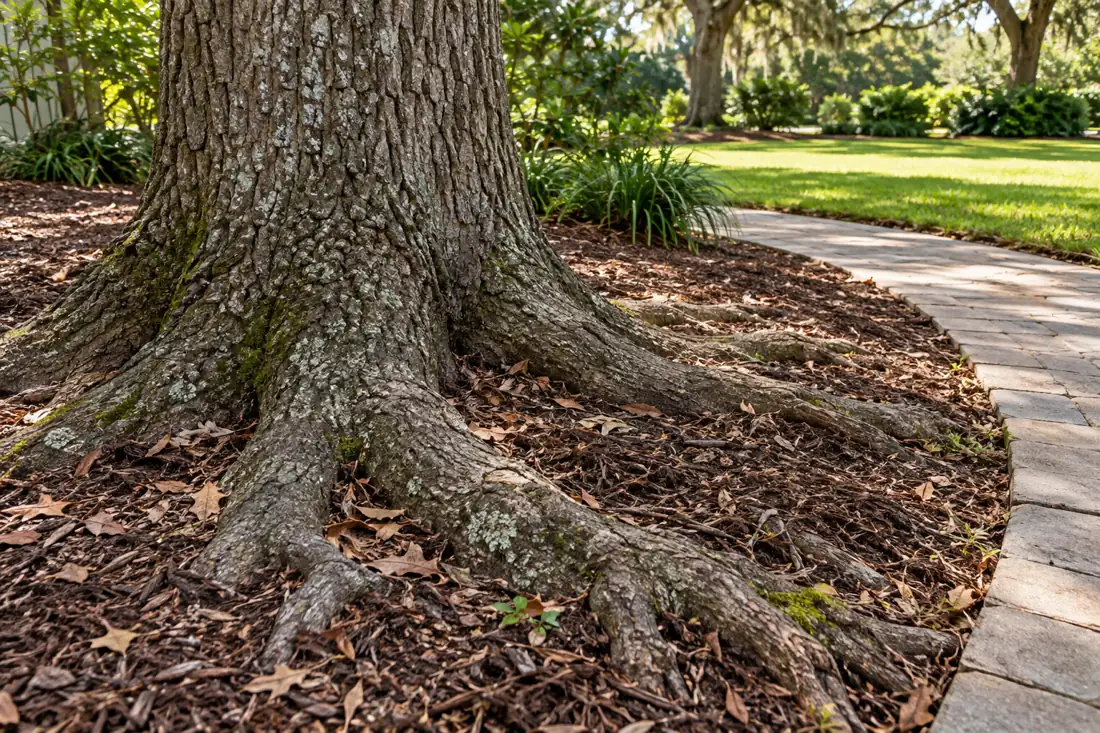
A visible crack where major branches meet should be evaluated in the context of the connected stems and what is below them. Keep people out of the affected area if failure appears possible. Share when the crack was noticed and whether it changed after weather. A support recommendation requires assessment of the actual structure.
Site planning detail: Photograph a suspected union crack from a safe position, including the full crown and anything below the affected leaders. The most important new detail may be whether the opening is widening, whether bark has recently split, or whether the two stems are moving separately after wind. Do not climb into the canopy or wrap a homeowner cable around the union to hold it together. Clear the immediate target area until an arborist evaluates the structure.
A recommendation may involve selective reduction, engineered support by qualified personnel, additional assessment, or removal, but no photograph can establish the correct choice or the load capacity of a proposed support. If a building, driveway, or public path is exposed, record that use clearly so the assessment addresses the consequences as well as the defect.
A split at a union involves both the defect and the forces acting on the connected stems. From the ground, photograph the crack in relation to the full crown and any nearby building, walkway or vehicle route. Record whether the opening is old and weathered, fresh and pale, or visibly widening after wind.
Do not climb, strap the stems together or attempt to wedge the split closed. A narrow photograph can conceal heavy limbs, included bark or the direction a damaged stem could travel if it separates.
For an estimate or independent opinion, ask what inspection can establish about the union, whether temporary exclusion beneath it is needed and which options are actually viable. Cabling, bracing, selective reduction and removal solve different problems and must not be treated as interchangeable add-ons. If fresh splitting, audible movement or hanging material is present, keep people clear and report the change as potentially urgent.
Request a documented scope that identifies the affected stems, the reason for each proposed action and the limitations of any support system.
Recognize the difference between a bark seam and an opening in wood
A branch union is the connection where a limb or stem joins another part of the tree. Some unions have a natural ridge of bark, while others have a tight seam where bark can become enclosed as stems grow together. A visible line is not automatically a dangerous split. The question is whether the wood at the union is continuous and sound, whether the line has opened, and whether loads are changing the connection. These facts require more than a photograph of dark bark.
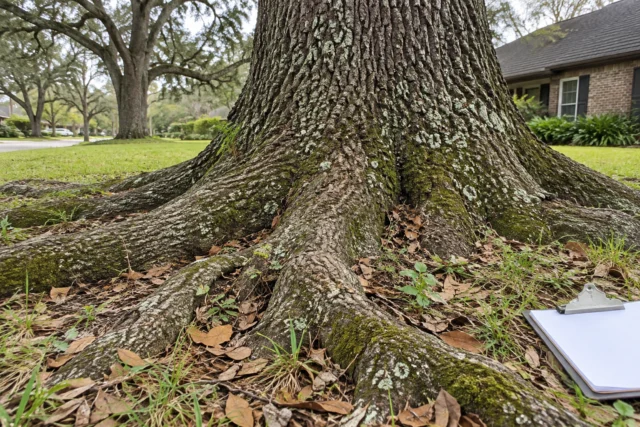
Consider the connected stems and load distribution
A fork with two large leaders can have different forces acting on it than a small side limb. Weight toward the end of a long branch, asymmetric canopy growth, decay, previous pruning, and wind exposure can change the load at an attachment. A union that looks narrow from one angle may not reveal how much sound wood connects the stems. That is why professional evaluation considers the entire tree, not only the visible fissure.
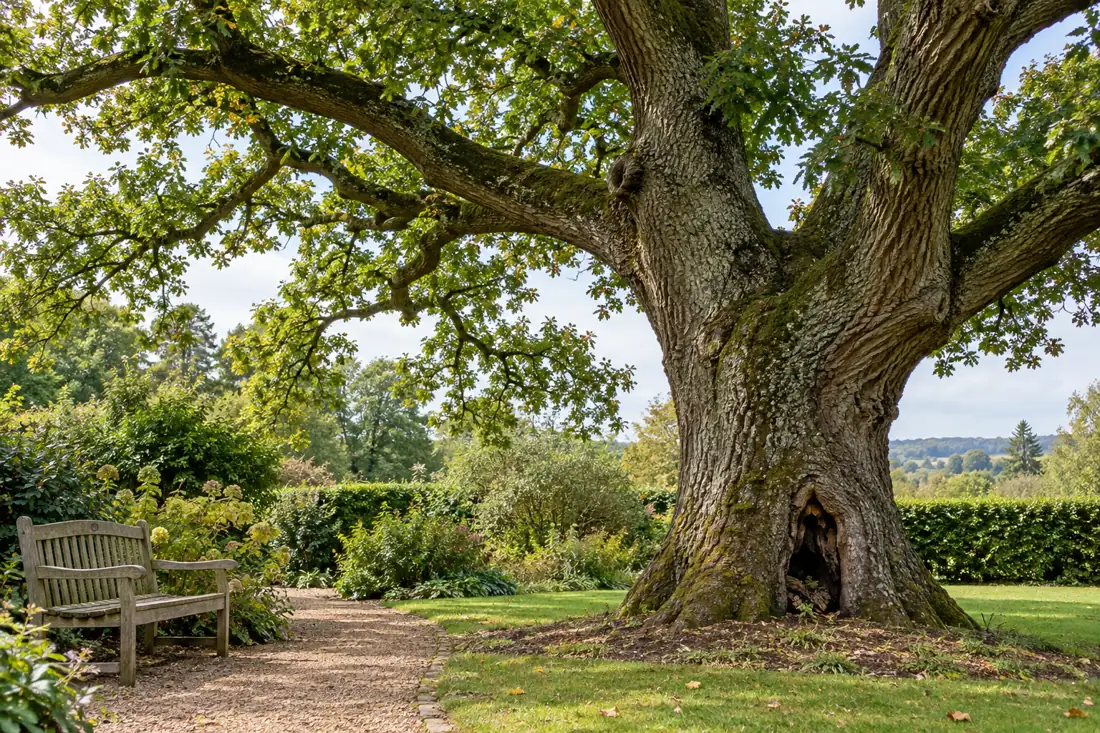
Ask whether one stem is relying on another for support, whether the union has included bark, and whether branch movement or crown imbalance is relevant. The answer may depend on the tree's species and history. A mature live oak spreading across multiple targets presents different consequences from a young ornamental tree in a low-traffic field. The defect, likely loading, and exposure all belong in the decision.
Describe both stems and what the union supports. A crack at a branch union should be documented with photographs that show the whole tree, both attached leaders and the location of the fracture relative to people, vehicles or structures. Note whether the crack is new, extending or associated with recent wind, but avoid climbing, tugging on limbs or applying a strap yourself. A qualified evaluation may consider load, decay, structure and the consequences of failure; no single image proves that pruning, support or removal is the right answer. Keep the potential fall zone clear while the condition is assessed.
From a safe ground-level location, note whether the apparent crack exposes fresh wood, changes after wind, or continues down the trunk. Do not place hands in an opening or climb to inspect it. A close-up without the full branching structure is incomplete; a wider view helps show which connected limbs are involved and what occupies the space below.
Observe a suspect union in the context of the canopy
A narrow dark seam where branches meet may be ordinary bark, an old injury or an active structural opening. Note whether the line is new, whether bark is freshly separating, whether any branch changes position and what lies beneath the union. Use a safe wide overview instead of stepping below a suspected limb for detail photographs.
A qualified inspection should consider the whole tree, branch load, decay indicators, likely targets and the purpose of intervention. Selective pruning, support systems and removal are distinct recommendations and should not be chosen simply from a single close-up image. If the limb could fall, keep the area closed until it is evaluated.

Distinguish an active branch split from an old bark seam
A dark bark line and a fresh opening through load-bearing wood can look similar in a cropped image. Document the whole fork and supporting branches from outside the possible fall area. Record separated wood fibers, visible movement and whether a storm preceded the change. Do not strap, drill or cable the union without professional assessment.
An appropriate recommendation considers the load on each stem, exposed targets and the condition of adjacent branches. The scope may involve carefully chosen reductions, support work where justified, monitoring or controlled removal. No online picture can guarantee a split branch is stable.
Document change without testing the branch yourself
A crack that appeared after a storm deserves a different conversation from an old surface feature that has looked similar for years. Record when it was first noticed and whether anyone heard splitting or saw movement. If there is an existing photograph taken before the change, keep it with the new image so a professional can compare appearance. Do not bend, shake, pull, or probe the limb to decide if the union is strong.
Use an ordinary zoom from a safe location and photograph both sides when accessible without entering a hazardous area. If a cracked limb extends over a driveway, patio, school path, or roof, identify that target. If you suspect an active split or see hanging wood, keep people away and seek prompt professional guidance. A phone photograph is a starting point for triage, not a mechanical strength test.
Distinguish crack symptoms from other tree conditions
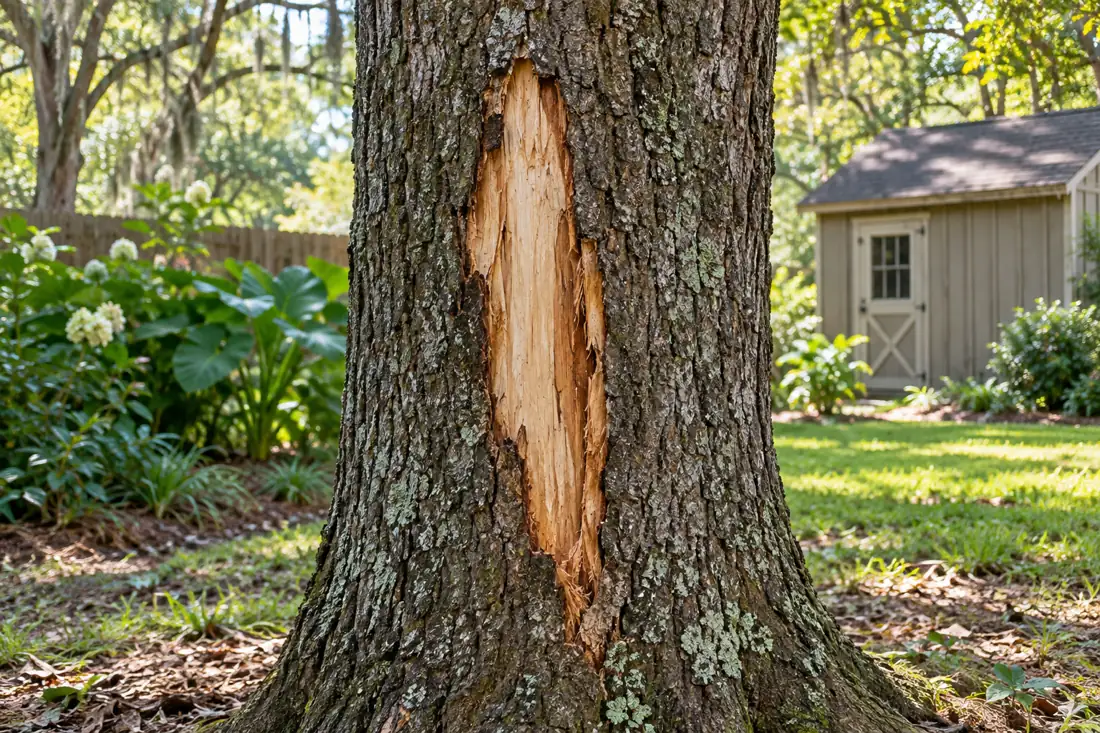
Cracks can appear near cavities, old branch wounds, decay areas, or large unions with bark included between stems. Fresh splinters or displaced bark may suggest recent movement, while dark discoloration alone can have several causes. Mushrooms at the base or a leaning trunk may be relevant to the whole-tree assessment but should not be assumed to explain a branch union without evidence. Multiple observations are useful because a single symptom seldom tells the full story.
Provide any known history of lightning, major pruning, trenching, construction, or previous support hardware. Be careful with online diagnosis claims that label every V-shaped fork unstable or every U-shaped fork safe. Geometry can influence a professional inspection, yet wood quality, size, forces, defects, and consequences vary. The correct question is what a qualified assessor can establish for this particular tree.
Describe the branch union and the exposure below it
Begin by identifying whether the visible mark is a longstanding bark seam or a change that appears to have opened through wood. Photographs from an earlier season, if available, may answer the timing question better than a close-up today. Take a broad view showing both connected stems, followed by a view of the union from a safe position.
Do not tug on branches, insert a tool into a crack or climb to measure it. Some unions require urgent attention, and DIY testing adds risk without producing a defensible diagnosis.
Record what sits beneath each connected limb: an occupied patio, driveway, bedroom roof, public footpath or a rarely used lawn. This helps the assessor discuss likely consequences instead of focusing only on the appearance of a split. Observe whether the stems carry unequal crown weight or reach over different structures, but leave load judgments to the professional. If there is recent movement, a fresh audible fracture or a visibly unstable limb, keep the potential impact area clear until it is assessed.
Request a recommendation that identifies which limbs and connection are being addressed. Reduction pruning may lower loading in some conditions; support hardware can sometimes manage selected structural weaknesses but cannot reverse existing severe wood damage or guarantee against failure. A proposed cable should come with a description of what it supports, what it does not protect and who will maintain or inspect it. For certain unions, removing a major stem or the entire tree may be more appropriate, depending on findings.
After work, retain the original union photographs and a written account of any hardware installed or branches reduced. Ask when the connection should next be inspected and what changes should prompt earlier review. Do not assume an intact canopy indicates an unchanged union. A property owner gains more from a monitored, explained decision than from a one-time treatment label that never defines what condition was found or how the remaining risk will be managed.

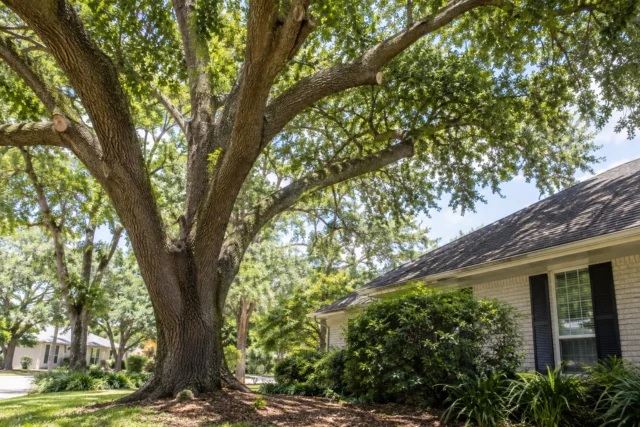
Know the difference between reduction pruning and removal
One possible recommendation for a defective union may be reducing loads through selective pruning, but that is not appropriate for every condition. Removing healthy canopy unnecessarily can create stress and additional wounds, and indiscriminate topping is not a substitute for structural assessment. A professional should identify which branches would be affected, the intended objective, and whether enough healthy tree would remain. Some defects require a different approach, including exclusion or removal.
Ask the provider to explain whether proposed cuts address the problem, merely improve clearance, or serve a separate aesthetic purpose. Removal of a hazardous part and removal of the whole tree are not interchangeable decisions. If several trunks share the same union, simply cutting one stem may change forces on the others. The plan should describe what remains, not only what comes down.
Understand support systems and their limitations
Cabling or bracing may be considered in some trees with specific structural conditions, but a support system cannot turn unsound wood into sound wood. Its suitability depends on the assessed defect, the remaining structure, installation design, and an inspection or maintenance plan. Hardware should not be prescribed from a distant photograph or treated as an everlasting safety certificate. An existing cable also does not prove the union is secure today.
If the tree has support hardware, report its approximate location and any visible change. Do not climb to tighten or remove it. Ask who installed it, whether records exist, and what the current professional recommends. A support recommendation should state what it is intended to mitigate and what risks or uncertainties remain. A branch above an occupied area may require different treatment from one where exposure can be controlled.
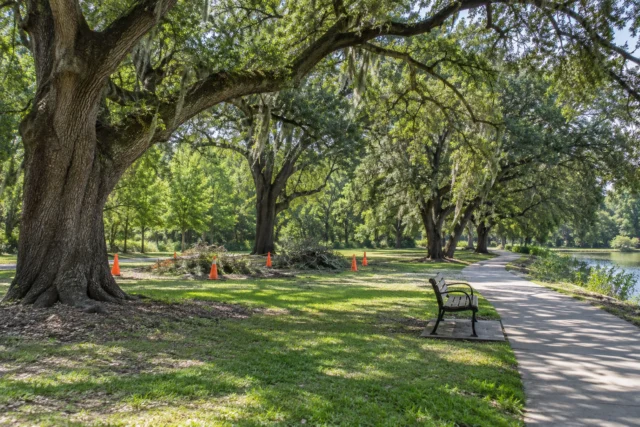
Assess who and what is within the potential impact area
A visible branch crack becomes more consequential when the connected limb extends over a frequently used path, building, vehicle parking area, or play space. The same defect may present a different management decision in an unused back corner of a large property. This is why risk assessment considers the tree and the targets together. Do not solve the uncertainty by walking directly under the union to measure it.
Identify whether access can be restricted while an evaluation is arranged. An owner may temporarily move vehicles or close a path without altering the tree. For shared properties, communicate which areas are restricted and who can authorize work. Do not claim that a warning sign or a roped-off area makes an unstable tree safe. Those measures address exposure temporarily and should be matched to the actual professional advice.
Prepare a focused professional evaluation request
Send the whole-tree photo, a zoomed union view, an image showing what lies below, and a short account of when the condition was noticed. Note the species if known, the approximate size, and any changes after recent weather. If the tree is near lines, structures, or shared property, say so before the visit. A clear description is more useful than asking someone to certify the tree as safe based on a few pixels.
Ask what level of assessment is being provided, whether further investigation might be needed, and how recommendations will be documented. When reviewing proposals, distinguish a structural inspection from an estimate for a specific pruning or removal service. If the provider recommends monitoring, request an explanation of what changes should trigger another review and who is responsible for scheduling it.
Create a record that follows the union over time
If the professional determines that observation or ongoing management is appropriate, save dated images from repeatable safe viewpoints and a description of the exact branch union. Record the recommendation, any work completed, and the circumstances that should prompt reinspection. Weather events, new cracking, visible movement, or changing targets may alter the assessment. A record is useful only if it helps a later reviewer understand what actually changed.
For Tree Huggers, a responsible first inquiry can focus on the defect, the nearby exposure, and whether the owner is considering evaluation, pruning, support, or removal. Work should not be described as eliminating all future failure risk. The practical goal is a documented, site-specific choice that respects both the value of a mature tree and the consequences of a structural problem.
Questions about this project
Does healthy-looking foliage mean a tree is structurally safe?
No. Leaves do not establish the condition of roots, trunk or branch connections. Explain visible defects and recent changes, and ask for an assessment appropriate to the tree and nearby targets.
Should I test a cracked branch or trunk?
Do not pull, shake, climb or cut damaged material to test it. Keep clear of the affected area and describe the condition from a safe location. Qualified assessment and an appropriate work plan are needed.
Does a cable make a tree permanently safe?
No support system should be treated as a guarantee against failure. The tree and hardware need appropriate review, and new damage or changed conditions should be assessed rather than assumed to be contained.
What should I ask about a proposed support system?
Ask what condition it addresses, why the tree is suitable, what limitations apply and what inspection or follow-up is recommended. Keep those recommendations with the tree's work and maintenance records.
Is a free work estimate the same as a written risk assessment?
Not necessarily. Explain whether you need pricing, condition advice, a documented assessment or a combination. Ask what the visit includes, who provides it and what limitations apply to any findings or recommendations.
What history should I share?
Share known storm damage, prior failures, construction, root disturbance, flooding, pruning and recent changes. Include the timing and nearby property use. Useful history supports the evaluation without replacing inspection of the current tree and site.
Which property features should I point out?
Identify buildings, vehicles, fences, fixed fixtures, landscape features, utilities and occupied routes. Explain what can move and what must remain. Include existing damage and any buried features you know about along the access route.
Should people remain inside the work area?
The contractor and site contact should establish an exclusion area and access arrangements appropriate to the work. Keep children, pets, visitors and other workers outside the active zone until the responsible parties say it can reopen.
Which photos should I text first?
Send a wide tree view, the base if safely visible, nearby targets and the equipment route. Add the address, desired work and any recent change. Identify each tree clearly if the request involves several.
Can photos confirm that a damaged tree is stable?
No. Photographs may omit defects, support conditions and other important details. Use them to prepare for the contractor's assessment, and avoid entering hazardous areas to obtain a better view.
What should I tell Tree Huggers about cracks at a tree branch union?
Explain the property address, the work you want and the specific concerns: union crack, connected stems, target exposure. Send safe photos of the tree, surroundings and access route. The contractor can then discuss the assessment and scope needed for this situation.
How do I request an estimate for this work?
Call 504-458-8336, text photos or use the estimate form on this page. Include the address, desired outcome and any timing constraints. The company will need to review scope and availability; an online request does not confirm a price, appointment or emergency dispatch.
Get a scope for your property
Branch-union cracks deserve a safety-focused inquiry, not a guess based on a distant photograph. Identify which tree is affected and whether the split is between two major stems, along a branch attachment, or on a limb already hanging. Describe any recent wind, sudden movement, fresh exposed wood or changes in the opening; include photographs only from ground that is already safe to occupy.
Tell us what lies beneath the union, such as a driveway, play area, pedestrian path or roof. Do not enter the fall zone or pull on either stem to test it.
Ask for an assessment that distinguishes the visible crack from the condition of the whole tree, discusses exposure to people or property, and records what is known versus uncertain. The written scope should separate temporary access restrictions, further diagnostic work and any proposed pruning, support or removal. A brace or cable is not an automatic solution, and a photo cannot prove the attachment will hold. If a limb appears unstable over an occupied area, restrict access while seeking qualified evaluation.