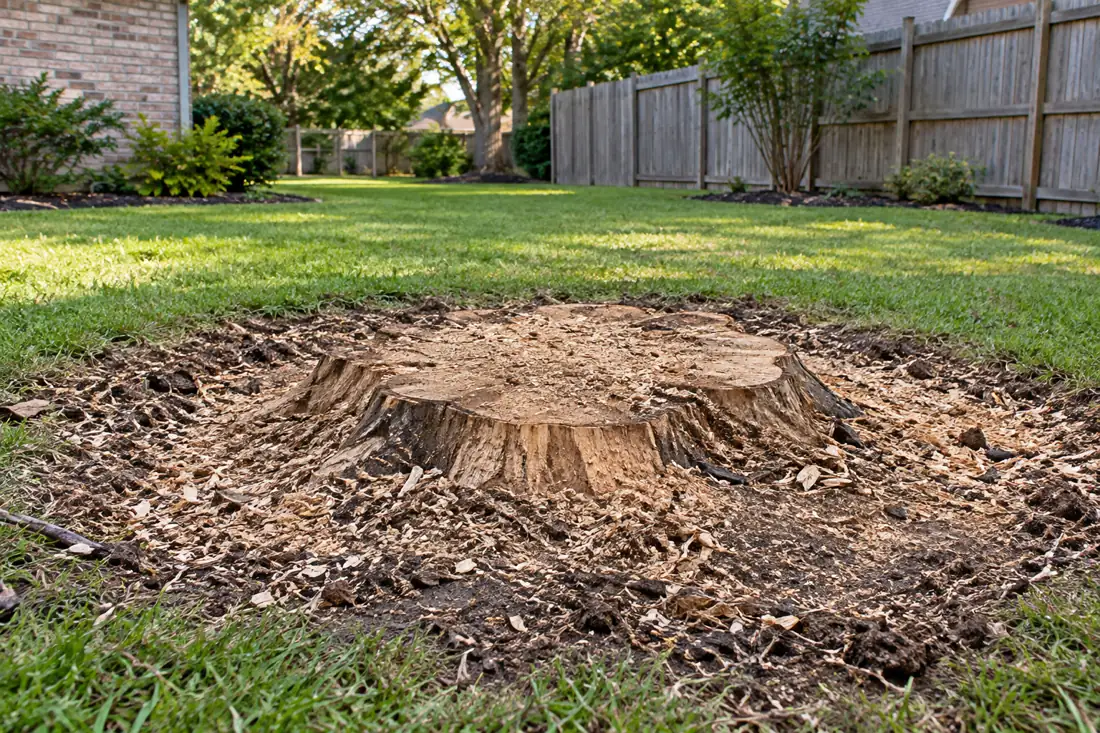
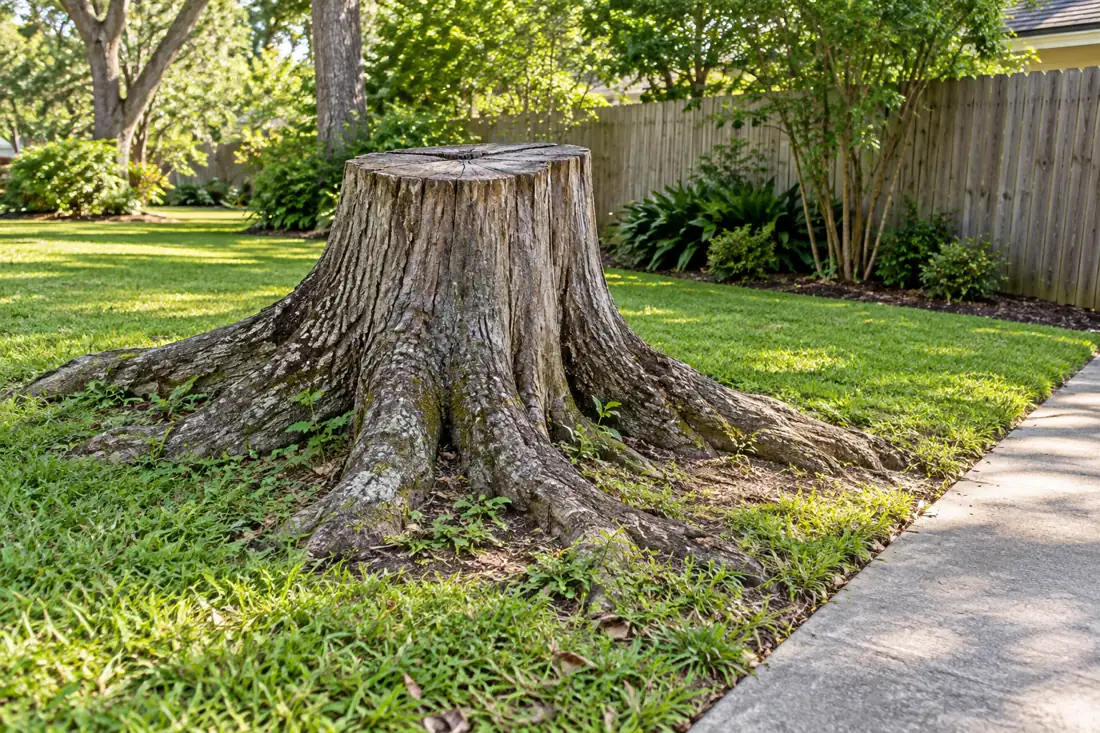
A backyard stump may need a different machine or access arrangement from an open front-yard stump. Measure the usable gate opening and identify steps, slopes and tight turns. Discuss where grindings will go and whether hauling is included. Access should be confirmed before the work appointment.
Site planning detail: A fenced yard can look spacious on a property map while the actual machine route is too tight. Measure the clear gate opening with the gate swung fully open, not simply the distance between posts. Then check the narrowest turn, overhead branches, patio corners, steps, utility boxes, slopes and soft turf. Photograph the route from the street to the stump as well as the stump itself.
If fence removal is proposed, identify which panels or hardware may be disturbed, who authorizes it and what restoration is included. A small grinder may fit but have different production or grinding-depth limitations. Protect vulnerable landscaping and discuss where chipped wood will be placed. A quote that describes only stump diameter without documenting access can miss a large part of the real job.
Before pricing a fenced-backyard stump, measure the narrowest usable gate and note steps, grade changes, planting beds, air-conditioning units and soft ground along the route. A machine that fits the opening may still be unable to turn or travel safely. Share photographs from the street, gate and stump instead of relying on one close-up.
If temporary panel removal is considered, agree who authorizes it, who removes and reinstalls it, and how the fence is checked afterward. Confirm whether chips remain on site or travel back through the gate. Keep children and pets away from the work area until debris is cleared and the contractor confirms normal access can resume.
Plan the return journey through a backyard
A backyard machine must not only fit through the gate on arrival; it must also travel back across the same ground after any chips or equipment loads change. Record narrow corners, step heights, gate swing direction, overhead obstacles and vulnerable patios or landscape edges along the entire route. A width measurement at the latch post alone may miss the tightest turn. Keep pets and children away from the route and never arrange to lift machinery over a fence without an approved professional method.
Recent rain changes the access question. Ruts, sinking wheels and turf tearing can develop before a grinder reaches the stump, especially near drainage swales or soft fill. Decide beforehand whether the work should be rescheduled, protected with suitable access measures or re-scoped for different equipment. The soft-ground guide covers that weather-sensitive decision; this fenced-backyard guide remains focused on route geometry, permissions and reinstatement of disturbed yard features. For the related but distinct decision, see Stump Grinding on Soft Ground.
Map the entire route to a backyard stump
Walk from the unloading point to the stump and record the tightest gate opening, turns, steps, slope changes and soft patches. Note pool equipment, irrigation heads, low branches and outdoor furniture that cannot be moved. A clear gate by itself does not establish that a machine can reach the stump; a narrow turn or raised threshold can be the limiting point.

Protect fence posts and nearby structures
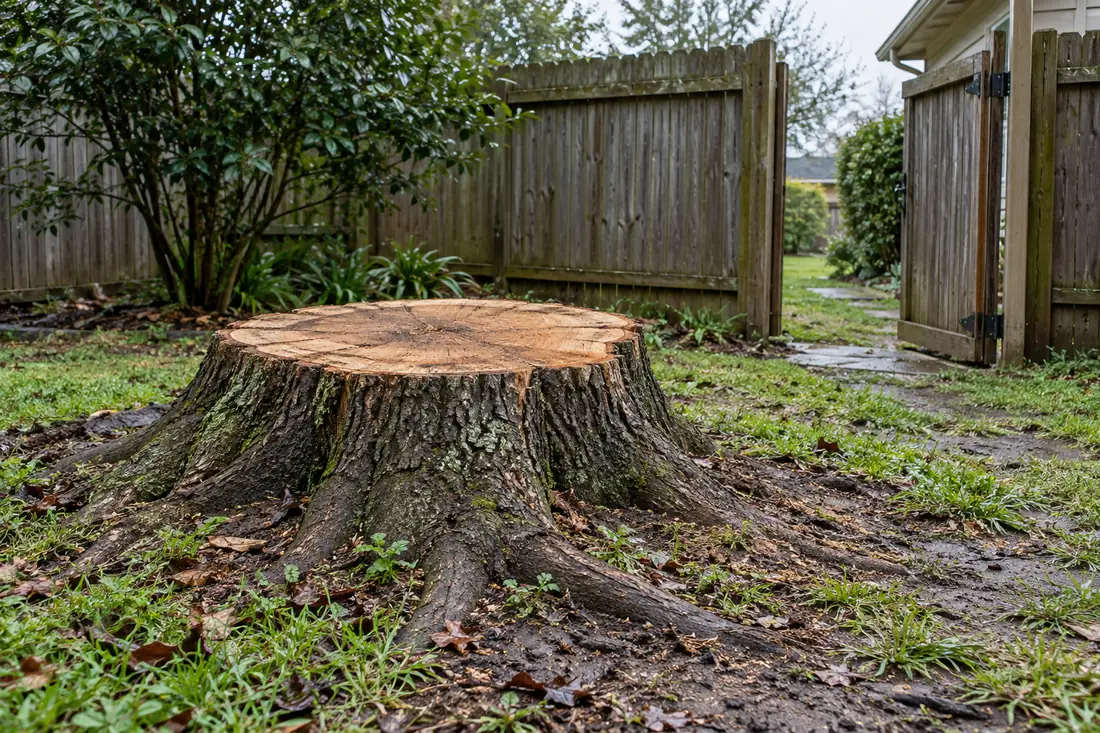
A stump close to a fence may extend beneath the bottom rail or toward a post footing. The grinder can usually remove only material it can reach without striking nearby objects. Identify whether the fence is wood, vinyl, metal or masonry and note how the post is anchored. Photographs at ground level are particularly valuable when the root flare disappears beneath a rail or a concrete footing. Define any wood likely to remain against the boundary.
A neighbor's fence line adds an authorization question as well as a clearance problem. Do not move, detach or cut a shared panel without the appropriate owner's approval. If the tree was on or close to a surveyed boundary, avoid interpreting a fence as definitive proof of property ownership. Have the relevant parties settle permission and access before asking the crew to operate directly alongside the fence.
Confirm gate clearance and the route through a fenced yard. Measure the actual clear opening with the gate fully open, including hinges, latches, steps and any tight turns. Identify irrigation heads, landscape edging, soft ground and pets' access before equipment enters. Some sites need a different grinder or a changed scope rather than removal of a fence. The estimate should explain how machines reach the stump, where chips will collect and whether restoring disturbed lawn or fence components is included.
Send one photograph from outside the gate, one looking through it and one of the work area. Ask how equipment, ground protection and grindings would move through the yard without assuming that neighboring property can be used. Clarify who moves obstacles and whether a different machine or staged approach alters the written scope.
For a stump immediately beside posts, review the fence-line limits.
Measure the complete route through the fence
The apparent width of an open gate is not always the working opening. Hinges, latches, posts, uneven ground and the angle of the approach can reduce usable clearance. Measure the narrowest passage with the gate in its actual operating position and photograph both sides. Include tight corners between the fence and house. A grinder that fits through one straight opening may still be unable to turn toward the stump without contacting a post or wall.
If the route includes a step, narrow bridge, deck or soft section of lawn, identify it separately. A machine's listed width does not establish that every surface can carry its weight. Ask whether the contractor has equipment suited to the route before assuming that removing a fence panel is necessary. Temporary disassembly should be an agreed access choice, not a surprise once the crew arrives.
Create a safe work area in a small yard
Backyards often combine play equipment, grills, patio furniture, storage sheds, pets and planting beds in a relatively small area. A grinder needs more than its body footprint: the operator must move around the wheel and control the ejection of wood chips and debris. Ask the contractor what temporary clearance is needed and move portable items before the scheduled visit. Screens and controls should suit the equipment, not a homeowner's guess.
Keep children, pets and visitors outside the working area for the entire operation, including setup and cleanup. A closed house door is not a substitute for a defined exclusion zone if another exit leads into the yard. Where the entire backyard is small, it may be easier to keep residents indoors or use a different part of the property until the job is complete. Do not plan a party or other activity through an active grinding schedule.

Plan the full backyard access route, not only the gate opening
Walk from the street or driveway to the stump with the actual equipment path in mind. Record clear gate width with the leaf fully open, turning radius at the side yard, overhead limbs, low eaves and changes in elevation. A machine that fits the gate can still be unable to turn past an air-conditioning unit or traverse a soft low area. Provide wide photos of every pinch point instead of a single close-up of the stump. If a temporary panel removal is discussed, identify who has authority and who will reattach it.
Check ground conditions before choosing the route. Saturated soil, buried drain lines, edging, stepping stones and shallow utility covers can be vulnerable to equipment weight and vibration. Ask whether the proposed machine uses tracks or wheels and what protective surface is appropriate for the actual lawn conditions.
Do not assume plywood or mats eliminate all risk of rutting. Schedule restoration responsibilities explicitly: turf repair, fence hardware and reset landscape features may be separate from grinding. Include the access route itself in the contractor's site review.
Because the yard is enclosed, set a clear plan for pets, children and household access on workday. Identify a location outside the operation zone where animals can be secured without requiring a worker to open unfamiliar gates. Move toys, furniture and loose planters before arrival, but leave buried or fixed features for the operator to evaluate.
Ask whether the crew expects a chip pile and where it can be safely staged. If debris is to be removed, verify how it leaves the yard without damaging the gate threshold or dragging through a narrow garden path.
Confirm the final grade relative to surrounding lawn, patios and fence bottoms. A grind below visible soil may still leave lateral roots, and chipped material can settle as it decomposes. If the owner wants an immediately usable lawn, ask what backfill, compaction and seed or sod preparation are included.
Photograph the route and the stump area before and after, then note any agreed repairs. This is more useful than a generic promise that the backyard will look untouched after a machine and material removal have passed through.


Locate irrigation and private yard services
Buried sprinkler tubing, pool equipment, electrical feeds to sheds, landscape-lighting cables and drainage lines can cross a backyard without obvious surface evidence. Public utility markings do not necessarily identify privately installed systems. Gather any landscape plans, irrigation maps or prior repair notes and tell the contractor where valves, boxes and equipment connections are visible. These records guide questions but do not prove a route is clear.
Never test for hidden lines by grinding slowly or probing blindly. If a specific section cannot be safely cleared, postpone that cut or set an explicit exclusion until a suitable locating method is used. The desired depth for a future lawn or garden is not a reason to override an underground-service concern. Document whether the quote includes only the central stump or any visible roots that approach those systems.
Consider terrain and soil conditions
A shaded backyard can retain moisture long after the front lawn dries, especially near downspouts or low points. Wet soil may reduce traction, create ruts or leave a grinder unable to reach the stump without damaging the landscape. Note recent rain, pooling, soft spots, slopes and buried landscape edging when requesting service. The operator should choose access and timing based on the actual conditions, not a presumed standard residential yard.
Ground-protection materials may help on suitable terrain but should not be represented as eliminating all risk of turf marks. Ask what damage is reasonably avoidable and what restoration, if any, the estimate includes. If the yard slopes toward a neighbor or drain, plan how loose grindings will be kept from washing away. The final surface should not redirect runoff into the house or a nearby property.

Set the depth according to the next use
If the area will return to grass, the owner may care most about eliminating the trip hazard and creating enough room for topsoil. A proposed garden bed, patio or new fence post creates different expectations. Explain the intended use before a depth is quoted. A stump grinder is a wood-reduction tool; it does not automatically prepare a compacted foundation for paving or construction.
Talk through how much of the raised root flare is included, especially where several old stems have merged at ground level. Some buried wood may remain because of utility clearance, fence footings or equipment limitations. A written scope should distinguish the visible stump, accessible surface roots and any excluded areas. That prevents a cleared-looking surface from being mistaken for the complete removal of the root system.
The narrowest turn may matter more than the gate
A fence opening that appears wide enough in a straight line may still prevent safe movement once a grinder, operator and turning envelope reach a corner, step, drain or narrow patio. Measure the usable gate opening and every pinch point along the whole route from unloading to the stump. The actual machine selection belongs to the contractor, not to a homeowner estimating from a photograph.
Do not arrange private access over a neighboring lot without their permission and an agreed restoration plan.
Verify the grinder's entire travel envelope before promising access
Record the narrowest true width from the street to the stump, not just the distance between two fence posts. An open gate may still lose clearance to hinges, a latch, a low arch or a sharp turn immediately inside. Measure changes in level, steps, soft ground, air-conditioning equipment and planted beds that cannot be driven over.
Include a wide image looking back toward the exit so the operator can evaluate a turn with the machine's actual wheelbase and guarded cutter, not a guessed model.
Make the estimate say whether the grinder is expected to enter intact, whether temporary gate removal requires written owner permission and who restores any moved hardware. Mark irrigation, known private lines, and the stump's distance from active tree roots and paving. The desired finish could be chips left in place, chips hauled away or preparation for a particular next use; each has different handling and does not automatically mean every buried root is excavated.

Measure more than the gate opening
For stump grinding behind a fence, measure the clear width while the gate is fully open and include hinge hardware, fence-post spacing, turns, steps, lawn slope and the narrowest point after the gate. A machine that clears the first opening may still be unable to turn or reach the stump without damaging paving, irrigation or planting beds.
State whether the gate may be removed only with the owner’s permission, who will restore it and where chips and equipment may be staged. Share the stump’s dimensions and its distance from the fence, utilities and buildings; machine photographs do not establish fit for a specific yard.
For an estimate: Give only safe, owner-authorized photos and describe the finished condition you want. A request is not a confirmed visit or price.
Plan the fate of chips and soil
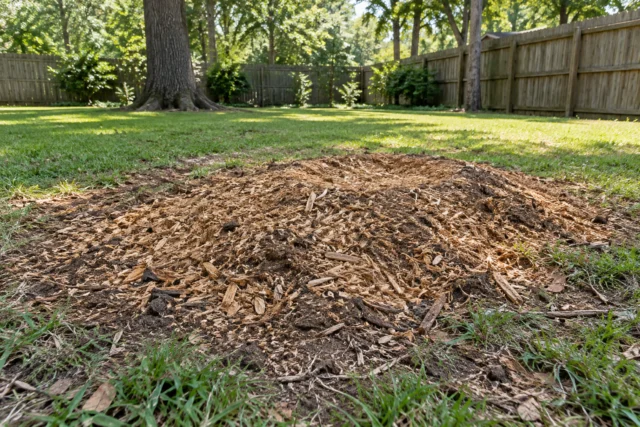
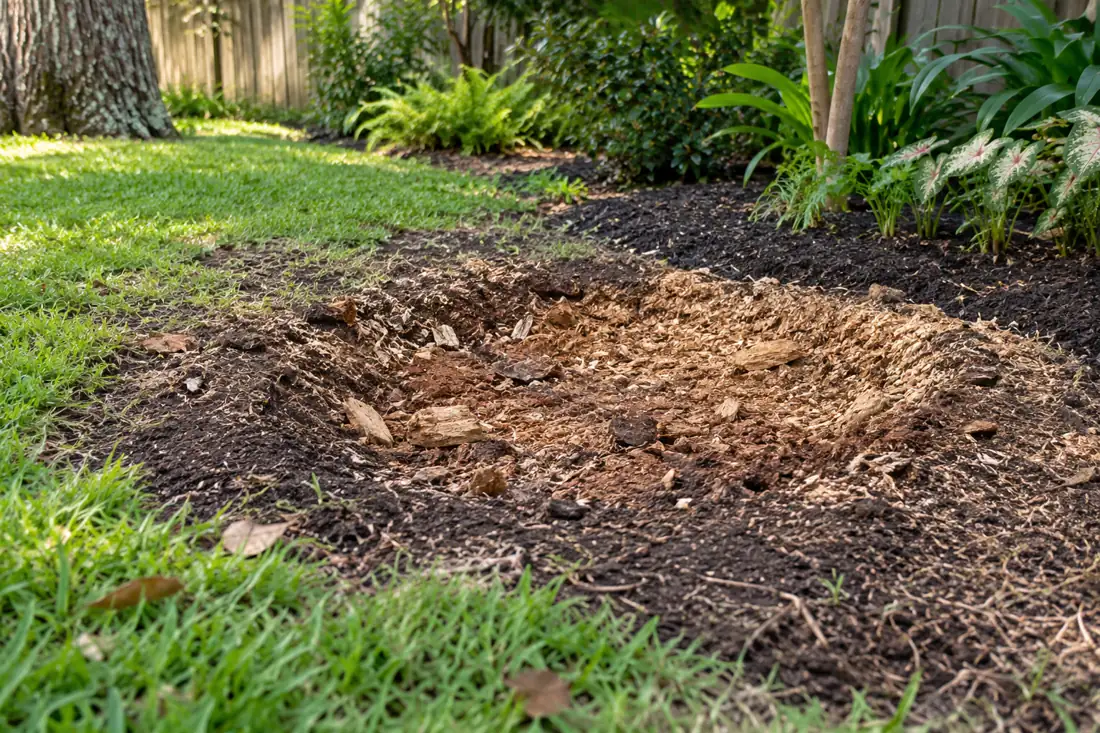
Grinding creates a mound of wood fragments mixed with existing soil. In a fenced yard, the pile might be difficult to transport without tracking debris through a narrow gate or across a patio. Decide whether the contractor will rake chips into the hole, move them to a specified spot or haul them away. Ask whether the quoted cleanup includes the access path as well as the stump location.
Do not assume a chip-filled hole is ready for immediate seeding, a new concrete slab or a raised garden. Organic material decomposes and can leave a depression later. If you want a smooth lawn, discuss removal of excess chips and the need for suitable soil and later leveling. Keep the finished grade clear of fence rails, drainage paths and structures rather than piling leftover material against them.

Coordinate other backyard work
Stump removal often sits between tree removal and a fence, irrigation, patio or landscaping project. Sequencing matters: new fencing installed before grinding may eliminate the machine's access, while freshly laid sod can be damaged by the required route. Share the other contractor's drawings and dates during the estimate. Ask what needs to be completed first and what can safely wait until after grinding.
Where a section of fence might be temporarily removed, specify who handles its removal, storage and reinstallation. Do not assume a tree crew also repairs fence alignment or landscaping. Document the condition of nearby posts and paving before work and photograph the area after cleanup. Those records help each trade understand what was actually done without inventing a promise that the site will look untouched.
Send a detailed fenced-yard estimate request
Provide the stump's width at soil level, the gate's clear opening, photographs of the full access route and the shortest distance to the fence, house or shed. Include any soft ground, slopes, irrigation, lighting or visible roots and explain what you plan to build or grow in the area. These details allow the service team to identify access questions that diameter alone cannot answer.
Ask for the grinding depth assumption, included roots, chip removal, possible fence-panel work and any exclusions near buried utilities. If the grinder cannot reach without modifying another person's property, resolve permission before scheduling. An online request starts a scope conversation; it does not prove equipment will fit or guarantee a price, date or particular restoration result.

Review boundaries before the crew leaves
At the end of the job, look beyond the stump to the route the machine used. Check that the gate opens, the latch engages, loose chips are not trapped along the fence and sprinkler heads or drains remain visible. If a panel was removed by an authorized party, confirm its restoration is recorded separately from stump grinding. A smooth-looking stump site does not show whether the rest of a compact backyard is ready for daily use.
Photograph any agreed residual wood beside posts, the final grade and the location of chips that are staying behind. If a neighboring owner shared access, communicate when the route is clear rather than leaving them to discover equipment tracks or loose material. Keep children and pets away until the crew has fully departed and the yard is safe for normal use. The final check should reflect the entire property experience.
Questions about this project
How should I measure backyard access for a stump grinder?
Measure the narrowest usable opening and document the full route, including corners, steps and overhead obstacles. Share the measurements and photographs rather than assuming a particular machine will fit. The contractor needs to confirm the actual equipment and protection plan.
Can the crew use a neighbor's yard if my gate is too small?
Only with appropriate permission and a specifically agreed route. Do not remove a shared fence or assume access from another property. Discuss alternatives and restoration responsibilities before anyone changes a gate, panel or landscape feature.
What access information helps an estimator?
Send the narrowest opening, overhead obstacles, turns and the distance between the tree and the loading area. Include photos of the entire route and identify steps, soft ground or features that must remain protected.
Should I remove a fence before the visit?
First ask the contractor to assess access and agree on any temporary opening. Identify who owns the fence, who can authorize the change and who will reinstall it. Do not assume the opening is necessary or included.
Can tree equipment use any driveway?
No general assumption should be made. Pavement condition, edges, support, buried infrastructure and the proposed equipment all matter. Ask the contractor to assess the intended setup and route for the particular property.
Do mats guarantee there will be no ground damage?
Ground protection is one part of a site-specific plan. It does not remove every load, soil or access limitation. Discuss the proposed measures and any restoration responsibilities in the written scope.
Does cleanup include every root and wood chip?
That depends on the written scope. Tree removal, stump grinding, chip hauling and root excavation are different tasks. Ask what material is removed, what remains and whether soil or landscape restoration is separately included.
What should a final walk-through check?
Compare the identified trees and tasks with the agreement. Check agreed debris handling, stump treatment, access openings and any listed restoration. Record unresolved items clearly instead of relying on a general impression that the property looks finished.
What should I compare besides the price?
Compare tree identification, work objectives, access assumptions, hauling, stump treatment, site finish and exclusions. Ask whether permits or other coordination are part of the scope and who can approve changes if conditions differ.
Does an online request book the crew?
No. A request starts the estimate conversation. The company still needs to discuss scope, availability and any site assessment. For a dangerous or urgent condition, call 504-458-8336 rather than relying on a form response.
What should I tell Tree Huggers about stump grinding in a fenced backyard?
Explain the property address, the work you want and the specific concerns: gate opening, route constraints, grindings handling. Send safe photos of the tree, surroundings and access route. The contractor can then discuss the assessment and scope needed for this situation.
How do I request an estimate for this work?
Call 504-458-8336, text photos or use the estimate form on this page. Include the address, desired outcome and any timing constraints. The company will need to review scope and availability; an online request does not confirm a price, appointment or emergency dispatch.
Get a scope for your property
Fenced backyard work often succeeds or fails on access measurements before anyone discusses grinding depth. Photograph the stump, a full view of the yard, the gate swing, steps and tight turns from the street to the work area. Measure the clear opening at the narrowest point, not the nominal width printed on a gate.
Note soft soil, irrigation heads, pets, play structures and areas where equipment could not turn safely. If the route passes a neighbor's property, explain that permission is not yet secured unless you already have it.
Request a written plan that confirms whether the available grinder can actually reach the stump, whether a removable gate panel is proposed, and who would authorize and restore any affected fencing. State whether the grinding chips stay on site, how deep the area must be prepared for its next use, and what cleanup is expected along the equipment route.
Do not move children or pets into adjacent work areas or assume a protected lawn will look untouched afterward. An on-site access check can prevent an impractical quote.