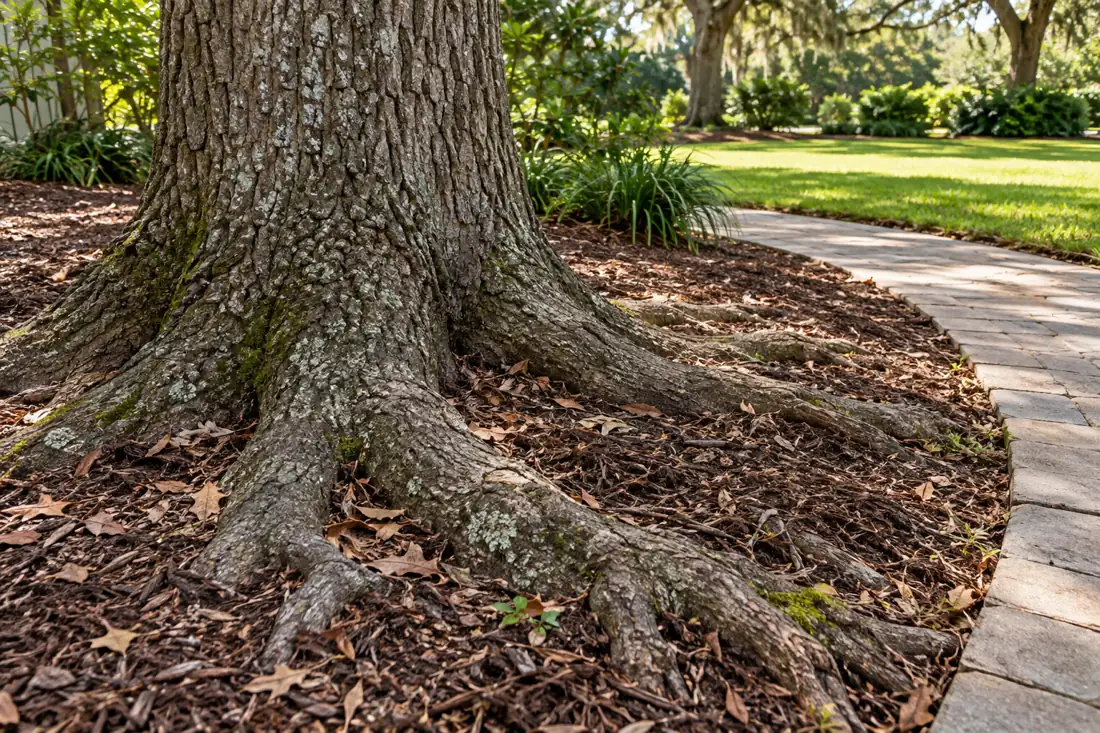
A mature tree can be affected by repeated vehicle traffic long before the canopy provides a clear signal. Record how the ground has been used before deciding on a treatment.
Site planning detail: An effective compaction discussion starts with how the site was used. Note delivery-truck routes, repeated parking, fill placement, trench backfill, and the time of year the ground was wet. Take wide photographs showing traffic patterns and closer photographs of bare, rutted, or sealed soil. A hard surface alone does not prove the same subsurface condition everywhere, and leaf color alone cannot diagnose compaction. A qualified assessment can combine rooting conditions, drainage, soil texture and other causes of declining growth.
The response may require changing traffic and water management before any physical soil treatment makes sense. Avoid deep mechanical work around structural roots without a site-specific plan. Mark a protected equipment route for future service work so the same pressure is not immediately restored after corrective measures.
Identify the repeated pressure on the site
Soil compaction often begins with an ordinary convenience: parking under shade, routing landscaping vehicles across the lawn or storing heavy pallets beside a trunk. Create a factual history of where equipment traveled, how often, approximate vehicle types and when activity increased. Note whether the problem followed a renovation, storm cleanup, utility repair or expansion of a parking area. A single footprint may be less relevant than months of repeated loading. Avoid declaring a precise compaction percentage from the appearance of tire marks alone.
Show the affected tree and route on a simple map. Include driveways, gates, low spots, drainage inlets and any existing pavement. Distinguish the place where vehicles enter from where they turn, stop and load materials. A tree's root system can extend well beyond the trunk and drip line, so the relevant area may include ground that was never considered part of a planting bed. Safe wide photos and a dated activity log help a qualified professional evaluate the actual conditions.

Understand why compressed soil matters
Healthy roots depend on a suitable soil environment for moisture, gas exchange and growth. Heavy pressure can change pore space, drainage and resistance to root growth. The consequences depend on soil type, moisture, load, existing root condition and duration. Do not assume a compacted-looking surface proves that the tree will decline, but do not assume a green canopy guarantees that root function is unaffected. A professional assessment connects site history to observed tree and soil conditions instead of jumping from one photograph to a diagnosis.
Compaction is not identical to every wet or bare patch of ground. Shade, soil texture, erosion, poor drainage, weeds and repeated foot traffic may produce overlapping surface signs. A qualified person may consider appropriate soil testing or further site evaluation before recommending management. Avoid buying aeration, fertilizer or injection treatments based solely on a general advertisement. A treatment that does not address ongoing traffic can leave the underlying source of disturbance unchanged.
Look for surface changes without disturbing roots
From safe accessible ground, record persistent ruts, soil crusting, bare patches, standing water after rain and changes to the normal drainage route. Note whether roots have become exposed or whether imported fill was placed around the trunk. Do not dig exploratory trenches or drive stakes deeply near valuable roots to check soil hardness. The absence of visible ruts does not rule out compaction beneath turf. Wide and detail photos together can make reports more useful without implying the images measure underground soil structure.
Compare observations before and after heavy rain, but do not drive a truck onto saturated soil to test its bearing strength. In southeastern Louisiana, low areas may soften quickly even where ground appeared firm earlier. Mark which symptoms occur repeatedly versus only during one storm. If an apparent tree hazard such as fresh soil movement, significant new lean or unstable material is present, keep people clear and seek qualified help promptly. Routine compaction planning should not delay response to a separate urgent condition.

Compacted soil can be a site-use problem rather than a pruning problem
Look for the pattern of traffic beneath a mature tree. A short worn path between parking and a doorway, repeated service-vehicle turns, stockpiled materials and heavy lawn equipment all create different pressures on soil. Sparse turf by itself is not a diagnosis: shade, roots, drainage and routine foot traffic may contribute. Photograph the whole tree and the ground beneath its canopy, noting where the surface is hard, rutted, bare or chronically wet. A site plan showing actual foot and vehicle routes is often more useful than a close-up of a leaf that has turned brown.
Consider whether the use causing compression can be changed before considering intervention. Re-routing carts or pedestrians, designating a permitted access path, avoiding wet-soil vehicle travel and removing storage from a root area may prevent repeated damage. Mechanical treatments such as aeration or soil modification should be considered with a qualified professional who understands the tree and buried utilities, rather than digging or drilling blindly around roots.
Adding a thick layer of soil over the root flare can create additional problems; more material is not automatically a cure.
For an estimate, identify the tree, affected ground area, history of construction or heavy traffic if known, nearby irrigation and intended future use. Ask which observations support the proposed care, what the treatment can reasonably address and how the area will be protected afterward. If soil samples or specialized root assessment are recommended, separate that work from routine pruning.
A contractor should not promise that the canopy will recover on a fixed schedule, because the tree's response depends on condition, weather, species and whether harmful traffic actually stops.
Establish a follow-up photo record showing ground use and canopy condition from consistent safe locations. Facility managers can share the protection plan with mowing crews, landscapers and deliveries so the root area is not immediately compacted again. Tree health is influenced by more than the visible soil surface; if the crown is rapidly declining or large structural defects are observed, request a broader assessment. A practical prevention plan can be more valuable than a treatment performed once while the underlying site problem continues.

Stop new disturbance before planning remediation
An effective next step may begin with changing how the area is used. Relocate regular vehicle parking, material storage or equipment access where practical, and establish a clearly marked protected zone suitable for the tree and property layout. A decorative mulch circle is not a traffic barrier. For commercial sites, maintenance crews and vendors should receive the route restrictions, not just the property owner's verbal preference. Use gates, barriers or site notes that reliably communicate the restriction without blocking required access.
If construction must continue near the tree, coordinate temporary ground protection and equipment routes with the qualified professionals involved. Different loads and soil conditions require different measures; a mat is not a guarantee that all root pressure is eliminated. Avoid putting new fill over roots merely to make a temporary road level. Record the agreed staging plan and what triggers reassessment if rain or site activity changes. Preventing further compaction is often a prerequisite to evaluating whether any soil treatment would be useful.
Diagnose compaction as a site condition, not a cosmetic lawn problem
Heavy trucks, repeated foot traffic, stored materials, and construction equipment can compress soil so that air and water move differently through a tree's root zone. The surface might look intact while fine roots are stressed below, especially when machinery has crossed damp ground.
Symptoms such as thin growth, poor infiltration, exposed roots, or decline may have several causes, so soil compaction should be assessed alongside drainage, species, irrigation, construction history, and root disturbances. A quick probe or surface photograph alone cannot prove the condition throughout the root zone or determine whether a tree is structurally safe.
Start with traffic history and how the ground behaves after rain. Compare heavily used paths with nearby undisturbed areas, note any recent excavation, and ask a qualified arboricultural professional what tests or treatments are warranted. Preventing continued traffic is usually more sensible than repeating a treatment while the same machinery parks under the canopy.
Possible soil management steps depend on site conditions; uncontrolled deep digging, trenching, or aggressive mechanical disturbance could injure roots. Coordinate any aeration, mulching, routing changes, and irrigation corrections with existing utilities and landscape use. Document how the area will be protected over time rather than relying on a one-day appearance improvement.
Compaction investigation: isolate the cause before treatment
When a crown begins thinning after months of traffic, the practical first step is to map where vehicles, pallets and temporary parking concentrated pressure. Compare current ground use with photographs taken before construction. A soil treatment should respond to actual conditions rather than a marketing promise that all tree decline can be aerated away.
Protect the suspect zone from further loading while an appropriate professional considers soil texture, moisture, drainage and roots. Aggressive trenching or adding water to saturated ground may compound the problem. Recovery may need a land-use change as much as a treatment.
Consider irrigation and drainage before adding water
Compacted soil can alter water movement, but the correct irrigation response depends on actual site conditions. Standing water may coexist with poor infiltration, while nearby areas dry quickly. Do not respond automatically by watering more or applying fertilizer. Review the drainage pattern, existing sprinkler system and recent changes to grading or downspouts. A soil or landscape professional may need to investigate water flow, while a tree-care specialist considers how root conditions relate to the tree.
Check whether a blocked drain, broken irrigation line or newly paved area contributes to the problem. Those infrastructure concerns belong to the relevant specialists. Correcting them may reduce repeated saturation and make tree management more effective. Do not excavate around roots or install a French drain based on a generic online diagram. A proposed trench can itself damage roots; its location and method should be coordinated with appropriate expertise and the existing utility information.

Ask what evidence supports a soil intervention
Potential management approaches sometimes include altering traffic, correcting drainage, modifying mulch practices or professionally guided soil treatments. No single technique is suitable for every mature tree or every compacted site. Before approving a proposal, ask which observed condition the intervention targets, how it is expected to help and what limitations apply. Mechanical aeration or air excavation near roots should not be treated as a do-it-yourself lawn service without considering root injury and underground systems.
Request a clear distinction between diagnostic work and treatment. A provider may need to assess tree vigor and site conditions before deciding whether intervention is warranted. Ask how success will be judged over time and whether ongoing site-use controls are required. Avoid unsupported promises that a fertilizer treatment will reverse years of compaction or that a tree will regain full health by a specific date. Responsible care is based on verified conditions and realistic outcomes.
Protect roots during nearby paving and landscaping
Construction planning should include root-area protection before excavation, grading, paver installation or landscaping deliveries. Mark retained trees on the site plan and review where vehicles can turn or stockpile materials. If a new parking pad or walkway is proposed within an affected area, consider appropriate design alternatives with the relevant professionals. Simply burying compacted soil beneath new pavement may prevent investigation and add further load. A tree professional's input is most useful while the footprint can still be adjusted.
Do not assume that removing an old driveway automatically restores root function. Demolition and new subbase installation can cause additional disturbance. Coordinate tree work, utility locating and surface design rather than assigning the entire problem to the tree company. Where significant roots are encountered, pause the affected activity for qualified advice. Document actual site changes so future tree assessments can distinguish older compaction history from new construction impacts.
Use follow-up observations with realistic expectations
Trees may respond to chronic root-environment stress over time, and symptoms can be influenced by weather, pests, disease and other conditions. Keep periodic dated observations of canopy appearance, site moisture, repeated traffic and any qualified assessment findings. A brief improvement in leaf color is not proof that soil structure has recovered. Likewise, one sparse branch does not establish compaction as the only cause. Use a consistent tree identifier and photograph vantage point where possible without entering hazardous areas.
If a professional recommends follow-up, record the purpose and timing rather than inventing a universal monitoring interval. Keep completed treatments, drainage repairs and changed access rules in the record so future reviewers understand what was tried. A maintenance contract should clarify who keeps vehicles out of the protected area after the tree crew leaves. Without that operational commitment, a property can repeatedly damage the same root environment and pay for interventions that do not address the cause.
Request an assessment that begins with site history
When contacting Tree Huggers, describe the tree's location, years or months of vehicle activity if known, recent construction and what surface or canopy changes were actually observed. Include safe wide photographs of the tree and traffic area along with a simple access sketch. Do not dig or deliberately compact soil to produce diagnostic evidence. State whether a separate immediate structural concern exists so the request can be appropriately evaluated. The right assessment may involve tree condition, soil issues or coordination with another professional.
Ask for a written explanation of tree-related recommendations and any dependencies such as drainage repair or restricting vehicle access. A treatment request should not bypass diagnosis. Use the native estimate form for personal contact details and optional photos, with analytics limited to privacy-conscious interaction signals. Track inquiry, assessment, protection measures, approved work and follow-up as separate stages. A mature tree is more likely to benefit from informed site management than another generic promise that its roots have been 'fixed.'

Identify the pressure source before planning recovery
Begin with the history of traffic and site use: vehicles parked under the canopy, recurring maintenance routes, events, deliveries or storage of heavy materials. The same tree may also have drainage, irrigation or root-disturbance issues. A worn lawn alone does not diagnose compaction, and visible thinning should not be treated as proof of its cause.
Ask which site observations or tests would distinguish compressed soil from drought, flooding, shade or other problems. If heavy use continues, an isolated treatment may offer little lasting improvement. Establish a route that prevents repeated pressure before deciding whether any remediation is appropriate.
Record a baseline of the tree and soil area, the agreed protective measures and the realistic review interval. Growth and recovery can take time, and photographs from different seasons may be hard to compare. Keep grading, pavement and irrigation changes in the same project history so later observations have context.
Change the ground use as well as documenting symptoms
A worn path beneath a shade tree is often an ongoing-use issue rather than a single repair. Mark where tires, carts, delivery vehicles or stored materials repeatedly cross the root area, then ask whether traffic can be redirected before considering soil intervention. The visible rut may show where pressure occurred, but it does not establish the condition of the entire root system or explain every canopy symptom.
Where drainage, irrigation or new paving also changed, capture those facts in the same site history and identify the responsible specialist for each issue. A tree-care recommendation might include follow-up observations and changes in ground use; it should not be sold as an instant reversal of years of compaction. Photographs taken from repeatable safe locations provide a better comparison than dramatic close-ups alone.
Questions about Soil Compaction Around Mature Trees
What causes soil compaction near trees?
Repeated vehicles, heavy equipment, material storage and other sustained loads can compress soil.
Can a tree have compacted soil without visible decline?
Yes. Surface and canopy symptoms may not show an immediate or definitive response.
Do tire ruts prove root damage?
No. They indicate disturbance but do not by themselves diagnose root health.
Will adding fertilizer fix compacted soil?
Not automatically. The cause and site conditions require appropriate evaluation.
Should I aerate near mature roots myself?
Avoid unsupervised root-area intervention; seek qualified guidance and account for utilities.
Does tree mulch prevent heavy equipment damage?
Mulch alone is not a substitute for appropriate traffic exclusion or ground protection.
Can excess water and compaction occur together?
Yes. Soil structure and drainage can interact, requiring site-specific assessment.
Should equipment access change after heavy rain?
Potentially. Wet ground conditions can increase disturbance and warrant reassessment.
Can paving over compacted soil affect a tree?
It may change the root environment and create further construction impacts.
How should I document suspected compaction?
Record traffic history, wide site photos, visible conditions and changes over time.
When is professional tree evaluation urgent?
Fresh significant lean, soil movement or unstable material near occupied areas may require prompt qualified assistance.
What belongs in a tree-soil service request?
The tree location, traffic and construction history, observations, drainage context and safe photos.
Get a scope for your property
Repeated vehicles and stored materials can compact soil without visibly breaking the tree's bark. Around mature trees, oxygen and water movement through the root zone may matter as much as direct root cutting. Record recent equipment routes, parking, fill placement, excavation and changes in drainage before assuming a disease is the cause of canopy decline.
Do not drive additional machinery into soft root areas to investigate. The size of a protection zone and any soil treatment require evaluation of the tree, site and planned work—not a generic radius applied to every species.
For a site assessment, provide a plan or photographs showing the root flare, paving, access gates, delivery route and areas where heavy materials were staged. Ask what conditions can be observed now, what could be monitored and how future equipment access might avoid additional compaction. A proposal should distinguish preventive barriers and matting from corrective treatment and should avoid promising recovery where significant damage is already present. Confirm responsibility for site controls among contractors.