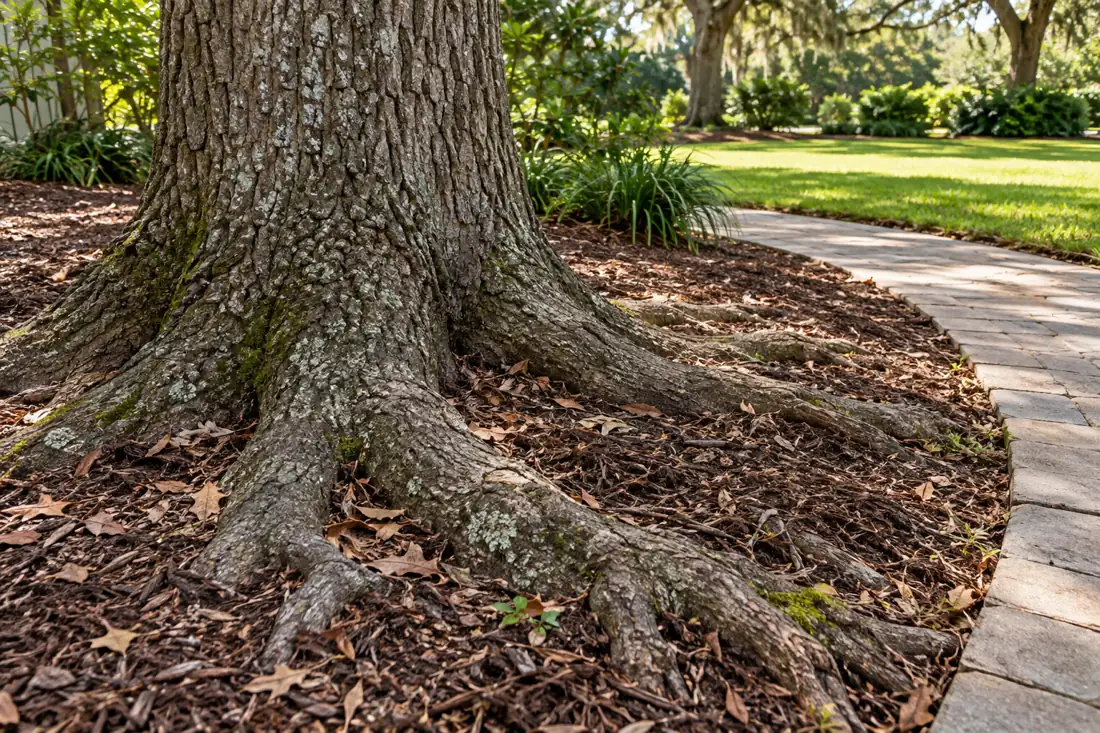
A clearer picture of the scope


Example: Tree removal beside damaged paving
The tree and visible roots are removed while the damaged sidewalk remains. Tree work does not automatically include pavement repair.
A lifted sidewalk presents an access issue while the roots may be important to the tree. Coordinate the tree assessment with the party responsible for the pavement. Cutting roots or replacing concrete without considering both can leave the underlying conflict unresolved. Document the condition and identify public or private responsibility before planning work.
Treat lifted pavement and tree roots as one site-design problem
When roots raise a sidewalk, the visible bump is the result of interacting tree growth, available soil space and the pavement structure. Cutting a large surface root may undermine stability or introduce decay, especially close to the trunk. Do not authorize root cutting simply to make a concrete patch fit. Document the lifted sections, trip hazards, nearby utilities and the tree’s root flare, then consult qualified tree and pavement professionals about options and responsibilities.
Depending on the site, solutions may include rerouting or bridging a walkway, changing pavement details, addressing drainage or selecting a different long-term site layout. Any design must respect accessibility and applicable public right-of-way requirements. Ask for a plan that specifies how roots will be protected during demolition, where tools and materials will be staged and who will inspect the finished route. Separate immediate temporary hazard controls from the permanent repair so users are not exposed while decisions are pending.
Photograph the lifted slabs, the full pedestrian route, adjacent tree and nearby drainage conditions. Note where a wheelchair, stroller or other user encounters a change in level, and alert the property manager to any urgent access hazard. The first decision is who owns and maintains the sidewalk, because public and private responsibilities may differ.
Roots may contribute to movement, but cutting them close to a mature tree can undermine stability or increase decline. Treat the pavement and tree as one site problem instead of choosing a repair method from a single photograph.
Coordinate a qualified tree assessment with the party planning pavement work. Ask whether redesign, gradual grade adjustment or other root-sensitive construction approaches can address access while preserving critical roots. Identify underground services and whether permits or accessibility standards apply to the particular location. Keep pedestrians away from an unsafe surface while the solution is determined. The estimate should document who evaluates root retention, who performs pavement repairs and what conditions would trigger a revised plan.
Separate a walking hazard from a tree-health decision
A sidewalk lifted by roots can create a trip risk, but the appropriate remedy depends on the path's condition, access requirements and the tree's root system. Start with photos showing the full path, the raised joint or slab, and the tree in relation to it. Measure differences only where it is safe and practical, and identify whether the walkway is private, shared or maintained by a public authority.
Do not assume the tree must be removed or the offending root cut. The same site may offer alternatives such as rerouting the path, changing the slab design or correcting a localized trip edge through the responsible pavement provider. An arborist can discuss the likely consequences of root disturbance while the sidewalk designer or owner addresses accessibility and construction specifications. Both decisions matter.

Identify ownership and maintenance responsibility
A sidewalk may belong to a homeowner, condominium association, commercial owner or a public agency even when it crosses a private-looking landscape. Determine who controls the path and who can authorize changes before work begins. If the route is public or serves an accessible entrance, relevant design and safety requirements may apply. The tree contractor should not be asked to infer ownership from where a trunk stands.
A site sketch can mark the tree, property boundary, damaged segment and route people use while repairs occur. Obtain any necessary permissions before excavation or closure. If the responsible authority requires a particular repair method, share that requirement with the arborist so root protection can be evaluated within actual constraints. A plan that ignores approval, access or accessibility may fail even when the tree work itself is technically possible.
Separate the sidewalk hazard from the proposed root treatment
A lifted sidewalk can create a trip hazard even before anyone knows the cause. Document the raised joint, broken slab, drainage path, nearby trunk and pedestrian use from a safe location. Do not conclude that a single visible root explains all pavement movement; soil settlement, prior construction and other forces may contribute. The immediate access decision may involve directing people to another route while the responsible party arranges assessment.
Determine whether the walkway is privately maintained, part of a public right-of-way or subject to an association's requirements. Ownership and permission can change who may authorize concrete or tree work. Cutting a large root to lower one slab may have consequences well beyond the pavement, so avoid offering root trimming as a routine sidewalk repair. A coordinated plan should consider accessible grades and tree preservation together.
Understand the role of roots beneath paving
Roots grow where soil conditions allow, sometimes extending beneath pavement and along disturbed edges. A raised slab can reflect growth, soil movement, inadequate subbase or several interacting factors. The closest root is not necessarily the sole cause of deformation. Ask the appropriate pavement provider to assess the structure and the arborist to consider roots that may be affected by repair.
Large roots may contribute to tree stability and function. Cutting them close to the trunk or on one side can have consequences that cannot be predicted by a universal diameter rule. Avoid a quick saw cut before the repair design is known. If a foundation, curb, drain or buried utility is involved, obtain the relevant specialist's findings rather than assuming stump grinding will correct the whole condition.

Plan a sidewalk correction that keeps the walkway usable and the tree assessed
Measure the walking problem before anyone digs. Record the approximate elevation difference between adjacent slabs, where a mobility aid or stroller encounters the lip, and whether there is an alternate accessible route. Photograph the conflict from each approach, not only from directly above the root. If the sidewalk is public, determine which agency or property owner controls repairs and temporary pedestrian routing. A tree contractor should not assume authority to modify public paving simply because a root appears close to the surface.
Keep the pavement design and the root assessment connected but distinct. Saw-cutting or shaving a slab may address the immediate transition without disturbing the tree, while a redesigned path, flexible surfacing or carefully altered grade may create a more durable route. The feasibility depends on site elevations, accessibility requirements, drainage and the location of structural roots. Before authorizing root cutting, ask a qualified tree assessor which roots are involved and whether the proposed excavation changes the tree's support or ability to remain healthy.
Inspect the conditions that helped create the conflict. Compacted fill, narrow planting strips, buried curbs, drainage concentration and previous sidewalk replacement can all influence how roots and paving meet. A root emerging at the surface is not automatically defective; it may be responding to available oxygen or space. Document neighboring utility boxes and irrigation lines so a pavement crew does not discover them during demolition. Provide the tree assessment and the pavement plan to both contractors before either starts work.
Define completion in ways a property owner can actually verify: a passable walking surface, clear runoff direction, no unapproved damage to roots or trunk, and restored access around the work area. Take after photographs from the same positions as the originals. Retain the written scope, any permits or agency instructions and the tree assessment in the property file. If the pavement has moved repeatedly, arrange a follow-up review rather than claiming the new surface will never move again.
Coordinate pedestrian safety with tree and pavement decisions
Record the raised joint or slab from multiple angles, show the full sidewalk route and identify who maintains the pavement. A property owner, public agency or pavement provider may need to address an immediate pedestrian hazard before a permanent tree decision is made. Ask an appropriate tree professional to evaluate root implications while the responsible pavement professional considers grading, alternate alignment or other accessible designs.
Do not order wholesale root cutting based solely on the visible bump. The written scope should distinguish temporary access protection, pavement repair and any tree work.

Map exposure and temporary pedestrian access
A lifted sidewalk near a school, business entrance or residential walkway may require prompt attention to user safety. Identify who travels through the area, including people with mobility aids, and whether a reasonably safe alternate route exists. A temporary closure or warning should be coordinated with the responsible owner or authority, not improvised in a way that directs users into traffic or another hazard.

Keep access considerations separate from the long-term tree decision. Immediate risk management might be necessary before the permanent repair can be designed and authorized. Photograph the problem from both directions to show what a walker actually encounters. Where the path lies near a street or utility corridor, planning must account for traffic and service restrictions as well as roots.
Treat sidewalk lifting as an access and tree-design problem
A lifted sidewalk panel creates a trip and accessibility concern, but the visible tree root may not be the only factor. Settling, drainage, old construction details, soil expansion, and root growth can work together. Begin by documenting the height changes, cracked edges, nearby trees, water paths, and how pedestrians actually use the route.
If the sidewalk is public, establish the responsible authority and any permit or inspection process before removing pavement or disturbing roots. A contractor should not assume permission to cut a major root simply because it is close to the trip hazard.
An appropriate solution balances passage, durability and tree stability. Depending on location and design constraints, a qualified team may consider a revised path, engineered bridging, flexible or adjustable surfaces, replacement details, or other approaches. Accessible slopes and transitions must be addressed by the designer; a patch that looks flat from a distance may still be unsuitable.
Coordinate arboricultural input before root cutting or trenching, particularly near a large mature tree with significant canopy targets. Document temporary pedestrian protection, ownership, the approved repair details, root safeguards, drainage and the eventual inspection. Repeated grinding of a lifted surface without resolving the cause may leave the owner with the same problem again.
Sidewalk lift: protect pedestrians while reviewing tree options
The first decision is how people will safely pass the displaced panel, especially where mobility aids, strollers or school routes use the sidewalk. That immediate accessibility concern must not be held open while the owner debates root pruning. The responsible walkway manager can arrange temporary protection and an appropriate repair design.
Document the panel displacement and root location without excavating around the tree. A concrete replacement, alternate alignment, bridging detail or other design belongs to the pavement professional, informed by tree assessment where needed. Removing a large live root should not be the default shortcut.
Compare repair options with documented constraints
A useful repair meeting includes a sidewalk contractor and qualified tree-care input where structural roots may be affected. Discuss whether the path can be rerouted, a slab adapted, or another surface design used without removing critical roots. Work around utility lines, drainage inlets and existing curbs may require additional review. Avoid guaranteeing that an adjusted slab will stay level as the tree and soil continue changing.
Keep dated photographs, the location of the raised joint, observed changes after rain, and any proposed construction footprint. Tell the tree professional if heavy equipment will need to cross the root zone. For businesses and public facilities, document temporary pedestrian access and who will maintain it. A clear record allows property decision-makers to compare safety, cost and long-term tree effects without inventing a diagnosis from one image.
Compare pavement alternatives before excavation
Depending on the site, options may include adjusting a local edge, redesigning a slab section, shifting a route or using a construction detail intended to accommodate roots. A qualified concrete or landscape professional should determine suitability and compliance. The arborist can identify likely root conflicts and protection needs. No option should be represented as universally appropriate without a site review and understanding of drainage and grade.
Avoid pouring fresh concrete directly over an unassessed root zone simply to make the path flat. Additional excavation, compaction or soil fill can damage the tree even if no visible root is deliberately cut. Ask what material must be removed, where equipment will work and whether the design allows adequate root space. Comparing alternatives on the same site plan reduces the chance that one contractor's solution creates a new problem for another.
Evaluate root pruning with qualified input
Sometimes the final design cannot avoid a root conflict. In that case, ask a qualified arborist to evaluate which roots are involved, their position relative to the trunk and the possible consequences of disturbance. The evaluation may lead to an alternate design, a more limited intervention or a recommendation that retaining the tree is impractical. Do not decide the cut by which root is easiest to reach with a saw.
If root work is authorized, define the boundary, method and protection of remaining roots. Excavation should be coordinated with utility location and the pavement contractor. A root cut is not automatically harmless because the tree still has green leaves; structural and health effects can emerge later. The owner should understand uncertainty and any recommended follow-up before work proceeds.
Protect the site during demolition and rebuilding
Removing old paving can expose roots that were previously concealed. Heavy equipment, jackhammers, stockpiled debris and repeated vehicle traffic may damage the surrounding root area. Identify a material staging location and access route that avoid unnecessary soil compaction. Tell the contractor which trees are to remain, and discuss how exposed roots will be handled if encountered during approved work.
A pause for professional review can be more efficient than an unplanned cut followed by a dispute. The project scope should explain who can authorize field changes and whether additional protection or redesign is separately priced. Do not assume a tree-service quote includes full sidewalk demolition, concrete finishing or compliance certification. Clear divisions of responsibility support both tree preservation and a functional path.

Consider drainage and soil settlement
A sidewalk may lift or settle unevenly for reasons beyond roots, including washout and subbase conditions. Look for downspouts, drainage channels, recurring puddles and prior repairs. Those observations should be shared with the pavement provider. If a new slab changes water flow toward a tree or house, the repair may need design adjustments. Grinding a surface root does not necessarily resolve a drainage or foundation problem.
The final grade should provide a practical walking surface without burying the root flare or trapping water around the trunk. Soil replacement and compaction requirements belong in the pavement plan, while the arborist considers effects on the tree. Document preexisting cracks and grade changes before construction. A successful repair should address the actual cause and site use, not merely hide the raised edge temporarily.
Prepare a coordinated estimate request
Send the location, path photographs, tree overview and description of the desired outcome. Include any public-authority requirements, accessibility concerns, known utilities and planned pavement work. Ask the tree professional to focus on root implications and the tree's condition, while the hardscape provider defines the built repair. Two proposals should reference the same marked area to avoid conflicting assumptions.
If removal is being considered, ask for the condition-based reason and a separate scope for tree, stump and debris work. A removal estimate does not by itself establish that the owner has authority to remove a protected or public tree. Similarly, an online request does not book a crew or certify a walkway repair. Written coordination helps the owner make a defensible decision before irreversible work.

Review completion and future root growth
After the repair, check that the agreed walkway limits, access arrangements and separately contracted restoration are complete. Retain the tree assessment, design and photos showing how the finished path meets the surrounding landscape. If roots remain beneath or near the surface, the owner should understand that growth and soil movement can continue over time. No pavement option can guarantee that a tree will never affect nearby hardscape.
Assign maintenance responsibility and note what changes should prompt inspection, such as a recurring lip, water pooling or significant new tree defects. Avoid sending maintenance crews to cut roots automatically when a surface changes again. A thoughtful long-term plan balances a usable, accessible route with the needs and limitations of an established tree.
Sidewalk Trip Hazards and Root Preservation Are Separate Decisions
A raised sidewalk panel may present an immediate accessibility issue while the underlying roots remain important to the tree's stability and water uptake. Cutting the exposed root to flatten concrete can create a new tree-health or structural hazard without solving soil or pavement problems. The owner should document the panel offset, pedestrian route, drainage and nearby trunk flare, and determine who controls the sidewalk or right-of-way. A qualified arborist and the relevant paving or public authority may need separate roles.
Treat temporary pedestrian management, long-term pavement repair and tree care as three distinct scopes. An arborist may be able to describe root significance and preservation constraints, but that does not guarantee a particular concrete design or code-compliant walking surface. Take measured photographs from a safe location and keep the follow-up plan in writing, especially if the area serves wheelchairs, strollers or deliveries. Do not promise that grinding pavement or pruning roots alone prevents future movement.
- Record the actual walking-surface change and any immediate safe alternate route.
- Identify the sidewalk owner and applicable permitting or accessibility requirements.
- Separate the arborist's recommendation from pavement design and construction responsibility.
Questions about this project
Can I cut a surface root to flatten the lawn?
Do not assume that is harmless. The root may matter to tree condition or stability. Describe the conflict and ask for an assessment and appropriate options before cutting or excavating near the tree.
Does a nearby tree prove it caused a plumbing problem?
No. Use the plumbing provider's findings and identify the affected system. Coordinate any tree or root work with that information rather than assuming location alone establishes the cause or the right remedy.
Can the crew block a public sidewalk or road?
Required arrangements must be coordinated with the appropriate authority. Identify public routes and restrictions before scheduling. A private work agreement should not be treated as automatic permission to occupy or close public space.
When should parked vehicles be moved?
Set the timing and responsible contact before the work window. Vehicles may need to leave the tree zone, equipment route and loading area. Confirm where access must remain available during each phase.
Is leaving the trunk untouched enough to protect a tree?
No. Roots, soil conditions and nearby work can matter even when the trunk is not cut. Identify retained trees before planning access, excavation and storage, and ask what site-specific protection is appropriate.
Can pruning undo construction-related root damage?
Do not assume it can. Share the work history and ask for an assessment of the current tree and site. Pruning, monitoring or other recommendations should address an identified need rather than substitute for protection planning.
How should extra work be approved?
Use the agreed approval process and identify the change, reason, scope, price or schedule effect as applicable. Confirm who has authority before treating an additional tree or task as part of the original job.
What completion records are useful?
Keep the agreed scope, tree or area identification, authorized changes, invoice and labeled photos where appropriate. Include unresolved items and a contact. Contract-specific records should follow the buyer's stated requirements.
What should I compare besides the price?
Compare tree identification, work objectives, access assumptions, hauling, stump treatment, site finish and exclusions. Ask whether permits or other coordination are part of the scope and who can approve changes if conditions differ.
Does an online request book the crew?
No. A request starts the estimate conversation. The company still needs to discuss scope, availability and any site assessment. For a dangerous or urgent condition, call 504-458-8336 rather than relying on a form response.
What should I tell Tree Huggers about tree roots lifting a sidewalk?
Explain the property address, the work you want and the specific concerns: pavement responsibility, pedestrian route, root retention. Send safe photos of the tree, surroundings and access route. The contractor can then discuss the assessment and scope needed for this situation.
How do I request an estimate for this work?
Call 504-458-8336, text photos or use the estimate form on this page. Include the address, desired outcome and any timing constraints. The company will need to review scope and availability; an online request does not confirm a price, appointment or emergency dispatch.
Get a scope for your property
When roots lift sidewalk sections, two different concerns need attention: a usable pedestrian route and preservation of the tree's anchoring system. Provide a wide image showing the entire affected segment, a close view of the change in elevation and a simple indication of whether people can use an alternate route. Identify any public right-of-way or ownership question for the appropriate property or agency contact to resolve. Do not stand on unstable pavement or dig beneath the slab to expose roots for documentation.
Request a coordinated review that distinguishes a civil paving repair from tree-related work, identifies which roots are likely involved and considers whether an alternative design could avoid unnecessary damage. Cutting large roots is not a harmless shortcut and may affect tree health or stability. Ask who will arrange access control, authorize sidewalk changes and monitor the site after construction.
The written tree scope should state the limits of its recommendation; an arborist's assessment does not replace the responsible sidewalk authority or a structural pavement design.