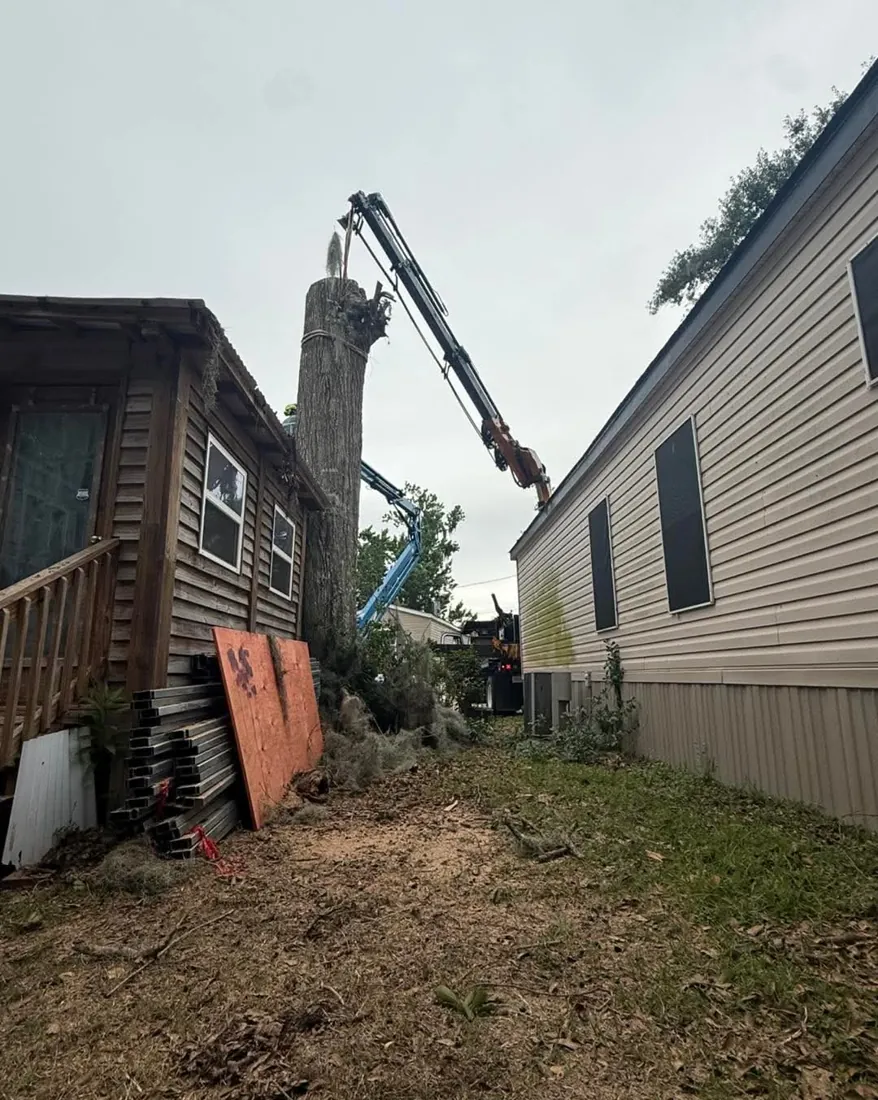
Tree work should not begin on an assumption about an uncertain boundary. Identify the tree and resolve ownership or access questions through appropriate property information and professionals. The contractor can prepare a scope for authorized work, but a visual estimate is not a boundary determination. Clear permissions protect the project from avoidable disputes.
Tree work at uncertain property boundaries
Do not rely on fences or mowing lines as proof of ownership. Locate available survey and easement documents and identify the trees on a site sketch. A contractor’s tree assessment does not settle a property dispute.
Any access across the line should have permission before equipment arrives. Confirm who authorizes removal or pruning on the relevant property and whether a municipality or utility controls part of the area.
Specify the tree IDs, entry gates, staging zones, retained landscaping and responsible contact. Keep legal ownership questions separate from the technical pruning or removal recommendation.
Site-specific planning checkpoint: A fence, landscaping edge or informal mowing line may not correspond to the legal boundary. Before scheduling removal, identify the exact tree by photographs and site markers, then flag any uncertainty about trunk position or needed equipment access. When appropriate, obtain a current survey or boundary clarification from a qualified professional rather than asking a tree estimator to decide ownership. Written permission may be needed for entry, equipment movement or handling wood beyond the customer’s land, even when the tree itself is clearly on one side. Distinguish an overhanging branch question from removing the entire tree or disturbing roots at the line. Provide any available easement documents and identify utilities near the proposed route. The estimate should show the approved work footprint and conditions that would stop work until authority is resolved, avoiding unnecessary conflict with adjacent owners.
Mark on a sketch where you believe the trunk, fence, driveway and surveyed monuments are located, but label uncertain lines clearly. A fence or long-used mowing edge is not a substitute for a boundary survey. If ownership affects whether a tree can be removed, consult reliable records and the appropriate licensed professional before treating visual assumptions as permission.
Take photographs of the tree from lawful access points and note where the canopy, roots and equipment route cross into neighboring space. Ask whether any street tree, easement, preservation requirement or shared access issue needs separate authorization. Do not ask a tree crew to make property-title decisions or to cut first and settle consent afterward.
When requesting an estimate, identify the intended scope as conditional on confirmed rights and permissions. Separate potential trimming from trunk removal and stump grinding, and document who can approve each. A clear stop point for missing authorization protects the trees, adjoining property and everyone involved in the project.
Do not choose a removal line from a guess
A fence, hedge or mowing pattern may indicate how people have used an area, but it is not a substitute for reliable boundary information. Before requesting removal near an uncertain line, identify the trunk location, the branches crossing neighboring space and the proposed work route. The safest starting point is to state plainly what is uncertain rather than ask a contractor to treat your visual estimate as ownership proof.
Review available property documents and seek a licensed surveyor or other appropriate professional when the actual boundary must be established. A tree company can explain a technical work scope after access is authorized, but its ordinary estimate is not a boundary survey or legal opinion. Preserve any existing markers and do not move them to make the job easier.

Separate tree ownership from equipment access
Even when a tree clearly belongs to one property, equipment may need to occupy another lot to perform the work. Those are different permissions. Identify where the crew could park, set up, process limbs and move material; show any shared driveway, gate or alley. Do not assume access because a neighbor previously allowed a different contractor to enter.
If a plan depends on adjoining property, obtain the relevant owner's agreement for the particular date and activities. Note whether any fence panel, landscape feature or gate needs to be changed and who will restore it. A written access arrangement reduces the risk of a crew arriving with a plan it cannot legally or practically use.
Document the work boundary before making irreversible cuts. An overhanging branch does not by itself establish who owns a trunk or who can authorize its removal. Identify the apparent trunk location, survey markers if available and the neighboring property likely to be affected. Resolve uncertainty with the owner and an appropriate survey or legal professional before scheduling disputed work. The written estimate should name the exact trees, access permissions and exclusion areas, and should not substitute a tree-service opinion for a formal boundary determination.
Use a boundary uncertainty stop point before cutting
Mark the work location on a simple sketch without presenting that sketch as a property survey. Distinguish the visible trunk position, the apparent fence line, the proposed access route and any adjoining structures. If the location of the legal boundary matters to authorization, obtain reliable property information or professional assistance before approving removal or site entry. A long-standing fence or shared maintenance habit does not automatically establish authority to remove a tree.
Have the requesting party identify the person legally authorized to approve the work and list any separate permissions required for neighboring land, public right-of-way, utilities or protected sites. Keep all contact notes factual. A contractor can discuss practical alternatives, such as reducing the equipment footprint, but should not be expected to adjudicate ownership or pressure someone into granting access.
Use a written hold point: no disputed removal or entry into another owner's space until the relevant authorization is documented and the work scope agrees with it. If conditions become immediately hazardous, keep people away and seek appropriate emergency or utility guidance rather than treating urgency as permission to ignore a legal dispute. Recheck the boundary and scope if the job changes from pruning to removal.
Use a clear tree identification method
Number trees on a simple site sketch and photograph each from a safe position that also shows a fixed reference such as a building corner or driveway. For multiple stems close to a boundary, a single close-up can be ambiguous. Ask the estimator to use the same identifiers on the proposal, so an agreement to remove tree two does not accidentally become a broad authorization for vegetation along the line.
Avoid attaching false location coordinates or claiming a precise boundary measurement from a consumer phone photo. If property records and visible conditions disagree, pause the affected operation until the people with authority resolve the question. Keep the uncertainty documented rather than silently making it disappear from the scope.

Distinguish pruning from removal rights
A homeowner may be concerned about branches reaching over a fence without controlling the whole tree. Different actions can raise different ownership, tree-health and legal questions. Do not assume that cutting back to a boundary, removing an entire tree or entering the neighboring yard is automatically permitted. Seek appropriate local professional advice where rights or responsibilities are disputed.
A qualified arborist can explain whether a proposed cut is consistent with the tree's condition and structure; an arboricultural opinion is not a substitute for a legal determination. Ask the tree contractor to describe the intended result in terms of identified branches and access, not an ambiguous instruction to take everything on our side.
Keep communication respectful and specific
When speaking with the neighbor, explain the physical concern rather than announcing an outcome. Share a simple sketch of the affected tree and proposed work area, and ask whether they have relevant information about the line, tree or access. A calm conversation is useful, but it does not replace needed written consent or other professional work.
Record whom you spoke to and which details remain unresolved. If the neighbor declines access, ask the estimator whether a different authorized method is viable without promising one exists. If there is a live dispute, stop short of using the tree service as leverage. Written clarity protects both the working crew and the people who live beside the tree.

Handle Unclear Property Boundaries Before Tree Removal
A mature tree at the edge of a lot can be difficult to assign to one property using appearance alone. Fences, garden beds and mowing lines are not necessarily legal boundaries; older improvements may have been placed with offsets. Before requesting removal, locate the available plat or survey and determine whether a licensed surveyor is needed to resolve conflicting information. A tree contractor can describe work methods but should not be asked to certify the ownership of land.

Record the tree's position relative to fixed landmarks in safe overview photos. Show the trunk base, fence, nearest structures and plausible equipment path. Distinguish a canopy that crosses a line from a trunk or root flare that may straddle it. Even where a local rule permits some vegetation work, removing or severely altering a boundary tree without appropriate review can create a separate problem. Do not rely on a neighbor's verbal guess as the only evidence of authority.

Do not treat a fence, hedge or old marker as a survey
If the work would require crews, machinery or rigging on adjoining land, secure clear permission from the proper owner or controlling party. Put the permitted areas and dates in writing and communicate any restrictions to the estimator. Confirm the debris route and temporary protection of fences and gardens. If boundary information cannot be resolved, ask for a proposed scope conditioned on confirmation rather than booking irreversible cutting.
When the boundary is established, carry that information into the actual work agreement. Identify the tree by photograph or map reference and name the party authorized to approve changes. Keep separate the cost to perform removal, any arborist assessment and any legal or surveying expense. This process may feel slower than a quick quote, but it prevents the crew from working on assumptions that neither the property owner nor the contractor can verify.
Account for roofs, utilities and public edges
A boundary tree may also overhang a house, service drop, fence or public sidewalk. Point out those features at the site visit, even if the original reason for calling was a disagreement over ownership. The crew needs an actual work zone and material path, not only a direction to cut at the visible line. A homeowner cannot authorize occupation of public space on behalf of the relevant authority.
Where wiring is involved, do not approach or touch the tree to inspect clearance. Utility coordination and qualified personnel may be necessary. Similarly, concerns about foundations or damaged structures may require a separate specialist. Keep each party's role clear before authorizing work.
Mark uncertainty, not a made-up boundary, on the first tree-work sketch
A fence, drainage swale or line of landscaping may not be the legal property limit. If the trunk or work route appears close to a boundary, begin with existing deeds, surveys or other authoritative site information rather than assuming a visible feature is proof. Note the tree base, stem lean, canopy spread, roots, adjacent structures and proposed machinery route on a simple site sketch.
Tree work may affect neighboring airspace or ground even where the trunk is clearly on one parcel. Do not direct a crew to trespass or cut over a neighbor's area based only on an unverified map screenshot.
Where the location matters to authorization, the owner may need a licensed surveyor or legal advice; a tree estimate is not a boundary determination. Clarify who can consent to access and how both parties will be notified when fencing, driveways or shared yards are involved.
A written scope should mark what is approved for removal or pruning and what is explicitly outside the bid, with change approval if field facts differ. Distinguish this issue from a tree-risk assessment, which evaluates condition and targets, not property title. The estimate-versus-assessment guide explains why these services answer different questions.
Ask for alternative scopes when permission is limited
A contractor may be able to propose a less intrusive operation or different method, but the tree's condition and site access govern what is practicable. Ask for a comparison of the outcomes and limitations, including whether an option changes the risk to people or property. Do not insist on a particular technique solely to avoid seeking needed permission.
Write down what an alternative would and would not include: which limbs, which side of a fence, how material is removed and what cleanup finish is expected. If no safe, authorized option can be established, deferring the work while the ownership question is resolved is preferable to beginning a disputed operation.

Document authorization before the start
The final work order should name the tree, scope, access route, approval contact and any permission obtained from another owner. Include known exclusions such as stump work, fence repair or landscape replacement. Ask how a newly discovered boundary issue will be handled; do not authorize a crew to improvise across the line under a general instruction to finish the job.
Retain the approved proposal and changes with any relevant property documents, without placing sensitive records on a public website. Photos may help explain the agreed layout but do not prove ownership. A project file should show what the contractor was allowed to do, not suggest it resolved a legal dispute.
Permission must be resolved before cutting
A tree near a fence, shared driveway, easement, or uncertain property line can create a scope dispute even when the proposed cut seems straightforward. Identify the legal owner and any parties who may need to approve access or work before scheduling. A fence, mowing line, or neighborhood assumption is not necessarily an accurate boundary.
If ownership is unclear, obtain appropriate survey or title guidance rather than asking a tree crew to resolve a legal boundary question. Describe whether branches cross the line, whether equipment would enter neighboring property, and whether an adjoining structure needs protection. Keep written permissions and the agreed work description together.
Do not enter a neighbor's property or move boundary markers to take pictures for the estimate.
Confirm the work area before marking a boundary tree
A fence, hedge or mowing line is not always the recorded property boundary. If a large tree stands near that line, avoid treating a rough aerial map as permission to cut. Begin with the parcel records and any available survey, then explain to the estimator which locations remain uncertain.
Photograph the trunk, fence and nearby permanent landmarks from accessible ground. If a qualified survey is needed to locate a line, resolve that separately from pricing tree work. The tree's roots and canopy may extend onto multiple properties even when its trunk location is clear.
A written estimate should identify the exact tree, the requested work, the equipment access route and who will authorize any entry across a boundary. If the plan would require dropping branches or staging logs beyond the owner's property, that permission should be established before scheduling.
Never use a contractor's proposed cut as a substitute for legal boundary advice. Where neighbors disagree, the safe next action may be to document the conditions and defer irreversible work until the rights and access are clear. Keeping boundary facts separate from arboricultural judgment protects the working relationship and reduces the chance of the wrong tree being touched.
Prepare a request without overstating ownership
Describe the tree location and the uncertainty directly: for example, trunk close to a shared fence, branches above a neighbor's shed, and access from only one driveway. Include safe photographs from your own property and state whether any neighbor consent has been received. Do not submit a survey drawing unless you actually have one or ask for a quote based on invented measurements.
Tree Huggers can discuss the possible tree-work objective and what information is needed to estimate it. The owner remains responsible for resolving permissions and boundary questions through the appropriate channels. A form submission is not authorization to cross a property line or a guarantee that removal can proceed.

Put consent and scope on the same sketch
Once the affected land has been identified through appropriate sources, draw the tree, nearest structures and proposed material route on one plain diagram. Label which spaces the customer controls and which require a separate owner's agreement. The drawing need not be a legal survey to be useful operationally, but it must not be passed off as one. Keep the actual property determination and any documented permissions in the private project record.
A tree contractor can then discuss whether the intended pruning or removal can occur within the authorized footprint. If part of the plan still depends on an unanswered permission, identify it as a condition precedent rather than an item the crew will work out on arrival. That protects everyone from relying on an incomplete instruction.
Consider the neighbor's continuing use
A gate, driveway or garden may be used regularly by the adjacent owner even if temporary access was discussed. Ask whether the proposed work would interrupt entry, deliveries, pets or a business operation. Acknowledging those practical interests can make a clear access agreement possible, but it does not replace permission. No worker should be expected to manage an unresolved dispute while operating machinery.
If both properties need access during the job, ask the contractor to set a controlled sequence and tell occupants when the area may reopen. Keep promised timing conditional on actual safety and work progress. A written arrangement should address preparation, temporary closures and any agreed restoration of the neighboring space.

A boundary question is a decision point, not a detail to ignore
When a boundary is uncertain, a tree contractor needs verified instructions rather than being asked to resolve property rights during a job.
- Mark uncertainty: Note the tree's trunk location, approximate fence position and the parcel references you actually have. Label the sketch as illustrative, not a boundary survey. A root or limb crossing a line does not by itself establish removal rights.
- Resolve authority: Ask the appropriate owners or representatives to confirm who may approve the proposed operation. When the legal location is disputed, a qualified survey or legal advice may be needed before a contractor can proceed. Do not ask a crew to adjudicate ownership.
- Separate access: Even where cutting is authorized, equipment access, drop zones and cleanup on another property require their own permissions and safety plan. Record these limits before scheduling instead of treating a verbal neighbor conversation as universal consent.
Request a conditional scope that clearly names the unresolved authorization. Once that decision is documented, the crew can evaluate a feasible work method without guessing property rights.
Keep ownership authority and site-entry permission distinct
A fence line, hedge or regular mowing edge is not proof of the legal property boundary. Draw the visible trunk, fence and work route, and mark the property line as unverified when it is. If ownership is material, seek appropriate property documentation or a qualified survey rather than asking the tree estimator to make a legal judgment.
Permission to place equipment next door does not automatically authorize removing a disputed tree. Create separate hold points for the treatment decision and neighbor access, and release them only when the corresponding permission is confirmed.
- Record uncertain lines and visible markers without disturbing them.
- Name the person authorized to approve removal separately from the access contact.
- Keep conditional quotes clearly conditional.
- Stop work if field conditions do not match the released plan.
Questions about this project
Can the contractor use my neighbor's yard?
Only after the required permission and suitable access arrangements are in place. Identify the proposed route and who can authorize it. A quote accepted by one owner does not automatically grant access to someone else's land.
Does a tree estimate determine the property boundary?
No. Resolve an uncertain boundary or ownership question using appropriate property information and professionals. The tree contractor needs an authorized scope and access plan, but a visual work estimate is not a survey or legal determination.
How should extra work be approved?
Use the agreed approval process and identify the change, reason, scope, price or schedule effect as applicable. Confirm who has authority before treating an additional tree or task as part of the original job.
What completion records are useful?
Keep the agreed scope, tree or area identification, authorized changes, invoice and labeled photos where appropriate. Include unresolved items and a contact. Contract-specific records should follow the buyer's stated requirements.
Is a total tree count enough for a large quote?
Usually the parties also need locations and tasks. Use consistent tree numbers, marked photos or a site plan so the estimate and crew instructions refer to the same trees and retained areas.
Does a work inventory include a condition assessment?
Only if that service is expressly part of the scope. A list used to identify and price tasks should not be mistaken for a documented assessment of every tree's condition or risk.
What should I compare besides the price?
Compare tree identification, work objectives, access assumptions, hauling, stump treatment, site finish and exclusions. Ask whether permits or other coordination are part of the scope and who can approve changes if conditions differ.
Does an online request book the crew?
No. A request starts the estimate conversation. The company still needs to discuss scope, availability and any site assessment. For a dangerous or urgent condition, call 504-458-8336 rather than relying on a form response.
What access information helps an estimator?
Send the narrowest opening, overhead obstacles, turns and the distance between the tree and the loading area. Include photos of the entire route and identify steps, soft ground or features that must remain protected.
Should I remove a fence before the visit?
First ask the contractor to assess access and agree on any temporary opening. Identify who owns the fence, who can authorize the change and who will reinstall it. Do not assume the opening is necessary or included.
What should I tell Tree Huggers about tree removal when property boundaries are unclear?
Explain the property address, the work you want and the specific concerns: ownership uncertainty, authorized scope, access permission. Send safe photos of the tree, surroundings and access route. The contractor can then discuss the assessment and scope needed for this situation.
How do I request an estimate for this work?
Call 504-458-8336, text photos or use the estimate form on this page. Include the address, desired outcome and any timing constraints. The company will need to review scope and availability; an online request does not confirm a price, appointment or emergency dispatch.
Get a scope for your property
For a boundary-tree request, share safe photos and available survey information; confirm ownership and access permission before authorizing removal.